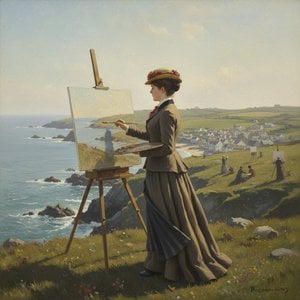
Václav Radimský: Bridging Impressionism and Bohemian Soul
Václav Jan Emanuel Radimský, a name perhaps less familiar than his contemporaries in the French Impressionist movement, nevertheless stands as a pivotal figure in bridging the gap between European artistic traditions. Born in 1867 in Kolín, Bohemia – a region steeped in both natural beauty and complex political history – Radimský’s life was a testament to the enduring power of observation, light, and color. His journey from a provincial Bohemian town to the heart of French Impressionism reveals not just an artist's evolution but also a fascinating interplay between national identity and international artistic influence.
Radimský’s early years were shaped by his family’s connection to the land. His father, a lawyer and landowner, owned a mill on the Elbe River – a constant source of inspiration for the young artist. This intimate relationship with water and its reflections would become a recurring motif in his work, reflecting a deep appreciation for the transient beauty of nature. He received an initial artistic education in Vienna and Munich, absorbing the classical techniques while simultaneously developing a keen eye for capturing fleeting moments of light and atmosphere. However, it was his move to France in 1889 that truly ignited his artistic spirit, introducing him to the revolutionary ideas of Impressionism.
The Giverny Years: Influence and Innovation
Radimský’s arrival in Giverny coincided with a period of intense creative ferment. Drawn by the allure of Claude Monet's studio and the vibrant community of artists who gathered there, he quickly immersed himself in the Impressionist ethos. Unlike some of his peers, who sought to replicate Monet’s style precisely, Radimský developed a distinctly personal approach, retaining elements of Bohemian sensibility while embracing the core principles of capturing light and atmosphere. He rented an old mill on the Seine River – La Bergamotte – transforming it into a studio and establishing himself as a regular participant in the Giverny colony.
His time in Giverny wasn’t merely about imitation; Radimský actively engaged with the evolving artistic landscape, experimenting with techniques and subject matter. He frequently painted alongside Monet, sharing ideas and observing his methods. The influence of Camille Pissarro is also evident in Radimský's work, particularly in his landscapes of the French countryside. However, he infused these borrowed elements with a unique Bohemian perspective – a sensitivity to color, an appreciation for texture, and a subtle melancholy that distinguished him from many of his contemporaries.
A Bohemian Palette: Subject Matter and Technique
Radimský’s paintings are characterized by their luminous quality and meticulous attention to detail. He was particularly drawn to scenes of the Seine River – its shimmering surface, the reflections of trees, and the interplay of light and shadow. His landscapes often depict rural scenes, capturing the essence of the French countryside with a remarkable sense of immediacy. He employed a broken brushstroke technique, layering colors to create an illusion of depth and movement, much like Monet and Pissarro. However, unlike the purely optical focus of some Impressionists, Radimský’s work retains a certain warmth and emotional resonance, reflecting his Bohemian heritage.
His subjects weren't merely landscapes; they were imbued with a quiet poetry. He captured not just the visual appearance of a scene but also its mood and atmosphere – the stillness of dawn, the shimmering heat of midday, or the melancholy beauty of twilight. The use of color was central to his artistic vision. He favored subtle harmonies of blues, greens, and yellows, creating paintings that are both visually stunning and emotionally evocative.
Recognition and Legacy
Radimský’s talent quickly gained recognition within the French art world. He exhibited at the Paris Salon in 1894, receiving an award for his painting “Etudes de Fougeres” – a testament to his early promise. Subsequent accolades followed, including medals at Rouen (1895) and the Universal Exposition in Paris (1900). Despite these successes, he remained largely outside the mainstream of the Impressionist movement, often viewed as an outsider due to his Bohemian origins.
Following World War I, Radimský returned to Bohemia, settling on his family’s estate near Kolín. He continued to paint prolifically until his death in 1946, largely unnoticed by the wider art world. Today, Václav Radimský is increasingly recognized as a significant figure in the development of Impressionism – a bridge between European artistic traditions and a testament to the enduring power of observation, light, and color. His work offers a unique perspective on the beauty of the natural world, infused with a quiet melancholy and a distinctly Bohemian soul.