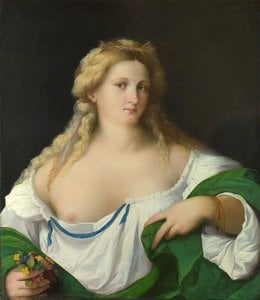
Palma Vecchio, 1480 – 1528

100 nejznámějších obrazů autora Palma Vecchio

Obrazem, díky němuž se Palma Vecchio stal slavným, je Madonna and Child (1515); visí v Státní Ermitáž v místě Sankt-Petěrburg. Portrait of a Man (1512) a Judith (1525) následují v srdcích sběratelů i návštěvníků muzeí. Z 107 děl umělce Palma Vecchio v našem katalogu je těchto 100 nejoblíbenějších, z nichž každé je uvedeno s datem vzniku, muzeem a unikátními rysy.

Seřazeno podle našeho skóre popularity, které kombinuje počet vyhledávání, návštěv a objednávek u každého díla. Aktualizováno říjen 2026. Každé dílo na této stránce lze objednat jako ručně malovanou olejovou reprodukci v muzeální kvalitě nebo jako umělecký tisk v požadovaném rozměru.

Portrét Palma Vecchio
Palma Vecchio · 1480 – 1528
Narozen · zemřel
1480 – 1528, Serina
Směr
High renaissance
Díla v našem katalogu
107
Nejslavnější
Madonna and Child (1515)
Nejvíce děl v
Kunsthistorisches Museum

Palma Vecchio: deset mistrovských děl

Madonna and Child (1515) od Palma Vecchio
1

Madonna and Child

1515 · Oil On Canvas · Státní Ermitáž, Sankt-Petěrburg

To stand before this depiction of the Madonna and Child is to be drawn into a moment suspended outside the rush of time—a sanctuary painted by the masterful hand of Palma Vecchio. This work, dating from 1515, transcends mere portraiture; it is an eloquent meditation on maternal love, divine connection, and the profound mystery of creation. The composition centers on the Virgin Mary, portrayed with a tender intimacy as she…

The Adoration of the Shepherds with a Donor od Palma Vecchio
4

The Adoration of the Shepherds with a Donor

Oil On Canvas

The air in the painting feels heavy with the scent of damp earth and hay. In a rural landscape of rolling hills and distant, pale buildings, a small light gathers around the Holy Family. Mary holds the infant Jesus close, her form a soft curve against the shadows. Beside them, Joseph stands as a steady presence. A shepherd boy kneels in the dirt, his posture a study in humility before…

Lucretia (1520) od Palma Vecchio
5

Lucretia

1520 · Oil · Kunsthistorisches Museum, Vídeň

The air feels heavy, thick with the scent of velvet and the silent weight of an impending end. Lucretia sits before us, her pale skin luminous against a backdrop of deep, swallowing shadows. A sharp, diagonal line of a dagger presses against her chest, creating a point of tension that vibrates through the stillness. Her reddish-blonde hair flows in soft, organic waves, framing a face caught in a moment of…

Portrait of a Gentleman (1520) od Palma Vecchio
6

Portrait of a Gentleman

1520 · Oil On Panel · Philadelphia Museum of Art, Philadelphia

In this 1520 portrait, we are met with a man whose steady gaze bridges the distance between his era and our own. He is positioned slightly off-center, a choice that lends a sense of naturalism to his posture, as if he has just paused in thought to acknowledge our presence. The composition is a medium close-up, focusing our attention on the quiet dignity of his features. His long, flowing brown…

John the Baptist (1527) od Palma Vecchio
7

John the Baptist

1527 · Oil On Panel · Kunsthistorisches Museum, Vídeň

A single light source enters from the upper left, carving a face out of the heavy darkness. This is the world of Palma Vecchio, where deep browns and muted greens emerge from a nearly black background. The man, identified as John the Baptist, looks directly at the viewer with a piercing, steady gaze. His reddish-brown hair falls in soft, organic waves around a face marked by contemplation. A thin, dark…

John the Evangelist (1528) od Palma Vecchio
8

John the Evangelist

1528 · Oil On Canvas · Kunsthistorisches Museum, Vídeň

An elderly man sits within a heavy shadow. His face, etched by time, turns toward an unseen light from the upper left. A thick, white beard flows over a deep green tunic. Over one shoulder, a red cloak rests with the weight of heavy wool. The skin of his hands and brow catches the glow, pulling him out from the dark, atmospheric background.

The Holy Family with St Mary Magdalen (1514) od Palma Vecchio
9

The Holy Family with St Mary Magdalen

1514 · Oil On Panel · The Ashmolean Museum of Art and Archaeology, Oxford

In this 1514 oil on panel, we find ourselves drawn into a private, outdoor moment of the Holy Family. The composition is intimate, centered on a man holding a child while a woman stands nearby, her hands resting upon a vase. This arrangement creates a sense of domesticity within a sacred context. The background, filled with the soft presence of trees, suggests a natural setting that allows the figures to…

Young Woman in Profile (1512) od Palma Vecchio
10

Young Woman in Profile

1512 · Oil · Kunsthistorisches Museum, Vídeň

The portrait presents a young woman in a strict profile view, her head and shoulders occupying the majority of the frame. She is positioned against a dark, circular backdrop that creates a halo-like effect around her silhouette. The subject's skin is rendered in warm, fleshy tones, transitioning through soft shadows that define the structure of her face and neck. This technique, known as sfumato, allows for a gradual blending of…

Více děl mistrů Palma Vecchio, od 11 do 100

John the Baptist (1528) od Palma Vecchio
#12

John the Baptist

1528 · Kunsthistorisches Museum

The figure of John the Baptist emerges from the shadows of history in this religious painting by Palma Vecchio. He stands alone, a solitary presence caught in a…

Pořiďte si ho domů →
Saint Sebastian (1527) od Palma Vecchio
#13

Saint Sebastian

1527 · Kunsthistorisches Museum

This religious work, titled Saint Sebastian, was executed by the Venetian painter Palma Vecchio around 1527. The painting focuses on the Roman martyr, a figure venerated for his…

Objednat reprodukci →
The Raising of Lazarus (1514) od Palma Vecchio
#14

The Raising of Lazarus

1514 · Philadelphia Museum of Art

is a dramatic Renaissance oil painting that captures a crowded and dynamic biblical scene. The composition focuses on a central group of figures gathered around a stone tomb,…

Objednat reprodukci →
The Three Sisters (1520) od Palma Vecchio
#15

The Three Sisters

1520 · Gemäldegalerie Alte Meister

“The Three Sisters” by Palma Vecchio, painted around 1520, stands as a captivating example of Venetian High Renaissance portraiture. This half-length composition depicts three young women, widely believed…

Objednejte si ručně malovanou kopii →
Saint Magdalene (1504) od Palma Vecchio
#17

Saint Magdalene

1504 · Bavarské státní sbírky malby

Saint Magdalene by Palma Vecchio is a bust-length portrait presented in a close-up composition. The female figure is positioned slightly off-center, her body angled toward the viewer while…

Pořiďte si ho domů →
The Triumph of Caesar (1510) od Palma Vecchio
#19

The Triumph of Caesar

1510 · Lowe Gallery

is a large-scale Renaissance oil painting by the Venetian artist Palma Vecchio. Executed around 1510, the work captures a Roman triumphal procession through a densely populated ceremonial scene.

Objednat reprodukci →
Daphnis (1514) od Palma Vecchio
#21

Daphnis

1514 · Bavarské státní sbírky malby

Daphnis, attributed to Palma Vecchio, presents a mythological depiction of the shepherd boy Daphnis. Created around 1513/15, the work draws upon the pastoral traditions of antiquity. The subject…

Pořiďte si ho domů →
Allegory (1510) od Palma Vecchio
#22

Allegory

1510 · Philadelphia Museum of Art

The painting titled Allegory is a work by the Venetian painter Palma Vecchio. Created around 1510, this oil painting belongs to the Italian High Renaissance. The artist, born…

Objednat reprodukci →
Venus and Cupid (1511) od Palma Vecchio
#23

Venus and Cupid

1511 · Statens Museum for Kunst

is a work by the Venetian painter Palma Vecchio. Created in 1511, the painting belongs to the Italian High Renaissance. The artist, born in Serina, Italy, was a…

Pořiďte si ho domů →
The Holy Family (1515) od Palma Vecchio
#24

The Holy Family

1515 · Gemäldegalerie

In Palma Vecchio's The Holy Family, the arrangement of figures creates a quiet, centered gravity. The Virgin Mary forms the heart of the scene, kneeling in a posture…

Pořiďte si ho domů →
The Virgin and Child (1502) od Palma Vecchio
#25

The Virgin and Child

1502 · Gemäldegalerie

A serene and intimate scene unfolds within a High Renaissance composition, where the Virgin Mary is captured in a moment of private study. Seated toward the right of…

Pořiďte si ho domů →
Visitation (1522) od Palma Vecchio
#30

Visitation

1522 · Kunsthistorisches Museum

The air in the painting feels heavy with the weight of a quiet afternoon. Two women meet in the center of the frame, their bodies leaning into one…

Objednat reprodukci →
Mars, Venus and Cupid (1520) od Palma Vecchio
#33

Mars, Venus and Cupid

1520

This Renaissance-style oil painting presents a mythological scene featuring three central figures: a muscular man, a woman, and a small winged child. The figures are situated within a…

Pořiďte si ho domů →
Young Woman in Green Dress (1513) od Palma Vecchio
#36

Young Woman in Green Dress

1513 · Kunsthistorisches Museum

This portrait, titled Young Woman in Green Dress, in the hand a box, was executed by the Venetian painter Palma Vecchio. Created around 1513, the work offers a…

Objednat reprodukci →
Portrait of Paola Priuli (1527) od Palma Vecchio
#41

Portrait of Paola Priuli

1527 · Fondazione Querini Stampalia

In the soft, luminous glow of the High Renaissance, few portraits capture the intersection of aristocratic poise and intimate vitality as masterfully as Palma Vecchio’s Portrait of Paola…

Pořiďte si ho domů →
Sacred Conversation (1525) od Palma Vecchio
#53

Sacred Conversation

1525 · Gallerie dell'Accademia di Venezia

In the quiet, luminous atmosphere of Palma Vecchio’s Sacred Conversation, dated to 1525, the viewer is invited into a moment of profound spiritual intimacy. This masterpiece serves as…

Objednat reprodukci →
De heilige familie od Palma Vecchio
#54

De heilige familie

Rijksmuseum

The air within the scene feels heavy with a soft, twilight stillness. A group of five figures gathers in a serene, classical arrangement, their presence anchored by the…

Objednat reprodukci →
A Blonde Woman od Palma Vecchio
#67

A Blonde Woman

National Gallery

A single figure dominates the composition, her pale skin and long blonde hair emerging from a dark, indeterminate background. She gazes toward the viewer with a sidelong, pensive…

Pořiďte si ho domů →
A Blonde Woman (1520) od Palma Vecchio
#68

A Blonde Woman

1520 · National Gallery

To stand before Palma Vecchio's "A Blonde Woman" is to encounter a moment suspended in time—a breath held just before revelation. This portrait, dating from 1520, transcends a…

Objednat reprodukci →
Venus (1520) od Palma Vecchio
#85

Venus

1520 · Gemäldegalerie Alte Meister

The painting Venus by Palma Il Vecchio is a masterpiece of Renaissance art, showcasing the artist's skill in capturing the beauty and elegance of the female form. Created…

Pořiďte si ho domů →

Obrazy umělce Palma Vecchio podle období

Témata, která Palma Vecchio maloval nejčastěji

Čtyři témata, která se v těchto dílech objevují nejčastěji, spolu s nejlepším příkladem každého z nich.

Kde vidět obrazy autora Palma Vecchio

8 muzea, v nichž je umístěno nejvíce obrazů z této stránky.

Muzea Město Díla autora Palma Vecchio Obrazy z tohoto seznamu
Kunsthistorisches Museum, VídeňKunsthistorisches Museum Vídeň 13 Lucretia, John the Baptist, John the Evangelist
Szépművészeti Múzeum, BudapešťSzépművészeti Múzeum Budapešť 7 Madonna and Child with the Infant Saint John and a Bishop Saint, The Holy Family with a Female Saint and Saint Francis of Assisi, Portrait of a Young Woman
Gallerie dell'Accademia di Venezia, BenátkyGallerie dell'Accademia di Venezia Benátky 6 Sacred Conversation (detail), Sacred Conversation (detail), Sacred Conversation
Gemäldegalerie, BerlínGemäldegalerie Berlín 5 The Holy Family, The Virgin and Child, Portrait of a young woman with bare chest
National Gallery, LondýnNational Gallery Londýn 4 A Blonde Woman, A Blonde Woman, Saint George and a Female Saint
Státní Ermitáž, Sankt-PetěrburgStátní Ermitáž Sankt-Petěrburg 3 Madonna and Child, Portrait of a Man, Christ and the Woman Taken in Adultery
Galleria degli Uffizi, FlorencieGalleria degli Uffizi Florencie 3 Judith, Judith with the Head of Holofernes, The Holy Family with Mary Magdalene and the infant saint John
Philadelphia Museum of Art, PhiladelphiaPhiladelphia Museum of Art Philadelphia 3 Portrait of a Gentleman, The Raising of Lazarus, Allegory

Palma Vecchio, dekáda po dekádě: klíčové dílo každého období

  1. 1500s
    Saint Magdalene (1504) od Palma Vecchio
    Pořadí 17 / 100

    Saint Magdalene

    Věk 20 – 29 · Bavarské státní sbírky malby

    Saint Magdalene by Palma Vecchio is a bust-length portrait presented in a close-up composition. The female figure is positioned slightly off-center, her body angled toward the viewer while…

  2. 1510s
    Madonna and Child (1515) od Palma Vecchio
    Pořadí 1 z 100

    Madonna and Child

    Věk 30 – 39 · Státní Ermitáž

    To stand before this depiction of the Madonna and Child is to be drawn into a moment suspended outside the rush of time—a sanctuary painted by the masterful…

  3. 1520s
    Judith (1525) od Palma Vecchio
    Pořadí 3 z 100

    Judith

    Věk 40 – 48 · Galleria degli Uffizi

Díla mistrovská umělce Palma Vecchio: otázky a odpovědi

Kterým obrazem je Palma Vecchio nejznámější?Zobrazit odpověď

Madonna and Child (1515), Státní Ermitáž, Sankt-Petěrburg. Následují Portrait of a Man (1512) a Judith (1525).

Kolik let bylo Palma Vecchio, když maloval/a Madonna and Child?Zobrazit odpověď

35 let: dílo Madonna and Child pochází z roku 1515 a Palma Vecchio se narodil/a v roce 1480.

Jakých deset nejvýznamnějších obrazů má Palma Vecchio?Zobrazit odpověď

Madonna and Child, Portrait of a Man, Judith, The Adoration of the Shepherds with a Donor, Lucretia, Portrait of a Gentleman, John the Baptist, John the Evangelist, The Holy Family with St Mary Magdalen a Young Woman in Profile. Výše uvedené pořadí uvádí rok a muzeum každého díla.

Kolik děl namaloval/a Palma Vecchio?Zobrazit odpověď

Náš katalog obsahuje 107 děl autora Palma Vecchio z let 1502 až 1528.

V kterých muzeích mohu vidět díla mistrovská umělce Palma Vecchio?Zobrazit odpověď

Většina z nich se nachází v Kunsthistorisches Museum (Vídeň), Szépművészeti Múzeum (Budapešť) a Gallerie dell'Accademia di Venezia (Benátky). V tabulce výše jsou jednotlivé muzea uvedeny postupně.

Kdy Palma Vecchio namaloval svá díla?Zobrazit odpověď

V období 1520s: 37 z 100 děl na této stránce pochází z tohoto období, z nich Judith.

Jaká jsou první a poslední slavná díla umělce Palma Vecchio?Zobrazit odpověď

Nejstarší dílo na této stránce pochází z The Virgin and Child (1502), nejnovější z John the Evangelist (1528).

Jakými tématy se Palma Vecchio nejčastěji zabýval/a?Zobrazit odpověď

Woman (29), Man (22) a Landscape (21), z celkových 100 děl na této stránce.

Kterou techniku Palma Vecchio upřednostňoval/a?Zobrazit odpověď

Oil On Canvas: 18 z 100 děl na této stránce.

K jakému uměleckému směru patří Palma Vecchio?Zobrazit odpověď

High renaissance, jak dokazují obrazy na této stránce.

Která díla od Palma Vecchio jsou vystavena v Kunsthistorisches Museum?Zobrazit odpověď

Lucretia, John the Baptist a John the Evangelist patří mezi 12 děl na této stránce, která má v zastarání Kunsthistorisches Museum, Vídeň.

Mohu vlastnit reprodukci díla mistra Palma Vecchio?Zobrazit odpověď

Ano. Každý obraz na této stránce lze objednat jako ručně malovanou olejovou reprodukci v muzeální kvalitě nebo jako umělecký tisk v požadovaném rozměru přímo z jeho vlastní stránky.

Život umělce Palma Vecchio

Benátský mistr senzuality: Život a dílo Palma Vecchio

Jacopo Negretti, v dějinách známý jako Palma Vecchio – „Palma Starší“ – se objevil na umělecké scéně začátku 16. století ve Benátkách jako klíčová postava prolínající vrcholné renesance s nastupujícími manýristickými styly. Narodil se kolem roku 1480 v Serina Alta nedaleko Bergama a jeho kariéra se plně rozvinula v rámci pulzující Benátské republiky, města již tehdy hluboce zapleteného do uměleckých inovací. Ačkoliv jsou historické záznamy o jeho raném výcviku vzácné, věří se, že mohl nejprve studovat u Andrea Previtali, než začal gravitovat k revolučním přístupům Giovanniego Belliniego a nakonec k fascinujícím světům, které vytvořili Giorgione a Titian. Palmaův příchod do Benátek se zrovna zrovna vrhl do období intenzivní umělecké konkurence; spolu s Lorenzo de Lottem si rychle vybudoval pověst neústupného talentu, který si dokázal osvojit lekce svých předchůdců a zároveň si vybudovat svou vlastní, naprosto jedinečnou cestu.

Rané vlivy a vývoj unikátního stylu

Počáteční fáze Palmovy kariéry odhalují jasný dluh vůči rafinované technice a devocečnímu stylu Giovanese Belliniego. Nicméně právě průlomová díla Giorgiona – s jejich poetickou atmosférou a enygnatickými narativy – skutečně zapálila jeho uměleckou představivost. Palma rychle přijal Giorgionův způsob práce s barvou, světlem a kompozicí a vplavil do svých vlastních obrazů podobný pocit lyrického krásna. Palma však nebyl pouhým imitátorem; disponoval jedinečným darem pro ztvárnění lidské postavy s nesmírnou senzualní grácií a fascinujícím realismem, který ho od ostatních odlišoval. Jak se na scéně ugruntoval Titian, Palma pokračoval v neustálém proměňování se a projevoval neuvěřitelnou schopnost syntetizovat různé vlivy do harmonického a působivého vizuálního jazyka. Právě v tomto období se v jeho díle začaly vyvádět dva hlavní motivy: sacra conversazione, tedy scény svatých rozhovorů, a polofigury portrétů idealizovaných žen, o nichž se často spekuluje, že jde o ztvárnění slavných benátských courtesanek.

Půvab mýtu a benátský portrét

Palma Vecchio se proslavil svou schopností vdechnout klasické mytologii nezaměnitelnou benátskou citlivost. Jeho pastoušské scény nejsou pouhými rekonstrukcemi starověkých příběhů; jsou to živé oslavy krásy, lásky a pozemských rozkoší, zasazené do bujných krajin pulzujících životem. Tato díla plnila vkus bohatých benátských patronů, kteří hledali umění odrážející jejich sofistikovaný životní styl a oblibu smyslných potěšení. Současně však jeho portréty – zejména ty ženské – fascinovaly diváky svou precizní detailností a psychologickou hloubkou. Vyvinul si svůj vlastní, ikonický typ: blondýnky s lákavým pohledem a jemnou nádechem tajemství. Identita těchto modelů zůstává převážně neznámou, což podněcuje spekulace o jejich spojení s městským demimonde. Jeho mistrovství v práci s barvou – využívající transparentní glazury vytvářející luminescenční efekty – bylo vysoce ceněno, ačkoliv se bohužel mnoho těchto jemných vrstev v průběhu času degradovalo. Právě neuvěřitelná malířská schopnost v jeho práci s barvou a pigmentem je často označována za definující rys jeho celokupního díla.

Hlavní úspěchy a umělecké dědictvo

Mezi nejvýznamnější úspěchy, které Palma Vecchio dosáhl, patří šest obrazů z commission pro kostel Santa Maria Formosa ve Benátkách, jejichž středem je monumentální oltář svaté Barbary. Tato velkolepá kompozice dokonale demonstruje jeho schopnost vykreslovat komplexní narativy a vytvářet harmonické skupiny postav. Jeho pozdější díla odhalují mistrovské ovládnutí techniky contrapposto – onoho elegantního vyvážení protichůdných sil v póze postavy – a využívají vyváženou paletu barev, která vyzařuje důstojnost a graciliti. Ačkoliv se v rané fázi jeho tvorby projevily vlivy středoitalské školy, včetně Michela Angela, Palma nakonec vypracoval styl, který byl zcela jeho vlastní. Významným milníkem v jeho kariéře bylo pověřením k vytvoření hlavního oltáře v kostele Sant'Elena v Benátkách roku 1525. Náhlá smrt v roce 1528, kdy mu bylo přibližně 47 let, však zanechala mnoho děl nedokončených, která museli doplnit jeho dílna a žáci. Navzdory tomuto předčasnému konci byl vliv Palma Vecchia na benátské malířství hluboký; působil jako klíčový spojovací článek mezi mistry vrcholného renesance, jako byli Titian a Giorgione, a nastupující generací manieristů, čímž inspiroval umělce jako Bonifazio Pitati či Giovanni Busi.

Historický význam a znovuobjevení

Po celé staletí zůstávalo dílo Palma Vecchia v určitém smyslu stínem svých slavnějších současníků. V posledních desetiletích se však v rámci odborných i širokých ప్రేక్షelské obhajoby stále více prosazuje uznání pro jeho jedinečný přínos k benátskému umění. Umělci a historici nyní znovu přehledávají atribuce, které byly v minulosti připisovány Giorgionovi či Titianovi, a rozpoznávají v nich nezaměnitelnou kvalitu a specifický styl Palmy. Jeho obrazy jsou dnes oslavovány pro svou smyslnou krásu, technickou brilanci a schopnost zachytit samotného ducha renesanční Benátky. Palma Vecchio představuje fascinující průsečík uměleckých vlivů, který překlenul mezeru mezi generacemi a nabízí nám poutavý pohled na kulturní hodnoty i estetické citění jeho doby. Jeho odkaz stojí jako svědomí nesmrtelné síly benátského malířství – jako dílo mistra, jehož tvorba i dnes nedokáže okouzać a inspirovat diváky po celém světě.

Všechna díla od Palma Vecchio: 107 →