Otto Dix, 1891 – 1969

100 nejznámějších obrazů autora Otto Dix

Obrazem, díky němuž se Otto Dix stal slavným, je Portrét novinářky Sylvie von Harden (1926); visí v Centre Pompidou v místě Paříž. Flandry a The Skat Players (1920) následují v srdcích sběratelů i návštěvníků muzeí. Z 373 děl umělce Otto Dix v našem katalogu je těchto 100 nejoblíbenějších, z nichž každé je uvedeno s datem vzniku, muzeem a unikátními rysy.

Seřazeno podle našeho skóre popularity, které kombinuje počet vyhledávání, návštěv a objednávek u každého díla. Aktualizováno říjen 2026.

Portrét Otto Dix
Otto Dix · 1891 – 1969
Narozen · zemřel
1891 – 1969, Untermhaus
Směr
Neue sachlichkeit
Díla v našem katalogu
373
Nejslavnější
Portrét novinářky Sylvie von Harden (1926)
Nejvíce děl v
Bavarské státní sbírky malby

Otto Dix: deset mistrovských děl

Portrét novinářky Sylvie von Harden (1926) od Otto Dix
1

Portrét novinářky Sylvie von Harden

1926 · Olej na panelu · Centre Pompidou, Paříž

„Portrét novinářky Sylvie von Harden“ od Otto Dixa je ikonické mistrovské dílo, které v sobě zachycuje samotnou podstatu éry Weimarské republiky. Tento fascinující portrét, vytvořený v roce 1926, představuje Sylvii von Hardenovou, významnou německou novinářku a poetku, jak sedí u kavárenského stolu s cigaretou v ruce a koktejlem před sebou. Dixův neúprosný realismus a mimořádná pozornost k detailu oživují androgynní rysy von Hardenové i její moderní oděv, což z tohoto…

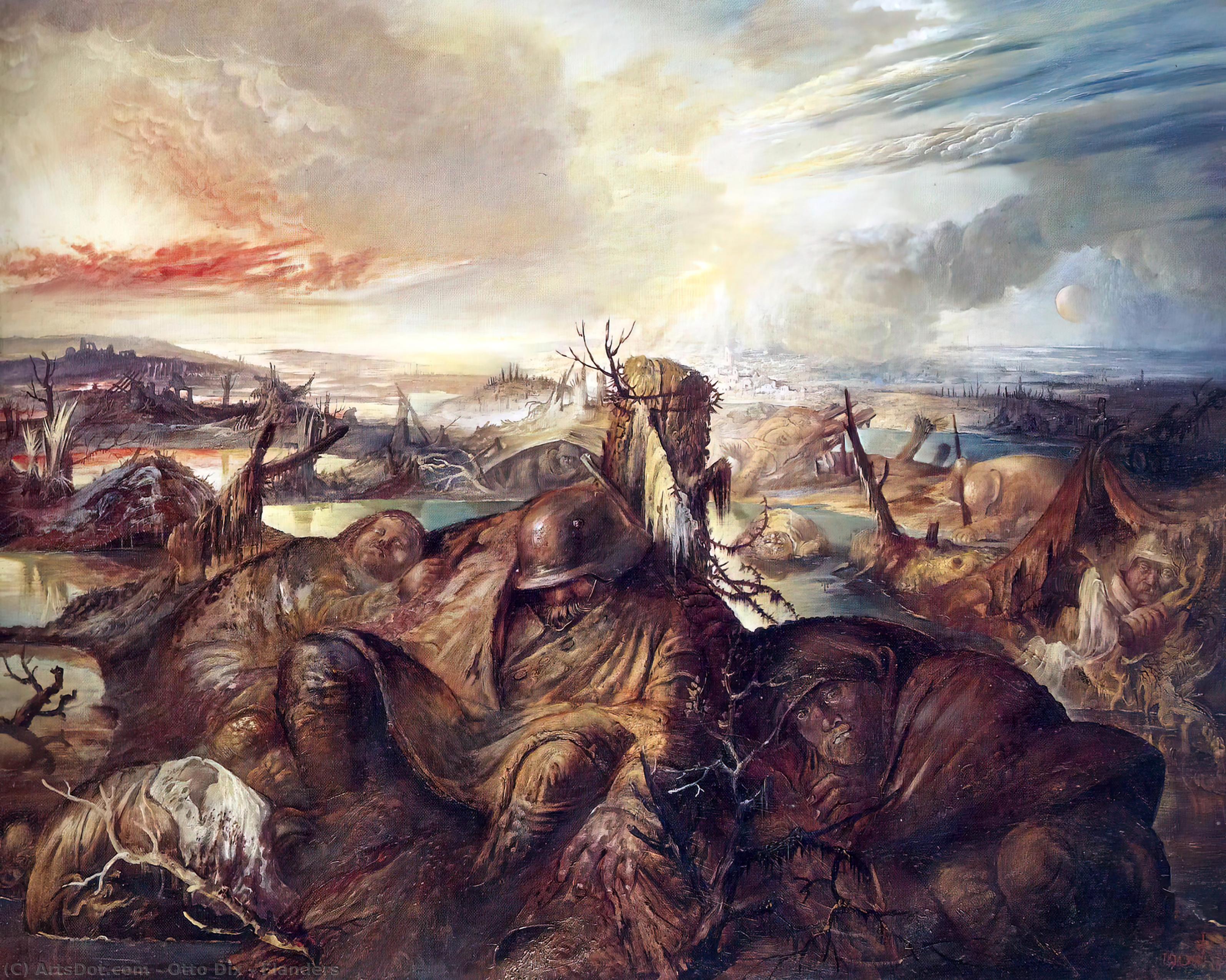
Flandry od Otto Dix
2

Flandry

Olej na plátně

Silný obraz válečné devastace Toto strašidelné umělecké dílo zachycuje syrový chaos a hlubokou beznaděj postapokalyptické krajiny, která vyvolává vzpomínky na brutální realitu války a lidského utrpení. Scéna je rozsáhlá a bouřlivá, plná zničených struktur, padlých vojáků a kosterních zbytků rozptýlených po pusté krajině. Postavy jsou zkroucené a plné úzkosti, čímž ztělesňují emocionální dopad konfliktů a ztrát. Díky svému fascinujícímu tématu vybízí dílo diváky k zamyšlení nad ničivými následky násilí a…

The Skat Players (1920) od Otto Dix
3

The Skat Players

1920 · Acrylic On Canvas

Otto Dix's "The Skat Players," created in 1920, is a profoundly unsettling and powerful artwork that serves as a stark commentary on the aftermath of World War I. This oil-on-canvas painting (87 x 110 cm) embodies the Dadaist style, capturing the despair, social upheaval, and struggle for survival prevalent in post-war Germany.

Trench Warfare od Otto Dix
4

Trench Warfare

Oil

is an oil painting by Otto Dix. The canvas captures the heavy, suffocating darkness of a battlefield, focusing on the visceral reality of war and its devastating consequences. A lone soldier emerges from a turbulent background of smoke and fire, his form highlighted by dramatic light against the surrounding gloom. The scene is a landscape of grit and unrest.

Nelly among Flowers od Otto Dix
5

Nelly among Flowers

Acrylic On Canvas · Museum Folkwang, Essen

Otto Dix’s Tender Reverie: Nelly Among Flowers The painting “Nelly Among Flowers” by Otto Dix stands as an arresting paradox—a glimpse into the artist's deeply personal world juxtaposed against the stark, uncompromising aesthetic of Neue Sachlichkeit. Created in 1924, shortly after Dix’s daughter Nelly was born, it represents a significant departure from his characteristic depictions of war and societal critique, offering instead a serene tableau bathed in soft light and…

Metropolis od Otto Dix
6

Metropolis

Oil On Panel

The triptych Metropolis by the German artist Otto Dix captures the fractured pulse of the Weimar Republic. Executed between 1927 and 1928, the work presents three nighttime city scenes. It focuses on the nightlife of a German big city during the golden twenties. The panels act as windows into a world of decadence, femininity, and sexuality. This modern city is a place of sharp contrasts and restless energy.

The Seven Cardinal Sins od Otto Dix
7

The Seven Cardinal Sins

Oil

Introduction to the Artist and Painting Title Otto Dix, a prominent German artist known for his powerful and thought-provoking works, created "The Seven Cardinal Sins" in 1933. This captivating painting is an exceptional example of the Neue Sachlichkeit (New Objectivity) movement, which emerged in Germany during the 1920s and 1930s as a response to the country's turbulent socio-political climate. Symbolism and Meaning In "The Seven Cardinal Sins," Dix masterfully employs…

Newborn Baby on Hands od Otto Dix
8

Newborn Baby on Hands

In this quiet composition titled Newborn Baby on Hands, the artist Otto Dix turns his gaze toward a moment of profound intimacy. The work presents a departure from the more turbulent social critiques often associated with his name, focusing instead on the delicate connection between a mother and her newborn child. It is a study of tenderness, captured through the simple, protective presence of a mother's hands.

Pragerstrasse (1920) od Otto Dix
9

Pragerstrasse

1920 · Oil On Canvas

Executed in July 1920, Pragerstrasse is an oil and collage on canvas that captures a scene on Prager Straße in Dresden, Germany, shortly after the First World War. The composition presents a fragmented view of urban life, featuring several distinct figures. In the foreground, a character from the middle or upper class is depicted without legs, moving with the assistance of a skateboard and canes; this figure wears a bowler…

To Beauty (1922) od Otto Dix
10

To Beauty

1922 · Oil On Canvas

Otto Dix's "To Beauty," painted in 1922, stands as a stark and unsettling critique of the moral decay and superficiality that permeated post-World War I Germany. Housed within the Von der Heydt Museum in Wuppertal, Germany, this oil on canvas masterpiece is more than just a painting; it's a historical document capturing an era defined by disillusionment and decadence through the lens of Expressionism.

Více děl mistrů Otto Dix, od 11 do 100

Portrait of the Lawyer Hugo Simons 1 od Otto Dix
#15

Portrait of the Lawyer Hugo Simons 1

Introduction Otto Dix was a German painter and printmaker who is best known for his critical portrayals of Weimar Germany and the rise of National Socialism. Born in…

Shock Troops Advance under Gas (1924) od Otto Dix
#18

Shock Troops Advance under Gas

1924 · MoMA - Museum of Modern Art

Otto Dix's "Shock Troops Advance under Gas," painted in 1924, isn’t merely a depiction of war; it’s a visceral scream rendered in stark black and white. This arresting…

Portrait of Mrs. Martha Dix od Otto Dix
#22

Portrait of Mrs. Martha Dix

Museum Folkwang

A Portrait Steeped in Modern Angst: Otto Dix’s Bildnis Frau Martha Dix The portrait of Mrs. Martha Dix by Otto Dix stands as a poignant emblem of the…

Sappenkopf (1920) od Otto Dix
#24

Sappenkopf

1920 · Bavarské státní sbírky malby

The work titled Sappenkopf was created by the artist Otto Dix in 1920. It is a piece of visual record, a moment captured in the wake of a…

Portrait of Paul F. Schmidt (1921) od Otto Dix
#29

Portrait of Paul F. Schmidt

1921

In the quiet depths of Otto Dix’s 1921 masterpiece, Portrait of Paul F. Schmidt, we are invited into a space of profound stillness and psychological weight. The painting…

Uneven couple od Otto Dix
#55

Uneven couple

In Uneven couple by Otto Dix, a heavy stillness anchors the foreground. A man sits firmly in a chair, his form weighted by a suit and the dark…

Témata, která Otto Dix maloval nejčastěji

Čtyři témata, která se v těchto dílech objevují nejčastěji, spolu s nejlepším příkladem každého z nich.

Kde vidět obrazy autora Otto Dix

4 muzea, v nichž je umístěno nejvíce obrazů z této stránky.

Muzea Město Díla autora Otto Dix Obrazy z tohoto seznamu
Bavarské státní sbírky malby, MnichovBavarské státní sbírky malby Mnichov 4 Sappenkopf, Portrait of the Poet Alfred Günther, Portrait of the Photographer Hugo Erfurth
Museum Folkwang, EssenMuseum Folkwang Essen 2 Nelly among Flowers, Portrait of Mrs. Martha Dix
Centre Pompidou, PařížCentre Pompidou Paříž 1 Portrét novinářky Sylvie von Harden
MoMA - Museum of Modern Art, New YorkMoMA - Museum of Modern Art New York 1 Shock Troops Advance under Gas

Otto Dix, dekáda po dekádě: klíčové dílo každého období

  1. 1910s
  2. 1920s
    Portrét novinářky Sylvie von Harden (1926) od Otto Dix
    1 z 100

    Portrét novinářky Sylvie von Harden

    Věk 29 – 38 · Centre Pompidou

    „Portrét novinářky Sylvie von Harden“ od Otto Dixa je ikonické mistrovské dílo, které v sobě zachycuje samotnou podstatu éry Weimarské republiky. Tento fascinující portrét, vytvořený v roce 1926,…

  3. 1930s
    War (1932) od Otto Dix
    11 z 100

    War

    Věk 39 – 48

Díla mistrovská umělce Otto Dix: otázky a odpovědi

Kterým obrazem je Otto Dix nejznámější?Zobrazit odpověď

Portrét novinářky Sylvie von Harden (1926), Centre Pompidou, Paříž. Následují Flandry a The Skat Players (1920).

Kolik let bylo Otto Dix, když maloval/a Portrét novinářky Sylvie von Harden?Zobrazit odpověď

35 let: dílo Portrét novinářky Sylvie von Harden pochází z roku 1926 a Otto Dix se narodil/a v roce 1891.

Jakých deset nejvýznamnějších obrazů má Otto Dix?Zobrazit odpověď

Portrét novinářky Sylvie von Harden, Flandry, The Skat Players, Trench Warfare, Nelly among Flowers, Metropolis, The Seven Cardinal Sins, Newborn Baby on Hands, Pragerstrasse a To Beauty. Výše uvedené pořadí uvádí rok a muzeum každého díla.

Kolik děl namaloval/a Otto Dix?Zobrazit odpověď

Náš katalog obsahuje 373 děl autora Otto Dix z let 1912 až 1932.

V kterých muzeích mohu vidět díla mistrovská umělce Otto Dix?Zobrazit odpověď

Většina z nich se nachází v Bavarské státní sbírky malby (Mnichov), Museum Folkwang (Essen) a Centre Pompidou (Paříž). V tabulce výše jsou jednotlivé muzea uvedeny postupně.

Kdy Otto Dix namaloval svá díla?Zobrazit odpověď

V období 1920s: 18 z 100 děl na této stránce pochází z tohoto období, z nich Portrét novinářky Sylvie von Harden.

Jaká jsou první a poslední slavná díla umělce Otto Dix?Zobrazit odpověď

Nejstarší dílo na této stránce pochází z House by the Stream (1912), nejnovější z War (1932).

Jakými tématy se Otto Dix nejčastěji zabýval/a?Zobrazit odpověď

Portraits (8), Wars (7) a German art (6), z celkových 100 děl na této stránce.

Kterou techniku Otto Dix upřednostňoval/a?Zobrazit odpověď

Oil: 4 z 100 děl na této stránce.

K jakému uměleckému směru patří Otto Dix?Zobrazit odpověď

Neue sachlichkeit a Expressionism, jak dokazují obrazy na této stránce.

Která díla od Otto Dix jsou vystavena v Bavarské státní sbírky malby?Zobrazit odpověď

Sappenkopf, Portrait of the Poet Alfred Günther a Portrait of the Photographer Hugo Erfurth patří mezi 4 děl na této stránce, která má v zastarání Bavarské státní sbírky malby, Mnichov.

Život umělce Otto Dix

Early Life, Family and Artistic Training

Untermhaus, Germany, 2 December 1891. The environment shaping Otto Dix is one of stark industrial labor and quiet, poetic undertones. His father, Franz Dix, works in an iron foundry, a setting defined by heavy toil. His mother, Louise, a seamstress, carries a history of writing poetry. This domestic landscape provides the first, subtle friction between the grit of manual labor and the impulse toward creative expression.

The path toward professional training begins in 1906. Dix enters an apprenticeship under the painter Carl Senff, a period of study that lasts until 1910. This formative training moves him away from the domestic sphere and into the technical discipline of the craft. By 1910, he moves to Dresden to enter the Kunstgewerbeschule, the institution known today as the Dresden Academy of Fine Arts. His early focus remains on applied arts and crafts rather than the fine painting that would later define his reputation.

The Brutal Reality of World War I

August 1914. The outbreak of World War I triggers a surge of patriotic fervor. Dix volunteers for the German army, trading the studio for the front lines. He serves as a machine gunner, facing the mechanized slaughter of both the Eastern and Western Fronts. The war is a landscape of mud, decay, and relentless suffering. He survives the carnage, eventually earning an Iron Cross for his service.

The trenches leave a psychological wound that refuses to heal. The experience of mechanized warfare becomes a central, haunting presence in his psyche. He witnesses the grotesque reality of combat—not the sanitized heroism of propaganda, but the visceral truth of destruction. These harrowing memories provide the raw material for his later work. After 1920, he begins to translate this trauma into a relentless, anti-war visual language.

Technique and Artistic Style

Dix operates through a lens of ruthless and harshly realistic depictions. He rejects the soft edges of romanticism, opting instead for a stylized realism that confronts the viewer with the grit of German society. His hand moves with clinical precision, whether he is applying glaze techniques to a canvas or scratching into a metal plate. This technical rigor allows him to document the physical and psychological decay of the Weimar era without the buffer of abstraction.

The medium often dictates the intensity of the message. In his printmaking, he employs a sophisticated combination of drypoint, aquatint, and etching to achieve deep, tonal shadows and sharp, biting lines. These methods allow for a granular level of detail in his depictions of war and urban life. Beyond the heavy textures of print, he utilizes silverpoint on prepared paper, a demanding technique requiring absolute control and leaving no room for error. His work oscillates between the broad application of paint and the meticulous, almost surgical precision of fine drawing.

Key Works and Masterpieces

The aftermath of the Great War finds its most unsettling reflection in 1920 with The Skat Players. This oil-on-canvas work captures the despair and social upheaval of post-war Germany through a Dadaist lens. It moves the viewer into a world of struggle and survival. By 1923, the focus shifts from social tension to the visceral carnage of the front lines. The Trench causes immediate controversy when it is first exhibited in Cologne. The graphic portrayal of the conflict strips away any sense of heroism, replacing it with the raw reality of the battlefield.

In 1924, the intensity of the war is distilled into The War, a series of 50 drypoint and aquatint etchings. These prints offer a relentless look at the madness of mechanized warfare. The precision of the graphic art confronts the viewer with the physical and psychological scars of the era. This period of unflinching observation continues into the urban landscape. Portrait of the Journalist Sylvia Von Harden, painted in 1926, captures the specific character of the era. By 1928, the gaze turns toward the decadence of the city. Metropolis makes its first appearance in Dresden, presenting a scathing indictment of urban life, filled with scenes of social alienation and debauchery.

Persecution and Later Years

The political climate shifts violently in 1933. The Nazi-affiliated German Art Society targets Dix, labeling his work as "degenerate." This designation carries immediate consequences: he is dismissed from his teaching position at the Dresden Academy of Fine Arts. The artist retreats from the political vitriol of the era, seeking seclusion in the small town of Hemmenhofen on Lake Constance. Even in this quietude, the tension remains. He paints religious allegories, often using them as a way to secretly criticize the regime.

The pressure intensifies in 1939. The Gestapo arrests Dix on suspicion of involvement in a plot to kill Hitler. He spends two weeks in interrogation before being released. The shadow of the Second World War looms large, and Dix finds himself conscripted into the Volkssturm during the waning months of the conflict. He survives the chaos of the war, eventually finding a period of renewed recognition in post-war Germany. He remains a significant figure in the cultural landscape until his death on 25 July 1969 in Singen, Hohentwiel (DE).

Legacy and Global Influence

Otto Dix remains a central figure in 20th-century German painting. His presence in the permanent collections of major institutions, such as the Museum of Modern Art in New York, confirms his lasting importance. He did not merely document the era; he forced a confrontation with the physical and psychological wreckage of war and the moral decay of the Weimar Republic. His etchings, particularly the series The War, are recognized as significant achievements in graphic art, utilizing drypoint and aquatint to capture the visceral reality of the trenches.

The impact of his work extends through subsequent generations of artists. Those who seek to challenge societal norms or confront difficult truths find a precedent in his uncompromising realism. He moved beyond the emotional abstraction of Expressionism to embrace a clinical, often harsh, clarity. This approach ensured that the struggles of the marginalized and the scars of conflict remained visible long after the political landscapes that birthed them had shifted.

Where to See His Works Today

The physical presence of Dix’s vision remains scattered across major international institutions. In London, the British Museum preserves a complete set of the folio prints from his series The War. These etchings offer a direct encounter with the graphic intensity of his wartime observations. Across the channel in Paris, the Centre Pompidou holds the 1926 Portrait of the Journalist Sylvia Von Harden, a work that captures the specific social atmosphere of the Weimar era.

The reach of his output extends to the United States, where the Museum of Modern Art in New York City maintains Shock Troops Advance under Gas. This piece brings the visceral tension of the front lines into a contemporary museum setting. In Germany, the Museum Folkwang in Essen houses Nelly among Flowers, providing a different perspective on his ability to handle intimate subject matter.

Všechna díla od Otto Dix: 373 →