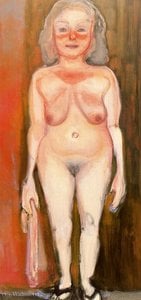
Marlene Dumasová, narozen 1953

37 nejznámějších obrazů autora Marlene Dumasová

Obrazem, díky němuž se Marlene Dumasová stal slavným, je The Painter (1994). The Accident (1986) a Young Boy (Blue Body) (2008) následují v srdcích sběratelů i návštěvníků muzeí. Z 37 děl umělce Marlene Dumasová v našem katalogu je těchto 37 nejoblíbenějších, z nichž každé je uvedeno s datem vzniku, muzeem a unikátními rysy.

Seřazeno podle našeho skóre popularity, které kombinuje počet vyhledávání, návštěv a objednávek u každého díla. Aktualizováno říjen 2026.

Portrét Marlene Dumasová
Marlene Dumasová · narozen 1953
Narozen · zemřel
narozen 1953, Kapské Město
Směr
Contemporary realism
Díla v našem katalogu
37
Nejslavnější
The Painter (1994)
Nejvíce děl v
La Biennale di Venezia

Marlene Dumasová: deset mistrovských děl

The Painter (1994) od Marlene Dumasová
1

The Painter

1994

Although based on a snapshot of Dumas’s daughter finger painting on a hot summer day, the child in The Painter is far removed from the little girl in the photograph. Dumas intentionally uses an aesthetic of the indistinct; the thinly painted background and the unevenly colored figure—sketchy in part and incomplete at the feet—reveal the artist’s fascination with the expressive qualities of non finito. The abstract, painterly characteristics of the…

Skulls (2015) od Marlene Dumasová
9

Skulls

2015 · Oil On Canvas · La Biennale di Venezia, Benátky

In 2015, Marlene Dumas produced Skulls, a work that centers on the stark reality of mortality and death. The painting presents a series of skulls, stripping the human form down to its most essential, skeletal remains. These objects are arranged in a row, stripped of the flesh and identity that once defined them. The subject matter focuses on the inevitability of the end, using the skull as a primary vessel…

Skulls (2015) od Marlene Dumasová
10

Skulls

2015 · Acrylic On Canvas · La Biennale di Venezia, Benátky

Marlene Dumas's "Skulls," painted in 2015, isn’t merely a depiction of mortality; it’s an intensely personal meditation on the fragility of existence, layered with echoes of South African history and the unsettling power of photographic memory. The painting immediately confronts the viewer with a stark arrangement: a row of skulls presented against a muted, almost bleached background—a deliberate choice that amplifies their presence and forces a direct engagement with death’s…

Více děl mistrů Marlene Dumasová, od 11 do 37

No Interviews, Please (1989) od Marlene Dumasová
#11

No Interviews, Please

1989 · Serralves Foundation

Marlene Dumas (b. 1953) stands as a singular voice in contemporary art—a painter whose work transcends mere visual representation, delving into the depths of human experience with unflinching…

Oh, Oh, Oh, Not Again od Marlene Dumasová
#34

Oh, Oh, Oh, Not Again

National Museum of Women in the Arts

Oh, Oh, Oh, Not Again – A Portrait of Vulnerability The artwork “Oh, Oh, Oh, Not Again,” created by Marlene Dumas in 1996, is a striking watercolor portrait…

Skulls (2015) od Marlene Dumasová
#35

Skulls

2015 · La Biennale di Venezia

Marlene Dumas’s paintings are instantly recognizable for their stark simplicity—often consisting of just a few figures rendered in muted tones against sparsely populated backgrounds. Yet, beneath this deceptively…

The Futility of artistic confession od Marlene Dumasová
#36

The Futility of artistic confession

Bonnefanten Museum

The Futility of Artistic Confession – Marlene Dumas Marlene Dumas is a South African painter whose work stands apart in contemporary art—a testament to profound emotional depth and…

Snowwhite in the wrong Story od Marlene Dumasová
#37

Snowwhite in the wrong Story

Bonnefanten Museum

Dumas lives and works in the Netherlands, but was born and raised in South Africa in the days of apartheid. Her many-layered figurative pictures reflect political and personal…

Témata, která Marlene Dumasová maloval nejčastěji

Čtyři témata, která se v těchto dílech objevují nejčastěji, spolu s nejlepším příkladem každého z nich.

Kde vidět obrazy autora Marlene Dumasová

6 muzea, v nichž je umístěno nejvíce obrazů z této stránky.

Muzea Město Díla autora Marlene Dumasová Obrazy z tohoto seznamu
La Biennale di Venezia, BenátkyLa Biennale di Venezia Benátky 3 Skulls, Skulls, Skulls
Bonnefanten Museum, MaastrichtBonnefanten Museum Maastricht 2 The Futility of artistic confession, Snowwhite in the wrong Story
Bavarské státní sbírky malby, MnichovBavarské státní sbírky malby Mnichov 1 The Accident
Serralves Foundation, PortoSerralves Foundation Porto 1 No Interviews, Please
Amsterdam Museum, AmsterdamAmsterdam Museum Amsterdam 1 Big Artists
National Museum of Women in the Arts, Washington, D.C.National Museum of Women in the Arts Washington, D.C. 1 Oh, Oh, Oh, Not Again

Marlene Dumasová, dekáda po dekádě: klíčové dílo každého období

  1. 1980s
    The Accident (1986) od Marlene Dumasová
    2 z 37

    The Accident

    Věk 27 – 36 · Bavarské státní sbírky malby
  2. 1990s
    The Painter (1994) od Marlene Dumasová
    Pořadí 1 / 37

    The Painter

    Věk 37 – 46

    Although based on a snapshot of Dumas’s daughter finger painting on a hot summer day, the child in The Painter is far removed from the little girl in…

  3. 2000s
  4. 2010s
    Skulls (2015) od Marlene Dumasová
    Pořadí 9 / 37

    Skulls

    Věk 57 – 66 · La Biennale di Venezia

    In 2015, Marlene Dumas produced Skulls, a work that centers on the stark reality of mortality and death. The painting presents a series of skulls, stripping the human…

Díla mistrovská umělce Marlene Dumasová: otázky a odpovědi

Kterým obrazem je Marlene Dumasová nejznámější?Zobrazit odpověď

The Painter (1994). Následují The Accident (1986) a Young Boy (Blue Body) (2008).

Kolik let bylo Marlene Dumasová, když maloval/a The Painter?Zobrazit odpověď

41 let: dílo The Painter pochází z roku 1994 a Marlene Dumasová se narodil/a v roce 1953.

Jakých deset nejvýznamnějších obrazů má Marlene Dumasová?Zobrazit odpověď

The Painter, The Accident, Young Boy (Blue Body), Untitled (675), Untitled (830), Untitled (347), Untitled (681), Untitled (807), Skulls a Skulls. Výše uvedené pořadí uvádí rok a muzeum každého díla.

Kolik děl namaloval/a Marlene Dumasová?Zobrazit odpověď

Náš katalog obsahuje 37 děl autora Marlene Dumasová z let 1986 až 2015.

V kterých muzeích mohu vidět díla mistrovská umělce Marlene Dumasová?Zobrazit odpověď

Většina z nich se nachází v La Biennale di Venezia (Benátky), Bonnefanten Museum (Maastricht) a Bavarské státní sbírky malby (Mnichov). V tabulce výše jsou jednotlivé muzea uvedeny postupně.

Kdy Marlene Dumasová namaloval svá díla?Zobrazit odpověď

V období 1990s: 3 z 37 děl na této stránce pochází z tohoto období, z nich The Painter.

Jaká jsou první a poslední slavná díla umělce Marlene Dumasová?Zobrazit odpověď

Nejstarší dílo na této stránce pochází z The Accident (1986), nejnovější z Skulls (2015).

Jakými tématy se Marlene Dumasová nejčastěji zabýval/a?Zobrazit odpověď

Portraiture (5), Human form (4) a Emotional portrait (2), z celkových 37 děl na této stránce.

Kterou techniku Marlene Dumasová upřednostňoval/a?Zobrazit odpověď

Acrylic On Canvas: 2 z 37 děl na této stránce.

K jakému uměleckému směru patří Marlene Dumasová?Zobrazit odpověď

Contemporary realism, jak dokazují obrazy na této stránce.

Která díla od Marlene Dumasová jsou vystavena v La Biennale di Venezia?Zobrazit odpověď

Skulls, Skulls a Skulls patří mezi 3 děl na této stránce, která má v zastarání La Biennale di Venezia, Benátky.

Život umělce Marlene Dumasová

A Life Shaped by Landscape and Sociopolitical Currents

Marlene Dumas, born in 1953 in Cape Town, South Africa, is a painter whose work resonates with an emotional depth rarely encountered in contemporary art. Her upbringing amidst the stark realities of apartheid profoundly shaped her artistic vision, instilling within her a keen awareness of social injustice and the complexities of human identity. Growing up on her father’s vineyard in Kuils River, she witnessed firsthand the divisions and inequalities that defined South African society during those years—a landscape both beautiful and burdened by history. This early exposure to a fractured world would become a recurring theme throughout her career, informing her exploration of race, sexuality, and the psychological weight of existence. Dumas’s formal artistic journey began at the University of Cape Town in 1972, where she pursued a Bachelor of Fine Arts degree alongside studies in ethics. This combination proved crucial, laying the groundwork for an art practice deeply concerned with moral questions and the human condition. She later continued her education at Ateliers ’63 in Haarlem, Netherlands, relocating to Amsterdam in 1976—a move that marked a significant shift in both her geographical location and artistic perspective. Further academic pursuits in psychology at the University of Amsterdam between 1979-1980 would further refine her ability to portray inner states with remarkable sensitivity.

The Evolution of a Distinctive Style

Dumas’s artistic development has been characterized by a constant questioning of representation and a willingness to confront difficult subjects. Her early work directly addressed the political climate of apartheid, reflecting her identity as a white woman grappling with the moral implications of living within a system of racial segregation. However, she quickly moved beyond purely political statements, delving into more universal themes of human vulnerability, desire, and loss. Influenced by the emotional intensity of Romanticism—particularly artists like Egon Schiele and Francis Bacon—Dumas developed a distinctive style marked by loose brushstrokes, distorted figures, and an evocative use of color. She often begins her paintings with source material gathered from diverse origins: Polaroid photographs, magazine clippings, even pornographic imagery. These images are not simply copied but rather serve as starting points for explorations of feeling and memory. Her technique is notable for its layering—a wet-on-wet approach that builds depth and texture through the interplay of thin and thick paint. This creates a sense of fluidity and ambiguity, mirroring the complexities of the emotions she seeks to convey. The resulting images are often hauntingly beautiful, simultaneously alluring and unsettling.

Themes of Identity, Sexuality, and the Human Condition

At the heart of Dumas’s work lies an unwavering commitment to exploring the intricacies of human experience. Her subjects range widely—from portraits of friends and lovers to depictions of children, strippers, and figures drawn from popular culture. However, these are never mere representations; they are vehicles for investigating deeper psychological states. Race, sexuality, identity, violence, guilt, innocence – these are all recurring themes in her oeuvre, approached with a rare degree of honesty and nuance. Dumas’s paintings often challenge conventional notions of beauty and desirability, exposing the vulnerabilities and contradictions inherent in human relationships. She is particularly interested in the ways in which bodies are constructed and perceived—how they become sites of both pleasure and pain, power and oppression. Her work frequently engages with issues of representation, questioning who has the right to look at whom and what implications arise from that gaze. This critical perspective extends to her own artistic practice, as she acknowledges the inherent limitations and ethical challenges of portraying others.

Recognition and Lasting Impact

Marlene Dumas’s contributions to contemporary art have been widely recognized through numerous exhibitions and accolades. A significant milestone was her first major American museum exhibition, “Measuring Your Own Grave,” which opened at the Museum of Contemporary Art, Los Angeles in 2008 and subsequently traveled to the Museum of Modern Art, New York City. This retrospective solidified her position as a leading figure in contemporary painting. Her market success has also been remarkable; in 2004, *Jule-die Vrou* (1985) sold for over $1 million, establishing her as one of only three living female artists to achieve such a price point at the time. More recently, *The Schoolboys* (1986–87) reached an astounding $9 million at Art Basel Miami Beach in 2023, and *Miss January* (1997) shattered records in May 2025 at Christie’s—a new high for a living female artist. Represented by the prestigious David Zwirner Gallery since 2008, Dumas continues to exhibit internationally and inspire a new generation of artists. Her influence extends beyond the realm of painting; she has challenged conventional notions of portraiture and encouraged a more critical engagement with social and political issues within art. Dumas’s legacy lies in her ability to create works that are both deeply personal and universally resonant—paintings that confront us with our own vulnerabilities, desires, and prejudices.

Všechna díla od Marlene Dumasová: 37 →