Honoré Daumier, 1808 – 1879

Honoré Daumier: 100 nejznámějších obrazů

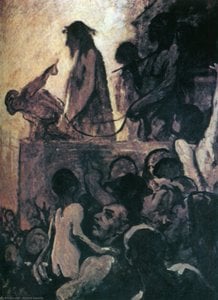
Nous voulons Barabbas (Ecce Homo) (1852) je nejslavnější obraz autora Honoré Daumier, který se nachází v muzeu Museum Folkwang ve městě Essen. The Third-class Carriage (1860) a Unknown, maybe Hippolyte Lucien-Joseph Lucas (1807-1878), a Journalist, maybe P.Mendez de Vigo (1790-1860) a Spanish General, but Most Probably the Count Pelet de la Lozere (1785-1871), a Politician (1833) jsou dalšími dvěma díly, která svět zná nejlépe. Z 355 děl umělce Honoré Daumier v našem katalogu uvádíme 100 těch, na které se kolektéři a návštěvníci muzeí nejčastěji dívají, včetně roku vzniku, názvu muzea a příběhu každého díla.

Seřazeno podle našeho skóre popularity, které kombinuje počet vyhledávání, návštěv a objednávek u každého díla. Aktualizováno říjen 2026. Každé dílo na této stránce lze objednat jako ručně malovanou olejovou reprodukci v muzeální kvalitě nebo jako umělecký tisk v požadovaném rozměru.

Portrét Honoré Daumier
Honoré Daumier · 1808 – 1879
Narozen · zemřel
1808 – 1879, Marseille
Směr
Realism
Díla v našem katalogu
355
Nejslavnější
Nous voulons Barabbas (Ecce Homo) (1852)
Nejvíce děl v
Musée d'Orsay

Top 10: nejznámější obrazy autora Honoré Daumier

Nous voulons Barabbas (Ecce Homo) (1852) od Honoré Daumier
1

Nous voulons Barabbas (Ecce Homo)

1852 · Olej na plátně · Museum Folkwang, Essen

Silný obraz lidského utrpení a sociální spravedlnosti Toto fascinující umělecké dílo zachycuje dojmovou biblickou scénu, která hluboce rezonuje s tématy soucitu, nespravedlnosti a společenské kritiky. Scéna, ztvárněná v syrovém, expresivním stylu, vtahuje diváky do okamžiku kolektivního emočního prožitku a morální reflexe. Postavy, vykreslené s gestickou okamžitostí, vyvolávají pocit naléhavosti a lidské zranitelnosti, čímž činí z tohoto díla hluboké vyjemtí sociálního svědomí a duchovní empatie. Umělecký styl a technika Dílo vytvořené…

The Third-class Carriage (1860) od Honoré Daumier
2

The Third-class Carriage

1860 · Oil On Canvas · Metropolitan Museum of Art, New York

In the crowded, dimly lit confines of a mid-19th-century railway carriage, Honoré Daumier captures more than just a moment in transit; he captures the very essence of human endurance. The Third-class Carriage serves as a profound window into the burgeoning urban reality of France during the Second Empire. As the industrial revolution reshaped the landscape of Europe, Daumier turned his gaze away from the gilded salons of the aristocracy and…

Unknown, maybe Hippolyte Lucien-Joseph Lucas (1807-1878), a Journalist, maybe P.Mendez de Vigo (1790-1860) a Spanish General, but Most Probably the Count Pelet de la Lozere (1785-1871), a Politician (1833) od Honoré Daumier
3

Unknown, maybe Hippolyte Lucien-Joseph Lucas (1807-1878), a Journalist, maybe P.Mendez de Vigo (1790-1860) a Spanish General, but Most Probably the Count Pelet de la Lozere (1785-1871), a Politician

1833 · Clay / Terracotta · Musée d'Orsay, Paříž

This evocative portrait captures more than just the likeness of an elderly gentleman; it arrests a moment in time, freezing the very essence of 19th-century Parisian intellectual life. The subject, whose identity is suggested by the possibilities of a journalist or politician, possesses a gaze that seems to look past the viewer, into some distant, weighty contemplation. Rendered with the unmistakable hand of Honoré Daumier, the piece transcends mere portraiture;…

Ratapoil (front view) (1850) od Honoré Daumier
4

Ratapoil (front view)

1850 · Bronze · Musée d'Orsay, Paříž

Honoré Daumier's "Ratapoil (front view)," created around 1850, is more than just a bronze sculpture; it’s a potent distillation of 19th-century French social commentary and political critique. This arresting figure, rendered with remarkable dynamism and a touch of unsettling realism, offers a captivating window into the turbulent world of post-Revolutionary France – a world grappling with nascent democracy, imperial ambitions, and the pervasive inequalities of its society. The sculpture’s enduring…

Intermission at the Comédie Française (1858) od Honoré Daumier
5

Intermission at the Comédie Française

1858 · Watercolor · Státní Ermitáž, Sankt-Petěrburg

Honoré Daumier's “Intermission at the Comédie Française,” painted in 1858, isn’t merely a depiction of an elderly gathering; it’s a meticulously crafted observation of a specific moment frozen in time – and brimming with unspoken commentary. The artwork immediately draws the viewer into a densely packed scene: rows upon rows of men, their faces etched with age and lined with contemplation, are absorbed in reading newspapers or pamphlets within the…

Ratapoil (1850) od Honoré Daumier
6

Ratapoil

1850 · Bronze · Staatliche Kunsthalle Karlsruhe, Karlsruhe

The photograph captures a pivotal moment – a frozen dance of energy and emotion rendered in the enduring medium of bronze. This exquisite reproduction offers an intimate encounter with "Ratapoil," a sculpture by the visionary artist Honoré Daumier, born in Marseille in 1808 and tragically lost in 1879. More than just a depiction of a figure, it’s a window into the social anxieties and artistic fervor that defined mid-19th century…

Scene from a Comedy (1858) od Honoré Daumier
8

Scene from a Comedy

1858 · Oil On Canvas · Musée d'Orsay, Paříž

Honoré Daumier's "Scene from a Comedy," painted in 1858, isn’t merely a depiction of two figures; it’s a meticulously crafted snapshot of Parisian society and the biting social commentary that defined the artist’s career. Housed within the walls of the Musée d’Orsay, this oil on canvas offers a rare glimpse into Daumier's world – a world brimming with observation, critique, and an undeniable sense of humor laced with profound sadness.…

Ratapoil (1850) od Honoré Daumier
9

Ratapoil

1850 · Acrylic On Canvas · Artizon Museum, Tokio

Honoré Daumier's "Ratapoil," created in 1850, isn’t merely a sculpture; it’s a distilled embodiment of the anxieties and frustrations simmering beneath the surface of mid-19th century France. This arresting figure, rendered in cast iron with a deliberate roughness that mirrors its subject matter, captures a moment of profound disillusionment – a silent indictment of societal hypocrisy and the precariousness of human existence. The sculpture’s power lies not just in its…

Family on the Barricades in 1848 (1854) od Honoré Daumier
10

Family on the Barricades in 1848

1854 · Oil · Národní galerie Praha, Praha

In the heart of Honoré Daumier’s 1854 masterpiece, Family on the Barricades in 1848, we find a moment suspended in the amber of history. This is not merely a painting of a political uprising; it is a profound psychological study of human resilience. As the Second French Revolution tore through the streets of Paris, Daumier captured the very essence of the era's turbulent spirit. The scene presents a family huddled…

Zbytek žebříčku Honoré Daumier, od 11 do 100

Sbíračka tištěných obrazů (1865) od Honoré Daumier
#11

Sbíračka tištěných obrazů

1865 · Art Institute of Chicago

Honoré Daumierova obrazová studie, "The Print Collector" (1865), je dílo, které vyzařuje zvláštní melancholickou atmosférou. Nejde jen o portrét muže; je to zobrazení introspekce, posedlosti a hlubokého vztahu…

Pořiďte si ho domů →
The Republic (1848) od Honoré Daumier
#12

The Republic

1848 · Musée d'Orsay

Honoré Daumier’s “The Republic” (1848) isn't merely a painting; it’s a potent distillation of the anxieties and aspirations swirling within post-revolutionary France. Captured with his signature blend of…

Pořiďte si ho domů →
On a Bridge at Night (1848) od Honoré Daumier
#14

On a Bridge at Night

1848 · The Phillips Collection

The scene captures a moment of silent intimacy under the artificial glow of lamplight. Two figures move across a bridge, their forms defined by expressive, simplified outlines that…

Pořiďte si ho domů →
Burden (1850) od Honoré Daumier
#16

Burden

1850 · Státní Ermitáž

In the quiet, somber depths of Honoré Daumier’s 1850 masterpiece, "Burden," we are invited into a moment of profound human endurance that transcends the boundaries of time. The…

Objednat reprodukci →
Street Musicians (1855) od Honoré Daumier
#17

Street Musicians

1855 · Art Institute of Chicago

This expressive oil painting presents a somber scene, capturing two figures within an intimate, dimly lit environment. The composition utilizes a tight crop on the subjects, fostering a…

Objednejte si ručně malovanou kopii →
The Studio (1870) od Honoré Daumier
#19

The Studio

1870 · J. Paul Getty Museum

In this intimate oil on canvas, a man leans toward a seated woman within a dimly lit interior. The composition is tightly cropped, creating a sense of enclosure…

Objednat reprodukci →
Jean-Marie Fruchard (1788-1872), Deputy (1833) od Honoré Daumier
#20

Jean-Marie Fruchard (1788-1872), Deputy

1833 · Musée d'Orsay

Honoré Daumier’s 1833 sculpture of Jean-Marie Fruchard, a deputy of the French parliament, functions as a sharp political indictment. Rather than an idealized likeness, the bust utilizes deliberate…

Load (Washerwoman) (1853) od Honoré Daumier
#21

Load (Washerwoman)

1853 · Národní galerie Praha

In this 1853 lithograph, a woman moves through a Parisian street, her form defined by the heavy burden she carries. A large basket, filled to the brim with…

Pořiďte si ho domů →
Two Lawyers (1860) od Honoré Daumier
#24

Two Lawyers

1860 · Art Institute of Chicago

This small-scale oil painting presents two men in profile, positioned side-by-side while facing one another. The subjects are captured from the upper torso upward, creating a close-up view…

Objednat reprodukci →
Exit from the Theater (1863) od Honoré Daumier
#26

Exit from the Theater

1863 · Nelson-Atkins Museum of Art

The work titled Exit from the Theater is an oil on panel. It is attributed to the artist Honoré Daumier. The painting captures a street scene of theater-goers…

Pořiďte si ho domů →
The Uprising (L (1848) od Honoré Daumier
#28

The Uprising (L

1848 · The Phillips Collection

For Duncan Phillips, the jewel of his unit of works by Honoré Daumier was The Uprising. When this long forgotten painting appeared on the market, Phillips seized the…

Objednat reprodukci →
Susannah and the Elders (1853) od Honoré Daumier
#33

Susannah and the Elders

1853 · Burrell Collection

A central female figure is caught in a claustrophobic embrace of shadow and light. The composition is tight, pressing the viewer into the immediate space shared by the…

Objednat reprodukci →
Penelopa's Dream (1842) od Honoré Daumier
#34

Penelopa's Dream

1842 · Národní knihovna Francie

Penelopa's Dream is a lithograph created by the artist Honoré Daumier. The work was produced in 1842. This specific piece belongs to the Ancient History series, a collection…

Pořiďte si ho domů →
The Washerwoman (1863) od Honoré Daumier
#36

The Washerwoman

1863 · Musée d'Orsay

Honoré Daumier’s “The Washerwoman,” painted in 1863, is more than just a depiction of a woman laboring by the Seine; it's a poignant meditation on poverty, resilience, and…

Objednat reprodukci →
The Beautiful Narcissus (1842) od Honoré Daumier
#59

The Beautiful Narcissus

1842 · Národní knihovna Francie

Honoré Daumier’s lithograph, "The Beautiful Narcissus," transcends mere depiction; it embodies the spirit of Realism—a courageous confrontation with societal realities tempered by profound artistic sensitivity. Created in 1842…

Pořiďte si ho domů →
Two Singers od Honoré Daumier
#66

Two Singers

Harvard Art Museums

In this oil painting, we find ourselves drawn into a quiet, private moment between two figures. A man and a woman are positioned closely together, their upper bodies…

Pořiďte si ho domů →
Don Quixote and the Windmills (1850) od Honoré Daumier
#68

Don Quixote and the Windmills

1850 · Art Institute of Chicago

The work before us is titled Don Quixote and the Windmills, a piece painted by Honoré Daumier. This specific composition is dated about 1850, a period during which…

Objednat reprodukci →
The Serenade (1858) od Honoré Daumier
#69

The Serenade

1858 · Scottish National Gallery

The Serenade is a painting by Honoré Daumier, created about 1858. In this work, the artist captures a strolling player singing within the setting of a garden restaurant.…

Objednejte si ručně malovanou kopii →
The Print Amateur (1855) od Honoré Daumier
#70

The Print Amateur

1855 · Harvard Art Museums

The Print Amateur is an oil on panel by Honoré Daumier. Created in France, this work captures a specific moment of observation. The pigment rests upon the hard,…

Pořiďte si ho domů →
Jacques Lefévre (1777-1856), Banker and Deputy (1833) od Honoré Daumier
#72

Jacques Lefévre (1777-1856), Banker and Deputy

1833 · Musée d'Orsay

Honoré Daumier's 1833 sculpture, “Jacques Lefévre (1777-1856), Banker and Deputy,” is far more than a simple bust; it’s a meticulously crafted caricature brimming with social commentary. Captured in…

The Print Collector (1862) od Honoré Daumier
#73

The Print Collector

1862 · Burrell Collection

is an oil on canvas work by Honoré Daumier, dated 1865. The painting belongs to the Realism and Satirical realism movements of the 19th Century. It captures the…

Objednat reprodukci →
Rue Transnonain, April 15, 1834 (1834) od Honoré Daumier
#79

Rue Transnonain, April 15, 1834

1834 · Národní knihovna Francie

Honoré Daumier's "Rue Transnonain, April 15, 1834" isn’t merely a depiction of an event; it’s a visceral scream frozen in lithograph ink. Published six months after the brutal…

Pořiďte si ho domů →
Theater Audience (1856) od Honoré Daumier
#80

Theater Audience

1856 · Národní muzeum západního umění

Theater Audience is an oil painting by the French artist Honoré Daumier. The work was created about 1856-60. Daumier was a male artist born in 1808 and he…

Objednat reprodukci →
Don Quixote Reading (1866) od Honoré Daumier
#81

Don Quixote Reading

1866 · National Museum Cardiff

In this oil on canvas, Honoré Daumier presents us with a quiet, intense moment of absorption. The work, titled Don Quixote Reading, captures the titular character lost within…

Pořiďte si ho domů →
Avant l (1865) od Honoré Daumier
#84

Avant l

1865

Honoré Daumier’s “Avant l’audience” (Before the Hearing), painted in 1865, is a deceptively simple yet profoundly resonant work that captures a pivotal moment of restrained tension and intellectual…

Objednat reprodukci →
Don Quixote and Sancho Panza (1864) od Honoré Daumier
#89

Don Quixote and Sancho Panza

1864 · Burrell Collection

The composition centers on the physical and psychological distance between two travelers moving through a rugged, mountainous landscape. In the foreground, Sancho Panza is seen from behind, riding…

Objednat reprodukci →
The Reader od Honoré Daumier
#91

The Reader

The quiet intensity of The Reader meets the viewer through the focused gaze of its subject. Painted by Honoré Daumier, this work captures a moment of profound stillness.…

Objednat reprodukci →
Street Scene (1864) od Honoré Daumier
#92

Street Scene

1864 · Museum Boijmans Van Beuningen

The shadows of a mid-19th-century urban environment emerge through Street Scene, a work by the French painter Honoré Daumier. Created about 1864, this piece captures a fleeting moment…

Objednejte si ručně malovanou kopii →
To the Street (1850) od Honoré Daumier
#97

To the Street

1850 · The Phillips Collection

In the evocative monochrome of Honoré Daumier’s To the Street, we are transported back to the mid-19th century, a period defined by the rapid pulse of urban transformation.…

Pořiďte si ho domů →
Mother (1855) od Honoré Daumier
#100

Mother

1855 · Národní muzeum v Srbsku

Executed in 1855, Mother by Honoré Daumier presents a portrait of disquiet. This work functions as a genre painting, utilizing a depiction of a mother and child to…

Pořiďte si ho domů →

Obrazy umělce Honoré Daumier podle období

Témata, která Honoré Daumier maloval nejčastěji

Čtyři témata, která se v těchto dílech objevují nejčastěji, spolu s nejlepším příkladem každého z nich.

Kde vidět obrazy autora Honoré Daumier

8 muzea, v nichž je umístěno nejvíce obrazů z této stránky.

Muzea Město Díla autora Honoré Daumier Obrazy z tohoto seznamu
Musée d'Orsay, PařížMusée d'Orsay Paříž 33 Unknown, maybe Hippolyte Lucien-Joseph Lucas (1807-1878), a Journalist, maybe P.Mendez de Vigo (1790-1860) a Spanish General, but Most Probably the Count Pelet de la Lozere (1785-1871), a Politician, Ratapoil (front view), Ratapoil (rear view)
Burrell Collection, GlasgowBurrell Collection Glasgow 9 The Good Samaritan, Susannah and the Elders, The Miller, His Son and the Donkey
The Phillips Collection, Washington, D.C.The Phillips Collection Washington, D.C. 8 On a Bridge at Night, The Uprising (L, The Strong Man
Art Institute of Chicago, ChicagoArt Institute of Chicago Chicago 4 Sbíračka tištěných obrazů, Street Musicians, Two Lawyers
National Museum Cardiff, CardiffNational Museum Cardiff Cardiff 8 Head of a Man, A Third Class Carriage, Don Quixote Reading
Rhode Island School of Design Museum of Art, ProvidenceRhode Island School of Design Museum of Art Providence 4 Second-Class Carriage, Mme Pipelet, the Concierge, Au Palais de Justice (At the Law Courts)
Národní knihovna Francie, PařížNárodní knihovna Francie Paříž 3 Penelopa's Dream, The Beautiful Narcissus, Rue Transnonain, April 15, 1834
Harvard Art Museums, CambridgeHarvard Art Museums Cambridge 3 Scapin, Two Singers, The Print Amateur

Honoré Daumier v průběhu desetiletí: jeden unikátní dílo pro každé období

  1. 1830s
  2. 1840s
    The Republic (1848) od Honoré Daumier
    Pořadí 12 / 100

    The Republic

    Věk 32 – 41 · Musée d'Orsay

    Honoré Daumier’s “The Republic” (1848) isn't merely a painting; it’s a potent distillation of the anxieties and aspirations swirling within post-revolutionary France. Captured with his signature blend of…

  3. 1850s
    Nous voulons Barabbas (Ecce Homo) (1852) od Honoré Daumier
    1 z 100

    Nous voulons Barabbas (Ecce Homo)

    Věk 42 – 51 · Museum Folkwang

    Silný obraz lidského utrpení a sociální spravedlnosti Toto fascinující umělecké dílo zachycuje dojmovou biblickou scénu, která hluboce rezonuje s tématy soucitu, nespravedlnosti a společenské kritiky. Scéna, ztvárněná v…

  4. 1860s
    The Third-class Carriage (1860) od Honoré Daumier
    Pořadí 2 z 100

    The Third-class Carriage

    Věk 52 – 61 · Metropolitan Museum of Art

    In the crowded, dimly lit confines of a mid-19th-century railway carriage, Honoré Daumier captures more than just a moment in transit; he captures the very essence of human…

  5. 1870s
    The Studio (1870) od Honoré Daumier
    19 z 100

    The Studio

    Věk 62 – 71 · J. Paul Getty Museum

    In this intimate oil on canvas, a man leans toward a seated woman within a dimly lit interior. The composition is tightly cropped, creating a sense of enclosure…

Obrazy umělce Honoré Daumier: nejčastější dotazy

Který obraz má nejznámější Honoré Daumier?Zobrazit odpověď

Nous voulons Barabbas (Ecce Homo) (1852), Museum Folkwang, Essen. Následují The Third-class Carriage (1860) a Unknown, maybe Hippolyte Lucien-Joseph Lucas (1807-1878), a Journalist, maybe P.Mendez de Vigo (1790-1860) a Spanish General, but Most Probably the Count Pelet de la Lozere (1785-1871), a Politician (1833).

V jakém věku namaloval(a) Honoré Daumier dílo Nous voulons Barabbas (Ecce Homo)?Zobrazit odpověď

44 let: dílo Nous voulons Barabbas (Ecce Homo) pochází z roku 1852 a Honoré Daumier se narodil/a v roce 1808.

Kterých 10 nejslavnějších obrazů má Honoré Daumier?Zobrazit odpověď

Nous voulons Barabbas (Ecce Homo), The Third-class Carriage, Unknown, maybe Hippolyte Lucien-Joseph Lucas (1807-1878), a Journalist, maybe P.Mendez de Vigo (1790-1860) a Spanish General, but Most Probably the Count Pelet de la Lozere (1785-1871), a Politician, Ratapoil (front view), Intermission at the Comédie Française, Ratapoil, Ratapoil (rear view), Scene from a Comedy, Ratapoil a Family on the Barricades in 1848. Výše uvedené pořadí uvádí rok a muzeum každého díla.

Kolik obrazů má Honoré Daumier?Zobrazit odpověď

Náš katalog obsahuje 355 děl autora Honoré Daumier z let 1832 až 1870.

Kde mohu vidět nejznámější obrazy autora Honoré Daumier?Zobrazit odpověď

Většina z nich se nachází v Musée d'Orsay (Paříž), Burrell Collection (Glasgow) a The Phillips Collection (Washington, D.C.). V tabulce výše jsou jednotlivé muzea uvedeny postupně.

V jakém období vytvořil/a Honoré Daumier svá nejznámější díla?Zobrazit odpověď

V období 1850s: 34 z 100 děl na této stránce pochází z tohoto období, z nich Nous voulons Barabbas (Ecce Homo).

Který je nejstarší a který nejnovější slavný obraz autora Honoré Daumier?Zobrazit odpověď

Nejstarší dílo na této stránce pochází z Count Antoine-Maurice-Apollinaire d'Argout (1782-1858), Minister and Peer of France (1832), nejnovější z The Studio (1870).

Jaká témata maloval/a Honoré Daumier?Zobrazit odpověď

People (18), Satire (15) a Man (13), z celkových 100 děl na této stránce.

Na čem a jakými prostředky mal Honoré Daumier?Zobrazit odpověď

Oil On Canvas: 14 z 100 děl na této stránce.

K jakému směru patří dílo umělce Honoré Daumier?Zobrazit odpověď

Realism, jak dokazují obrazy na této stránce.

Jaká díla Honoré Daumier má v obsluze Musée d'Orsay?Zobrazit odpověď

Unknown, maybe Hippolyte Lucien-Joseph Lucas (1807-1878), a Journalist, maybe P.Mendez de Vigo (1790-1860) a Spanish General, but Most Probably the Count Pelet de la Lozere (1785-1871), a Politician, Ratapoil (front view) a Ratapoil (rear view) patří mezi 19 děl na této stránce, která má v zastarání Musée d'Orsay, Paříž.

Kde si mohu koupit reprodukci Honoré Daumier?Zobrazit odpověď

Ano. Každý obraz na této stránce lze objednat jako ručně malovanou olejovou reprodukci v muzeální kvalitě nebo jako umělecký tisk v požadovaném rozměru přímo z jeho vlastní stránky.

Honoré Daumier: biografie

A Life Etched in Satire: The World of Honoré Daumier

Honoré-Victorin Daumier, born in Marseille in 1808, was a figure inextricably linked to the turbulent currents of 19th-century France. His early life, shaped by his father’s aspirations as a poet and subsequent relocation to Paris in 1814, immersed him within a city already brimming with artistic fervor. Initially destined for a legal career, Daumier's inclination swiftly shifted towards the visual arts. He began his apprenticeship under Alexandre Lenoir, absorbing the classical techniques and dramatic chiaroscuro favored by Rubens, and further honed his skills at the Académie Suisse. This foundational training wasn’t merely about mastering technique; it was about cultivating a profound sensitivity to the social injustices and political absurdities that permeated Parisian society – an awareness he would translate into his art with searing accuracy.

The Sharpened Pen: Caricature and Social Commentary

Daumier's career truly ignited in the wake of the 1830 Revolution, an event that fundamentally reshaped France’s political landscape and simultaneously provided a fertile ground for his burgeoning satirical talent. He quickly established himself as a master lithographer, initially contributing anonymously to various publications before gaining recognition through his work with *Le Charivari*, a fiercely independent comic journal founded by Charles Philipon. It was within the pages of *Le Charivari* that Daumier’s genius truly blossomed. His caricatures weren't simply humorous illustrations; they were biting critiques, exposing the hypocrisy and corruption of the bourgeoisie, the failings of the legal system, and the machinations of the political establishment. He fearlessly lampooned King Louis-Philippe, a figure he viewed as weak and indecisive, earning himself a six-month imprisonment in 1832 for a particularly provocative caricature depicting the monarch as a bloated, decadent figure. This experience, rather than silencing him, served to solidify his commitment to using art as a weapon against injustice – a conviction that fueled his prolific output for decades. His lithographs became visual manifestos, capturing the spirit of dissent and offering a starkly honest portrayal of the realities faced by ordinary people. The sheer volume of his work during this period is staggering—thousands of lithographs documenting Parisian life, political events, and social commentary.

Beyond Caricature: Painting and Sculptural Visions

While Daumier is most widely celebrated for his lithography, to reduce him solely to caricature would be a profound oversight. He was also a dedicated painter and sculptor, though recognition for these works came later in his life. His paintings, often depicting scenes of everyday Parisian life – the crowded third-class carriages, the weary laundresses, the pompous lawyers – are imbued with a remarkable sense of realism and empathy. They aren’t idealized representations; rather, they offer unflinching glimpses into hardship, poverty, and the struggles of ordinary people. He masterfully employed loose brushwork and dramatic lighting to convey emotion and atmosphere, anticipating some of the techniques that would later be embraced by the Impressionists. His sculptural work, largely created in clay (many pieces remaining unbaked during his lifetime), reveals a similar commitment to capturing the human form with honesty and emotional depth. These sculptures, rediscovered after his death, demonstrate a remarkable talent for modeling and an ability to convey psychological complexity through subtle gestures – a testament to Daumier’s profound understanding of the human condition.

A Lasting Legacy: Influence and Historical Significance

Honoré Daumier's impact on art history is undeniable. He bridged the gap between Romanticism and Realism, laying the groundwork for future generations of artists who sought to depict the world as it truly was – with all its flaws and imperfections. His unflinching social commentary profoundly influenced artists like Gustave Courbet and Édouard Manet, both of whom embraced a more direct engagement with social issues in their work. Furthermore, Daumier’s innovative use of lithography revolutionized printmaking, transforming it from a primarily decorative medium into a powerful tool for political and social critique. His legacy continues to resonate today, reminding us of the enduring power of art to challenge authority, expose injustice, and bear witness to the complexities of the human experience. The Musée d'Orsay in Paris houses a significant collection of his paintings and sculptures, offering visitors a valuable opportunity to immerse themselves in the world he so vividly portrayed. His lithographs are widely accessible through collections like those found on WahooArt, ensuring that his satirical genius continues to provoke thought and inspire dialogue – a testament to an artist who dared to hold power accountable. Daumier wasn’t merely an artist; he was a chronicler of his time—a visual poet whose art served as both entertainment and a potent form of social protest.

Všechna díla od Honoré Daumier: 355 →