Hans Baldung, 1485 – 1545

Obrazy autora Hans Baldung: 100 nejznámějších děl seřazených podle popularity

Nejslavnějším dílem umělce Hans Baldung je obraz Smrt a nevěsta v muzeu Kunstmuseum Basel v Basilej. Díky Portrait of Margrave Christopher I of Baden (1512) a Count Philip (1517) tvoří celek tří děl, která každý rozpozná. Náš katalog obsahuje 276 děl umělce Hans Baldung; níže je 100 děl, na která se svět dívá nejčastěji, každé s uvedeným rokem vzniku, muzeem, které jej uchovává, a důvodem jeho významu.

Seřazeno podle našeho skóre popularity, které kombinuje počet vyhledávání, návštěv a objednávek u každého díla. Aktualizováno říjen 2026. Každé dílo na této stránce lze objednat jako ručně malovanou olejovou reprodukci v muzeální kvalitě nebo jako umělecký tisk v požadovaném rozměru.

Portrét Hans Baldung
Hans Baldung · 1485 – 1545
Narozen · zemřel
1485 – 1545, Schwäbisch Gmünd
Směr
Severská renesance
Díla v našem katalogu
276
Nejslavnější
Smrt a nevěsta
Nejvíce děl v
Bavarské státní sbírky malby

10 nejslavnějších obrazů autora Hans Baldung

Smrt a nevěsta od Hans Baldung
1

Smrt a nevěsta

Olej na panelu · Kunstmuseum Basel, Basilej

Úchvatné téma a symbolika Toto silné umělecké dílo živě zachycuje nadčasové téma smrtelnosti prostřednictvím dojmové biblické scény. Ve svém jádru zobrazuje klidnou, a přesto emocionálně nabitou interakci mezi nahou mladou ženou a kostlivou postavou představující Smrt. Kompozice vybízí diváky k zamyšlení nad křehkou hranicí mezi životem a smrtí a zdůrazňuje motivy oběti, duchovní transcendence a nevyhnutelného plynutí času. Klidný výraz mladé ženy kontrastuje s něžnou oporou kostlivé postavy, což symbolizuje…

Count Philip (1517) od Hans Baldung
3

Count Philip

1517 · Oil On Panel · Bavarské státní sbírky malby, Mnichov

To stand before Hans Baldung's depiction of Count Philip is to encounter not merely a portrait, but a carefully constructed moment of aristocratic power frozen in time. This oil on wood painting, dating from 1517, immediately commands attention with its rich materiality and the palpable sense of authority emanating from the subject. The man, adorned in sumptuous fabrics—most notably the luxurious fur lining of his coat—gazes out at the viewer…

St John at Patmos (1515) od Hans Baldung
4

St John at Patmos

1515 · Oil On Board

To gaze upon Hans Baldung's depiction of St John at Patmos is to step directly into the crucible of divine inspiration. This masterful oil on wood, dating from 1515, transcends mere portraiture; it captures a profound moment of spiritual epiphany. The scene unfolds with an almost palpable weight of contemplation as St John sits upon his rock, his head cradled in his hands—a universal posture of deep thought and reception.…

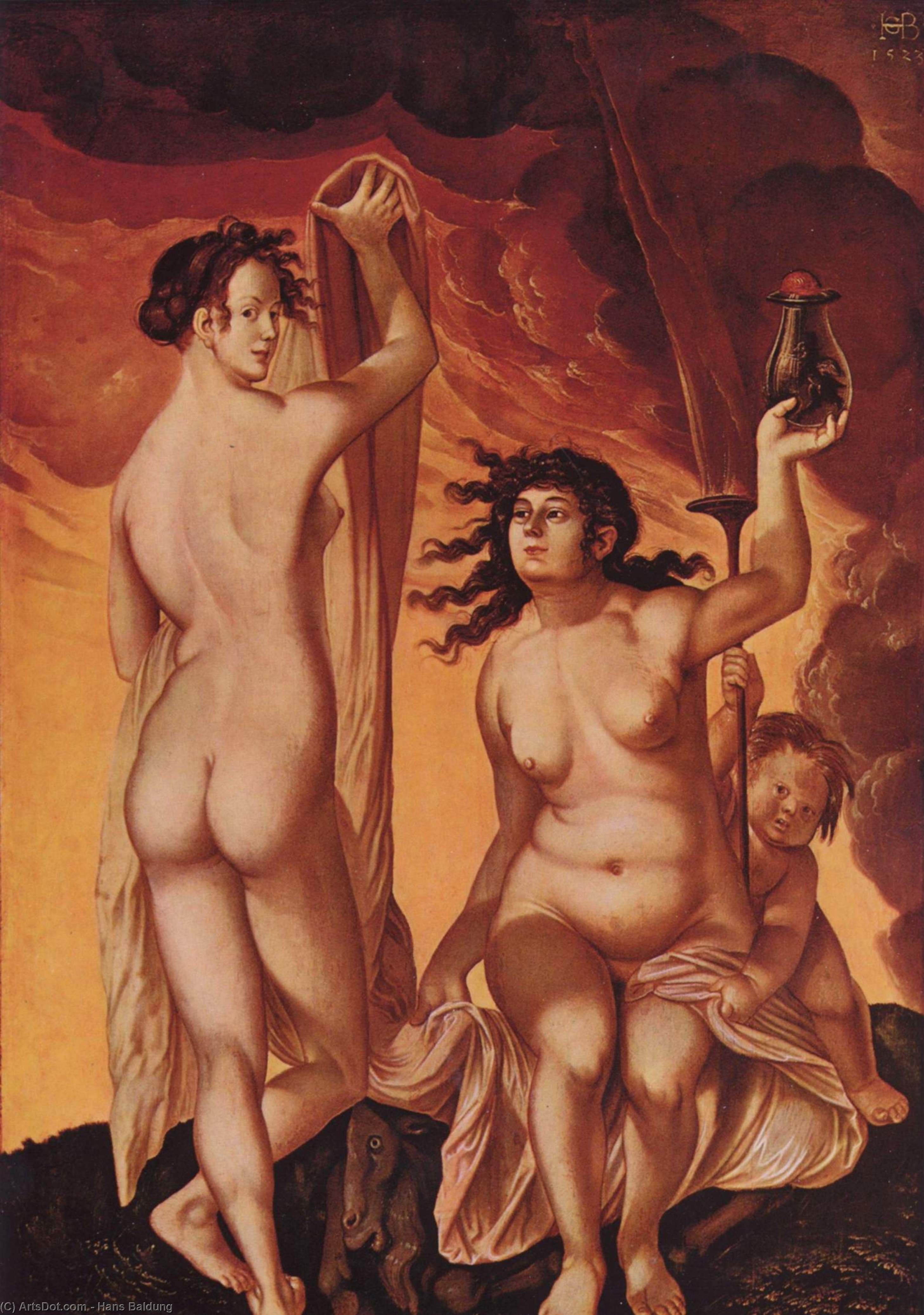
Two Witches (1523) od Hans Baldung
5

Two Witches

1523 · Oil On Canvas · Städel Museum, Frankfurt nad Mohanem

The painting "Two Witches" by Hans Baldung is a captivating work of art that showcases the artist's unique style and technique. Created in 1523, this Northern Renaissance masterpiece is a testament to Baldung's skill as a painter and printmaker. As a leading online platform specializing in handmade oil paintings reproductions, https://AllPaintingsStore.com offers a wide range of artworks, including the "Two Witches" by Hans Baldung. Artist's Style and Technique Hans Baldung…

Self-Portrait (1526) od Hans Baldung
6

Self-Portrait

1526 · Oil On Panel · Musée des Beaux-Arts de Strasbourg, Strasburg

A man stares directly from the wooden panel, his gaze meeting the viewer with a piercing, unyielding intensity. This is a moment frozen in 1526, a self-portrait where the artist, Hans Baldung Grien, confronts his own likeness. He sits with a stern expression, his features rendered with a startling realism that captures the weight of his thoughts. A dark, undifferentiated background pushes his figure forward, making the man appear to…

Woman with Cat (Allegory of Musik) (1529) od Hans Baldung
7

Woman with Cat (Allegory of Musik)

1529 · Oil On Panel

Woman with Cat (Allegory of Musik) is an oil on panel created by Hans Baldung Grien. Executed in 1529, the work emerged during the Northern Renaissance. The artist, a significant figure of the German Renaissance, developed a style characterized by expressive color and psychological depth, often diverging from the more classical approaches of his contemporaries.

Head of an Old Man (1516) od Hans Baldung
8

Head of an Old Man

1516 · Oil On Panel · Galleria Estense, Modena

A single face emerges from a void of shadow. The skin is a map of deep furrows and weathered ridges, etched by the slow passage of decades. Light strikes the brow and the ridge of the nose, leaving the rest of the features to dissolve into a dark, indistinct background. Every line tells of a life lived in the sun and the wind. The beard is a cascade of white…

Maria with the Sleeping Child (1540) od Hans Baldung
9

Maria with the Sleeping Child

1540 · Oil On Panel · Augustiner Museum, Freiburg

In this intimate portrait from 1540, we find ourselves drawn into a private, hushed moment between a mother and her infant. The composition is tightly focused, stripping away any sense of background depth to force an immediate, emotional proximity between the viewer and the subjects. A saturated red background provides a stark, almost startling contrast to the deep blue of the woman's mantle. This color choice directs the eye toward…

The Nativity (1527) od Hans Baldung
10

The Nativity

1527 · Oil · Städel Museum, Frankfurt nad Mohanem

The air in the stable is heavy, thick with the scent of damp straw and the warmth of animal breath. In this enclosed space, a single, unseen light source carves the scene out of a profound darkness. It falls upon the pale, luminous skin of the Christ child, turning the infant into a focal point of quiet radiance. Around him, the Virgin Mary sits in a heavy blue robe, her…

Hans Baldung, obrazy od 11 do 100

Lot drinking (1537) od Hans Baldung
#14

Lot drinking

1537 · Staatliche Kunsthalle Karlsruhe

(Lot mit Weinbecher) is a work by the German Renaissance artist Hans Baldung Grien. Executed about 1537, the piece exists as a fragment of a larger, complex composition…

Pořiďte si ho domů →
Saint Barbara (1504) od Hans Baldung
#23

Saint Barbara

1504

In this vertical portrait of Saint Barbara by Hans Baldung Grien, a single, full-length figure occupies the center of the frame. She is set against a dark, indeterminate…

Pořiďte si ho domů →
Holy Family (1513) od Hans Baldung
#27

Holy Family

1513

In this 1513 oil painting, we find ourselves drawn into an intimate, structured composition that defines the Northern Renaissance. The scene is set within a heavy architectural space,…

Objednat reprodukci →
Death chases a Maiden (1513) od Hans Baldung
#31

Death chases a Maiden

1513 · Museo Nazionale del Bargello

In "Death chases a Maiden" by Hans Baldung Grien, the composition is vertically oriented and tightly focused on two central figures. A personification of Death pursues a young…

Objednat reprodukci →
lamentation (1515) od Hans Baldung
#35

lamentation

1515

The scene centers on the body of Christ, which lies upon a shroud at the foot of the cross. His skin is pale, marked by wounds, and his…

Pořiďte si ho domů →
St. Jerome (1511) od Hans Baldung
#37

St. Jerome

1511

The air feels heavy with the stillness of a deep, ancient wood. In this monochrome world, St. Jerome sits upon the earth, his presence anchored by a quiet,…

Pořiďte si ho domů →
Merkurius (1530) od Hans Baldung
#39

Merkurius

1530 · Nationalmuseum

is an oil on panel painting by the German Renaissance artist Hans Baldung Grien. Executed around 1530, the work represents the Roman god Mercury. The composition focuses on…

Pořiďte si ho domů →
Mercenary Love (1527) od Hans Baldung
#41

Mercenary Love

1527 · Walker Art Gallery

The air in the room feels heavy, thick with the unspoken tension of a deal being struck. An older man leans toward a younger woman, his presence a…

Pořiďte si ho domů →
Arrest of Christ (1519) od Hans Baldung
#43

Arrest of Christ

1519 · Veste Coburg

The Arrest of Christ by Hans Baldung Grien depicts the biblical scene of the arrest of Jesus. Created about 1519, this work focuses on the immediate physical struggle…

Pořiďte si ho domů →
Saint George (1530) od Hans Baldung
#47

Saint George

1530 · Musée des Beaux-Arts de Strasbourg

A slender, elongated figure of a knight in full armor dominates this vertical composition. Positioned against a dark, minimalist background, the subject's silhouette is sharply defined by high-contrast…

Objednat reprodukci →
Hercules and Antaeus (1530) od Hans Baldung
#53

Hercules and Antaeus

1530

The painting titled Hercules and Antaeus is a work by the artist Hans Baldung Grien. Created about 1530, this oil painting on panel depicts a specific mythological encounter.…

Objednat reprodukci →
Deluge (1516) od Hans Baldung
#61

Deluge

1516 · Bavarské státní sbírky malby

In this work, titled Deluge, Hans Baldung Grien approaches the biblical narrative of the Great Flood with a profound sense of gravity. Painted about 1516, the scene captures…

Objednat reprodukci →
Venus and Amor (1524) od Hans Baldung
#66

Venus and Amor

1524 · Kröller-Müllerův Muzeum

In this oil on linden wood painting, a nude female figure, Venus, is positioned centrally against a dark, uniform background. Her pale skin tones contrast with the deep…

Objednat reprodukci →
The Burning Sodom (1537) od Hans Baldung
#67

The Burning Sodom

1537 · Staatliche Kunsthalle Karlsruhe

The Burning Sodom is a painting fragment by Hans Baldung Grien. It forms part of a larger, now fragmented work titled Lot and his Daughters. This specific piece,…

Pořiďte si ho domů →
Madonna with the Parrots (1533) od Hans Baldung
#70

Madonna with the Parrots

1533 · Germanisches Nationalmuseum

In the quiet, profound depths of 1533, Hans Baldung captures a moment of celestial intimacy that lingers in the soul. The scene unfolds with a serene Madonna, her…

Objednat reprodukci →
Nativity (1510) od Hans Baldung
#74

Nativity

1510 · Kunstmuseum Basel

In the quiet, evocative depths of Hans Baldung’s Nativity, painted around 1510, we are invited into a moment of profound stillness and sacred intimacy. This masterpiece serves as…

Pořiďte si ho domů →

Obrazy umělce Hans Baldung podle období

Témata, která Hans Baldung maloval nejčastěji

Čtyři témata, která se v těchto dílech objevují nejčastěji, spolu s nejlepším příkladem každého z nich.

Kde vidět obrazy autora Hans Baldung

8 muzea, v nichž je umístěno nejvíce obrazů z této stránky.

Muzea Město Díla autora Hans Baldung Obrazy z tohoto seznamu
Bavarské státní sbírky malby, MnichovBavarské státní sbírky malby Mnichov 10 Count Philip, Portrait of the Strasbourg Knight Commander Balthasar Gerhardi, Knight of the Order of Malta, Hospitaller of St. John of Jerusalem
Gemäldegalerie, BerlínGemäldegalerie Berlín 10 Head of a Bearded Old Man, Lot drinking (Berlin fragment), Three king altar
Staatliche Kunsthalle Karlsruhe, KarlsruheStaatliche Kunsthalle Karlsruhe Karlsruhe 8 Portrait of Margrave Christopher I of Baden, Portrait of Count Georg I of Erbach, Lot drinking
Kunstmuseum Basel, BasilejKunstmuseum Basel Basilej 6 Smrt a nevěsta, Christ Crucified with the Thieves, Saints, and a Female Donor, Young Woman and Death
Germanisches Nationalmuseum, NorimberkGermanisches Nationalmuseum Norimberk 7 Portrait of a 29-year-old Man, Madonna with Child and Gemstones, Madonna with the Parrots
Städel Museum, Frankfurt nad MohanemStädel Museum Frankfurt nad Mohanem 3 Two Witches, The Nativity, Altar of St. John the Baptist
Augustiner Museum, FreiburgAugustiner Museum Freiburg 3 Maria with the Sleeping Child, Christ as man of sorrows wept by mary and angels, Amor with arrow
Musée des Beaux-Arts de Strasbourg, StrasburgMusée des Beaux-Arts de Strasbourg Strasburg 6 Self-Portrait, Saint George

Nejslavnější obraz každého desetiletí umělce Hans Baldung

  1. 1500s
    Saint Barbara (1504) od Hans Baldung
    Pořadí 23 / 100

    Saint Barbara

    Věk 15 – 24

    In this vertical portrait of Saint Barbara by Hans Baldung Grien, a single, full-length figure occupies the center of the frame. She is set against a dark, indeterminate…

  2. 1510s
    Portrait of Margrave Christopher I of Baden (1512) od Hans Baldung
    2 z 100

    Portrait of Margrave Christopher I of Baden

    Věk 25 – 34 · Staatliche Kunsthalle Karlsruhe

    Further research suggests that Baldung's work was heavily influenced by humanist ideals, mirroring the broader cultural landscape of his time. The Karlsruhe Kunsthalle continues to illuminate this masterpiece…

  3. 1520s
    Two Witches (1523) od Hans Baldung
    Pořadí 5 / 100

    Two Witches

    Věk 35 – 44 · Städel Museum

    The painting "Two Witches" by Hans Baldung is a captivating work of art that showcases the artist's unique style and technique. Created in 1523, this Northern Renaissance masterpiece…

  4. 1530s
    Portrait of Count Georg I of Erbach (1533) od Hans Baldung
    Pořadí 11 / 100

    Portrait of Count Georg I of Erbach

    Věk 45 – 54 · Staatliche Kunsthalle Karlsruhe

    Portrait of Count Georg I of Erbach, executed in 1533, presents a formal study of German nobility. The subject is Georg I, Count of Erbach. Hans Baldung Grien,…

  5. 1540s
    Maria with the Sleeping Child (1540) od Hans Baldung
    Pořadí 9 / 100

    Maria with the Sleeping Child

    Věk 55 – 60 · Augustiner Museum

    In this intimate portrait from 1540, we find ourselves drawn into a private, hushed moment between a mother and her infant. The composition is tightly focused, stripping away…

Otázky k obrazům autora Hans Baldung

Který obraz je nejznámější dílem Hans Baldung?Zobrazit odpověď

Smrt a nevěsta, Kunstmuseum Basel, Basilej. Následují Portrait of Margrave Christopher I of Baden (1512) a Count Philip (1517).

Jakých je 10 nejlepších obrazů autora Hans Baldung?Zobrazit odpověď

Smrt a nevěsta, Portrait of Margrave Christopher I of Baden, Count Philip, St John at Patmos, Two Witches, Self-Portrait, Woman with Cat (Allegory of Musik), Head of an Old Man, Maria with the Sleeping Child a The Nativity. Výše uvedené pořadí uvádí rok a muzeum každého díla.

Kolik obrazů vytvořil/a Hans Baldung?Zobrazit odpověď

Náš katalog obsahuje 276 děl autora Hans Baldung z let 1502 až 1544.

Kde se nacházejí nejznámější obrazy umělce Hans Baldung?Zobrazit odpověď

Většina z nich se nachází v Bavarské státní sbírky malby (Mnichov), Gemäldegalerie (Berlín) a Staatliche Kunsthalle Karlsruhe (Karlsruhe). V tabulce výše jsou jednotlivé muzea uvedeny postupně.

Kdy Hans Baldung namaloval svá nejznámější díla?Zobrazit odpověď

V období 1510s: 33 z 100 děl na této stránce pochází z tohoto období, z nich Portrait of Margrave Christopher I of Baden.

Jaká jsou nejstarší a nejnovější slavná díla umělce Hans Baldung?Zobrazit odpověď

Nejstarší dílo na této stránce pochází z Self-Portrait (1502), nejnovější z Sleeping Groom and Sorceress (1544).

Co nejčastěji maloval/a Hans Baldung?Zobrazit odpověď

Man (26), Woman (16) a Skin (10), z celkových 100 děl na této stránce.

Jakou techniku používal(a) Hans Baldung nejčastěji?Zobrazit odpověď

Oil On Panel: 37 z 100 děl na této stránce.

K kterému uměleckému směru patří Hans Baldung?Zobrazit odpověď

Severská renesance, jak dokazují obrazy na této stránce.

Která díla Hans Baldung mohu vidět v Bavarské státní sbírky malby?Zobrazit odpověď

Count Philip, Portrait of the Strasbourg Knight Commander Balthasar Gerhardi a Knight of the Order of Malta, Hospitaller of St. John of Jerusalem patří mezi 9 děl na této stránce, která má v zastarání Bavarské státní sbírky malby, Mnichov.

Mohu si koupit reprodukci obrazu od Hans Baldung?Zobrazit odpověď

Ano. Každý obraz na této stránce lze objednat jako ručně malovanou olejovou reprodukci v muzeální kvalitě nebo jako umělecký tisk v požadovaném rozměru přímo z jeho vlastní stránky.

O umělci Hans Baldung

A Swabian Enigma: The Life and Early Influences of Hans Baldung Grien

Born around 1485 in the Free Imperial City of Schwäbisch Gmünd, nestled within the rolling hills of Bavaria, Hans Baldung—forever distinguished as Hans Baldung Grien due to his penchant for wearing green attire—emerged from an unexpectedly scholarly lineage. Unlike many Renaissance artists who followed established family crafts, Baldung was the first male in generations not destined for university studies. His father, Johann Baldung, a respected jurist serving the Bishopric of Strasbourg, envisioned a similar path for his son. Yet, young Hans chose the brush and burin, embarking on an artistic journey that would set him apart as one of the most distinctive and enigmatic figures of the German Renaissance. This decision wasn’t a rejection of his upbringing, but rather a redirection of intellectual curiosity—a characteristic that permeated his entire oeuvre. His early training commenced around 1500 in the Upper Rhineland with an artist from Strasbourg, laying the groundwork for his technical skills before he sought out more prominent masters to hone his craft. This initial period instilled within him a foundation of draftsmanship and composition, preparing him for the rigorous artistic environment that awaited him in Nuremberg.

Under Dürer’s Wing and Forging an Individual Style

The pivotal moment in Baldung's development arrived in 1503 when he became a workshop apprentice to Albrecht Dürer in Nuremberg. This period proved profoundly formative, exposing him to the meticulous detail, intellectual rigor, and innovative printmaking techniques that defined Dürer’s style. The two artists developed a close relationship; Baldung even managed Dürer's workshop during his master’s sojourn to Venice. However, while deeply influenced by Dürer—evident in early works showcasing precise draftsmanship and Northern realism—Baldung quickly began to forge his own artistic identity. He absorbed the lessons of the Renaissance masters but infused them with a uniquely German sensibility, characterized by expressive color, imaginative compositions, and an increasingly unsettling psychological depth. This divergence from Dürer’s more classical approach would become a hallmark of Baldung's mature style. His time in Venice, overseeing Dürer’s affairs, also exposed him to the burgeoning Italian Renaissance art scene, broadening his artistic horizons and subtly influencing his palette and compositional choices. He returned from Italy with a heightened sense of color and a willingness to experiment with spatial arrangements that set him apart from his contemporaries.

A Master of Many Mediums: Themes and Techniques

Hans Baldung Grien was an artist of remarkable versatility, proficient in painting, printmaking—particularly woodcuts and engravings—drawing, tapestry design, and even stained glass work. His paintings often feature small-scale works brimming with puzzling allegories and mythological narratives, rendered with a vibrant palette and a distinctive sense of spatial ambiguity. He excelled at portraiture, capturing the likenesses of his patrons with both realism and psychological insight. However, it is perhaps for his woodcuts that Baldung is most widely recognized today. These prints are characterized by their dramatic compositions, intricate detail, and often macabre subject matter. A recurring theme throughout his work is a fascination with witchcraft, death, and the supernatural—a reflection of the anxieties and beliefs prevalent in 16th-century Germany. His depictions of witches are particularly striking, portraying them not as stereotypical hags but as complex, even alluring figures, embodying both fear and fascination. The Bewitched Groom, for example, is a chillingly evocative work that encapsulates this preoccupation with the darker side of human experience. Baldung’s technique in woodcut was masterful; he exploited the medium's capacity for stark contrasts and intricate detail to create images that were both visually arresting and psychologically unsettling.

Reformation Currents and Lasting Legacy

Baldung’s career unfolded during a period of immense religious and political upheaval, marked by the rise of the Protestant Reformation. While not overtly aligned with any particular faction, his work often reflects the changing spiritual landscape of Germany. His monumental high altar for the city of Münster, completed in 1531, is a testament to this engagement, showcasing support for the reformation movement through its iconography and stylistic choices. In 1545, Baldung died in Strasbourg, leaving behind a body of work that continues to captivate and intrigue viewers today. His influence can be seen in the works of later German artists, and his unique blend of Renaissance technique, Northern expressionism, and allegorical complexity secures his place as a significant figure in art history. He remains an artist whose work invites contemplation, challenging us to confront the darker aspects of human nature and the mysteries of the unseen world. His exploration of themes like witchcraft and mortality continues to resonate with contemporary audiences, making him a timeless and compelling figure in the pantheon of Renaissance masters.

Museums and Collections

Baldung’s works can be found in prominent museums across Europe and North America:

  • Gemäldegalerie Alte Meister, Dresden, Germany: This renowned museum houses a significant collection of European paintings from the 15th to the 18th centuries, providing valuable context for understanding Baldung’s artistic milieu.
  • National Gallery of Art, Washington D.C.: The NGA holds several important woodcuts and drawings by Baldung, offering insights into his printmaking techniques and artistic process.
  • The J. Paul Getty Museum, Los Angeles: Features works that showcase the breadth of Baldung’s talent.
  • Kunstmuseum Basel, Switzerland: A museum with a rich collection spanning various periods, offering a broader understanding of Renaissance art in Europe.

These institutions provide opportunities to experience firsthand the captivating artistry and enduring legacy of Hans Baldung Grien.

Všechna díla od Hans Baldung: 276 →