Fernando Botero, 1932 – 2023

Fernando Botero: The 100 Most Famous Paintings

The President and First Lady is the most famous painting by Fernando Botero. la collectionneuse and Dancing in Colombia (1980) are the next two works the world knows best. From the 279 works of Fernando Botero in our catalogue, here are the 100 that collectors and museum visitors look at most, with the year, the museum and the story of each.

Seřazeno podle našeho skóre popularity, které kombinuje počet vyhledávání, návštěv a objednávek u každého díla. Aktualizováno říjen 2026.

Portrét Fernando Botero
Fernando Botero · 1932 – 2023
Narozen · zemřel
1932 – 2023, Medellín
Směr
Boterismo
Díla v našem katalogu
279
Nejslavnější
The President and First Lady
Nejvíce děl v
Národní muzeum v Kolumbii

Top 10: Fernando Botero's best-known paintings

The President and First Lady od Fernando Botero
1

The President and First Lady

Oil On Canvas

To stand before a work by Fernando Botero is not merely to observe paint on canvas; it is to encounter a celebration of form itself. His signature style, often termed Boterismo, immediately arrests the viewer with its magnificent exaggeration. Here, in "The President and First Lady," this characteristic volume takes center stage. The figures—the woman poised elegantly upon the horse, the attendant figures flanking the scene—are rendered with a delightful,…

la collectionneuse od Fernando Botero
2

la collectionneuse

Oil On Canvas

The gaze of the viewer meets the presence of la collectionneuse, a work that carries the unmistakable weight and volume of its creator. Fernando Botero, born in Medellín, Colombia, on April 19, 1932, breathes life into this scene through his singular way of seeing the world. The canvas holds a quiet, heavy energy that feels as though it has always existed in this specific, rounded state.

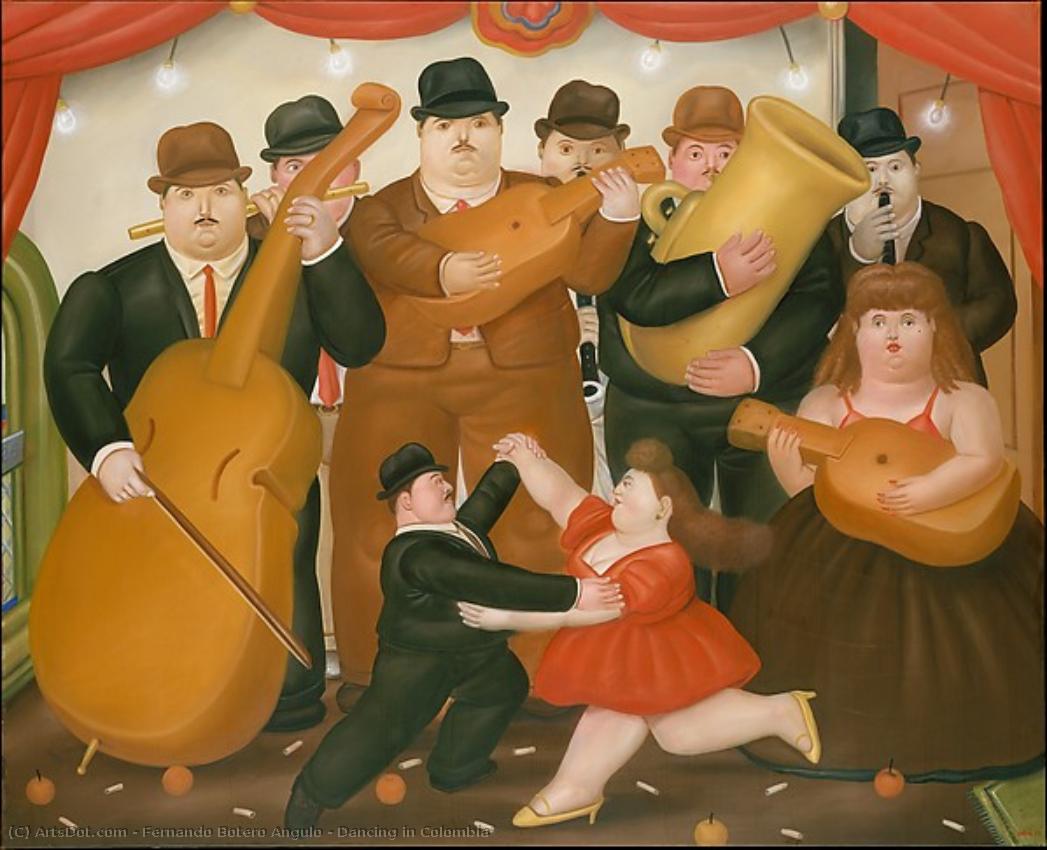
Dancing in Colombia (1980) od Fernando Botero
3

Dancing in Colombia

1980 · Oil On Canvas · Metropolitan Museum of Art, New York

In the vibrant tapestry of twentieth-century Latin American art, few works capture the exuberant pulse of a nation quite like Fernando Botero’s Dancing in Colombia. Completed in 1980, this masterful oil painting serves as a window into a world where movement and mass coexist in a joyful, rhythmic embrace. At first glance, the viewer is swept up in a scene of delightful disorder; a crowded café or social gathering teems…

la famille od Fernando Botero
4

la famille

Oil On Canvas

To stand before Fernando Botero’s depiction of la famille is to be enveloped in an atmosphere of profound, almost monumental warmth. This painting transcends a mere portrait; it is a celebration of connection, a visual ode to the enduring bond that ties generations together. The composition centers on a family unit—a mother seated between her two children, all gathered beneath the sheltering canopy of a tree. Botero masterfully captures not…

scene de famille od Fernando Botero
5

scene de famille

Oil On Canvas

To gaze upon Fernando Botero’s Scene de Famille is to be enveloped in an atmosphere of profound, yet utterly comfortable, domesticity. This painting transcends a mere depiction; it captures the very essence of togetherness—the quiet moments shared between loved ones that form the bedrock of human experience. The composition centers around a family unit of four—a man, a woman, and two children—all settled into a tableau of relaxed intimacy. Botero’s…

mona lisa od Fernando Botero
6

mona lisa

Oil On Canvas

Introduction to the Artist and his Style Fernando Botero Angulo, a renowned Colombian figurative artist, is celebrated for his unique style characterized by voluminous, exaggerated forms. His work has been exhibited worldwide and can be found in prestigious museums such as the Metropolitan Museum of Art in New York City and the Museo de Arte Moderno in Bogotá. At AllPaintingsStore.com, we offer handmade oil paintings reproductions of famous artwork, including…

Frank Lloyd et sa famille à paradise island od Fernando Botero
7

Frank Lloyd et sa famille à paradise island

Oil On Canvas

In this scene, we find ourselves on a tropical shore, observing a quiet moment shared by a family of four. Two adults and two children are positioned amidst the soft sands of paradise island, their presence anchored to the landscape. There is a certain weight to the figures; they do not merely occupy the beach but seem to emerge from it, their rounded silhouettes mirroring the organic curves of the…

les musiciens od Fernando Botero
8

les musiciens

Oil On Canvas

The scene unfolds through les musiciens, a work that carries the unmistakable presence of its creator, Fernando Botero. Created in 1986, this piece captures a moment of quiet musicality. The artist, who was born in Medellín, Colombia, in 1932, brings a specific sense of weight and volume to the figures within the frame. Every shape feels substantial, as if the air in the room has a physical density that holds…

Dog Turning a Corner (1980) od Fernando Botero
9

Dog Turning a Corner

1980 · Oil On Canvas

In the masterful hands of Fernando Botero, a simple street corner is transformed into a theatrical stage where life unfolds with exaggerated grace and exuberant color. Dog Turning a Corner invites the viewer into a sun-drenched village scene, captured with the unmistakable warmth that defines the Colombian master's vision. The painting presents a bustling tableau of small-town life, where yellow buildings glow under an unseen sun, casting a nostalgic radiance…

Walk in the hills (1977) od Fernando Botero
10

Walk in the hills

1977 · Oil On Canvas

In the vast landscape of twentieth-century Latin American art, few figures command attention with as much whimsical gravity as Fernando Botero. His 1977 masterpiece, Walk in the hills, serves as a profound window into the artist's signature aesthetic, often referred to as "Boterismo." At first glance, the painting presents a scene of quietude: a solitary figure, draped in heavy, dark garments and crowned with a black hat, stands amidst the…

The rest of the Fernando Botero ranking, 11 to 100

July 20th (1984) od Fernando Botero
#11

July 20th

1984 · Národní muzeum v Kolumbii

Fernando Botero’s “July 20th,” painted in 1984, isn't merely a depiction of two figures on a street; it’s a carefully constructed tableau brimming with quiet drama and subtle…

Quatre Musiciens od Fernando Botero
#12

Quatre Musiciens

Fernando Botero Angulo's "Quatre Musiciens" is a captivating oil painting that exemplifies the artist’s signature style – a harmonious blend of bold colors, exaggerated forms, and a playful…

couple dansant od Fernando Botero
#13

couple dansant

is an oil painting by the Colombian artist Fernando Botero. The work captures a couple lost in the rhythm of dance, presenting a scene of movement and intimacy.…

monna lisa od Fernando Botero
#14

monna lisa

The gaze of the woman in monna lisa by Fernando Botero holds a quiet, heavy presence. She sits before us, draped in a black dress that anchors her…

danse en colombie od Fernando Botero
#15

danse en colombie

The painting "Danse en Colombie" by Fernando Botero Angulo is a captivating representation of the rich cultural heritage of Colombia. This vibrant artwork, available as a handmade oil…

tablao flamenco od Fernando Botero
#16

tablao flamenco

In the painting tablao flamenco by Fernando Botero, the scene captures a lively performance taking place within a club setting. At the center of the activity is a…

le chasseur od Fernando Botero
#17

le chasseur

The work before us is titled le chasseur, a painting by the Colombian artist Fernando Botero. Born in Medellín, Colombia, in 1932, Botero developed a singular visual language…

pastèques et oranges od Fernando Botero
#18

pastèques et oranges

To stand before a piece evoking the spirit of Fernando Botero’s still life compositions is to encounter an immediate sense of opulent, almost monumental presence. This painting, featuring…

tête de christ od Fernando Botero
#20

tête de christ

The work before us is titled tête de christ, a painting by the Colombian artist Fernando Botero. Born in 1932 in Medellín, Colombia, Botero developed a singular visual…

oranges od Fernando Botero
#21

oranges

In the vibrant world of Fernando Botero, even the simplest objects undergo a profound transformation. His painting, oranges, invites the viewer into a tactile universe where volume and…

nature morte à la soupe verte od Fernando Botero
#22

nature morte à la soupe verte

To stand before Nature Morte à la Soupe Verte is to be enveloped in the warm, generous embrace of Colombian artistry. Fernando Botero Angulo’s vision here transcends a…

les soeurs od Fernando Botero
#23

les soeurs

In the captivating realm of Fernando Botero’s les soeurs, the viewer is immediately enveloped by a sense of profound intimacy and exaggerated grace. The painting presents a tender…

The Widower (1968) od Fernando Botero
#30

The Widower

1968

“The Widower,” painted in 1968 by Colombian artist Fernando Botero, is a striking oil painting depicting a poignant family portrait set within the confines of a domestic interior.…

jeune fille sur l'ane od Fernando Botero
#46

jeune fille sur l'ane

jeune fille sur l'ane is an oil painting by Fernando Botero. The artist was born in 1932 in Medellín, Colombia, and maintained a presence in international art hubs…

nature morte de fruits od Fernando Botero
#73

nature morte de fruits

Fernando Botero Angulo's “nature morte de fruits” is more than just a depiction of fruit; it’s an embodiment of the artist’s singular vision, a testament to his mastery…

The Prima Donna (1967) od Fernando Botero
#78

The Prima Donna

1967 · Královské muzeum výtvarného umění Antverpy
Guitar Lesson (1960) od Fernando Botero
#81

Guitar Lesson

1960 · Národní muzeum v Kolumbii

Fernando Botero’s “Guitar Lesson,” painted in 1960, isn’t merely a depiction of a musical scene; it’s an embodiment of the artist’s signature style – what he himself termed…

hommage à Bonnard od Fernando Botero
#83

hommage à Bonnard

The painting Hommage à Bonnard by Fernando Botero Angulo is a unique and fascinating work of art that pays tribute to the French painter Pierre Bonnard. As a…

rubens et sa femme od Fernando Botero
#84

rubens et sa femme

In the captivating realm of Fernando Botero, reality is not merely observed but reimagined through a lens of magnificent abundance. His work, rubens et sa femme, serves as…

chambre avec jeux d'enfants od Fernando Botero
#85

chambre avec jeux d'enfants

In the captivating realm of Fernando Botero, reality is not merely observed but reimagined through a lens of magnificent abundance. The painting chambre avec jeux d'enfants invites the…

le bain des évêques dans un fleuve od Fernando Botero
#86

le bain des évêques dans un fleuve

A Moment of Leisure: "Le Bain des Évêques dans un Fleuve" by Fernando Botero Angulo This captivating painting, “Le Bain des Évêques dans un Fleuve” (The Bathing of…

l'étude de vermeer od Fernando Botero
#87

l'étude de vermeer

The painting l'étude de vermeer emerges from the year 1964, a moment when Fernando Botero captures a singular presence on canvas. This work presents a portrait of a…

The subjects Fernando Botero painted most

The four subjects that return most often among these masterpieces, with the finest example of each.

Where to see Fernando Botero's paintings

6 muzea, v nichž je umístěno nejvíce obrazů z této stránky.

Muzea Město Díla autora Fernando Botero Obrazy z tohoto seznamu
Národní muzeum v Kolumbii, BogotaNárodní muzeum v Kolumbii Bogota 2 July 20th, Guitar Lesson
Bavarské státní sbírky malby, MnichovBavarské státní sbírky malby Mnichov 2 The First Lady, El Presidente
Metropolitan Museum of Art, New YorkMetropolitan Museum of Art New York 1 Dancing in Colombia
Museum of Latin American Art, Long BeachMuseum of Latin American Art Long Beach 1 Title translation: The Family
Tucson Museum of Art, TucsonTucson Museum of Art Tucson 1 Sailor Boy
Královské muzeum výtvarného umění Antverpy, AntverpyKrálovské muzeum výtvarného umění Antverpy Antverpy 1 The Prima Donna

Fernando Botero through the decades: one masterpiece for each

  1. 1950s
  2. 1960s
  3. 1970s
    Walk in the hills (1977) od Fernando Botero
    No. 10 of 100

    Walk in the hills

    Věk 38 – 47

    In the vast landscape of twentieth-century Latin American art, few figures command attention with as much whimsical gravity as Fernando Botero. His 1977 masterpiece, Walk in the hills,…

  4. 1980s
    Dancing in Colombia (1980) od Fernando Botero
    #3 of 100

    Dancing in Colombia

    Věk 48 – 57 · Metropolitan Museum of Art

    In the vibrant tapestry of twentieth-century Latin American art, few works capture the exuberant pulse of a nation quite like Fernando Botero’s Dancing in Colombia. Completed in 1980,…

  5. 1990s

Fernando Botero's paintings: frequently asked questions

What is the most famous Fernando Botero painting?Show the answer

The President and First Lady. Next come la collectionneuse and Dancing in Colombia (1980).

Which are the 10 most famous Fernando Botero paintings?Show the answer

The President and First Lady, la collectionneuse, Dancing in Colombia, la famille, scene de famille, mona lisa, Frank Lloyd et sa famille à paradise island, les musiciens, Dog Turning a Corner a Walk in the hills. The ranking above gives the year and the museum of each.

How many paintings by Fernando Botero are there?Show the answer

Our catalogue lists 279 works by Fernando Botero, dated from 1959 to 1992.

Where can I see the most famous Fernando Botero paintings?Show the answer

Most of them are in Národní muzeum v Kolumbii (Bogota), Bavarské státní sbírky malby (Mnichov) a Metropolitan Museum of Art (New York). The table above lists the museums one by one.

In which period did Fernando Botero paint the best-known works?Show the answer

In 1960s: 10 of the 100 works on this page date from then, among them Camera degli Sposi (Homage to Mantegna) II.

What is the earliest famous Fernando Botero painting, and the latest?Show the answer

The earliest on this page is Mona Lisa, Age Twelve (1959), the latest Title translation: The Family (1992).

What subjects did Fernando Botero paint?Show the answer

Woman (14), Portrait (9) a Volume (8), among the 100 works on this page.

What did Fernando Botero paint on, and with what?Show the answer

Oil On Canvas: 22 of the 100 works on this page.

Which movement does Fernando Botero's art belong to?Show the answer

Boterismo, as the paintings on this page show.

What Fernando Botero paintings does the Národní muzeum v Kolumbii hold?Show the answer

July 20th a Guitar Lesson are among the 2 works on this page held by the Národní muzeum v Kolumbii, Bogota.

Fernando Botero: biography

Raný život, rodina a formování

Fernando Botero se narodil 19. dubna 1932 v Medellínu v Kolumbii. Jeho raná léta byla formována tichými, rytmickými údery domácnosti, která se snažila v náročném životě zajistit základ pro přežití. Jeho otec, David Botero, si připadával jako obchodník, který často cestoval na koni, aby dostal ke svým zákazníkům. Jeho matka, Flora Angulo, pracovala jako švadna a poskytovala rodině nezbytnou oporu. Toto rané prostředí mu vštěpilo hluboký pocit místa, který v něm zůstal i dlouho poté, co město opustil.

V mládí strávil Fernando Botero několik let studiem v matadorské škole. Byl trénován v pohybech a tradicích býčích arén, ale jeho zájmy ho nakonec od areny odvedly pryč. Ve šestnácti letech se jeho pozornost přesunula k kresbě a skicování. V roce 1948 byly jeho první ilustrace publikovány v nedělním suplementu listu El Colombiano, což znamenalo počátek jeho veřejného působení prostřednictvím jeho vizuální tvorby.

Umělecké vzdělání a evropské cesty

V roce 1952 využil Botero prostředky vydělané prodejem svých děl v galeriích k cestě plavbou směrem k Evropě. Jeho první zastávkou byla Barcelona, ale brzy se přesunul do Madridu. Právě ve Španělsku zahájil své studia na Academia de San Fernando. Čas trávil v muzeu Prado, kde sedával a studoval, kopioval díla mistrů jako Goya či Velázquez. Tato tradice studia starých mistrů se stala trvalou součástí jeho umělecké praxe.

Jeho cestování ho nakonec zavedlo do Florencie, kde studoval na Academia de San Marcos. Do roku 1953 se již přesunul do Paříže. Většinu svého času trávil v Louvru, kde pozoroval, jak se světlo a forma usazují na postavách v muzeálních sálech. Tato evropská léta byla charakteristická neustálým pohybem mezi městy jako Madrid, Florencie a Paříž, během nichž nasával váhu a monumentální přítomnost klasického umění.

Vývoj stylu Boterismo

Tvary v jeho dílech nesou specifickou váhu. Tento přístup, často označovaný jako Boterismo, se soustředí na lidi a postavy vykreslené v obrovských, exagereovaně zvětšených objemech. Místo důrazu na tenké linie zůstává pozornost na kulaté, korpulentní formy, které zaplňují prostor svou těžkou přítomností. Tyto postavy mají určitou hmotnost, která působí fyzicky, jako by samotná barva nabyla na váze. Často využívá zářivé barvy a výrazné obrysy k definování těchto tvarů, díky čemuž subjekty vyčnívají z pozadí a získávají na dramatismu.

Kolem roku 1964 se tento zájem o objem přesunul z plátna do tří rozměrů. Začal vytvářet sochy a přenášet ten samý pocet expanze do bronzu a dalších materiálů. Zaoblenost, kterou známe z jeho obrazů, našla nový život v těchto pevných formách, což umožnilo existovat těmto exagereovaným proportioncím i v otevřených veřejných prostorech. Jeho tvorba zůstává věnou čisté fyzikalitě objektu, ať už jde o lidskou postavu nebo zvíře.

Klíčová díla a umělecká témata

Jeho tvorba se často točí kolem váhy lidské formy a tiché napětí, které v sobě nesou sociální situace. V díle Mona Lisa, Age Twelve (1959) je subjekt vykreslen s charakteristickou, zaoblenou přítomností, která se vzdaluje od tradičních proporcí. Tento důraz na objem se stal způsobem, jakým Botero zkoumal složitější sociální struktury. V obraze The Presidential Family (1967) nabízejí přehnané tvary postav subtilní pohled na politické elity, kde autor využívá hmotu k komentáři k lidem u moci. Tyto tvary používal k vyjádření jak radosti ze života, tak i tíhy konfliktů.

Témata jeho děl se často pohybují mezi oslavou života a realitou násilí. Dancing in Colombia (1980) zachytává živou scénu hudebníků a tanečníků, přičemž využívá silné vrstvy barvy, aby postavám dodal taktilní a těžkou kvalitu. Naproti tomu jeho pozdější díla často čelila temným aspektům jeho vlasti. The Death of Pablo Escobar (1999/2006) a jeho různé série věnované zneužívání v Abu Ghraib ukazují ochotu využít svůj ikonický styl k konfrontaci s těžkými pravdami. I jeho pozdější díla, jako například La paloma de la paz (2016), nesou pocit monumentální váhy, ať už je subjektem člověk, zvíře nebo symbol míru.

  • Mona Lisa, Age Twelve (1959)
  • The Presidential Family (1967)
  • Dancing in Colombia (1980)
  • The Death of Pablo Escobar (1999/2006)
  • La paloma de la paz (2016)

Pozdní roky a odchod

Poslední desetiletí jeho života byla charakteristická neustálým pohybem mezi několika světovými metropolitami. Udržoval si rezidence v New Yorku, Paříži i v Monaku, zatímco se pravidelně vracel do rodného Medellínu, aby zůstal v hlubokém spojení se svými kořeny. Jeho přítomnost v obytných prostorech veřejného mínění neustále rostla, neboť jeho bronzové sochy byly rozmístěny v parcích a na náměstích na několika kontinentech. I v pokročilém věku jeho tvorba neztrácela na váze a nadále se věnovala hlubokým tématům, jako byly sociální a politické napětí v Kolumbii či tragické události v cele Abu Ghraib.

Své poslední roky strávil v knížectví Monako. Tam, ve věku 91 let, odešel na necelé věčné odchod 15. září 2023. Příčinou smrti byly komplikace spojené s pneumonií. Jeho odchod znamenal konec dlouhé a fascinující kariéry, kterou zasvětil pozorování lidské podoby a složitostí společenského života skrze svůj naprosto jedinečný filtr objemu a proporcí.

Dědictví a vliv

Jeho přítomnost v celosvětovém veřejném prostoru byla neustálá a neochvějná. V New Yorku jeho sochy zaujímají prostory jako Park Avenue, kde se jeho těžké, zaoblené tvary střetávají s architekturou velkoměsta. V rodné Kolumbii se stal národním pokladem, postavou, jejíž dílo bylo hluboce zapleteno do každodenního života země. Za svého života byl nejuznávanějším a nejcitovanějším umělcem z Latinské Ameriky, což se odrazilo v tom, jak se jeho postavy staly blízkými lidem napříč mnoha hranicemi.

Jeho hluboké pouto k vlasti bylo patrné především skrze jeho rozsáhlé umělecké dary. V roce 2000 daroval 208 uměleckých děl Bankě republiky, což zásadním způsobem pomohlo utvářet kulturní krajinu Bogoty. Velká část jeho osobní sbírky byla rovněž sdílena s veřejností; daroval 123 děl a dalších 85 kusů pro Museo Botero. Tyto štědré činy zajistily, aby jeho jedinečný způsob vidění světa zůstal přístupný všem budoucím generacím.

  • La paloma de la paz
  • The Death of Pablo Escobar
  • Mona Lisa, Age Twelve

Kde dnes spatřit jeho díla

Jeho přítomnost je hmatatelná v tichých koutcích Bogoty, zejména v historické čtvrti La Candelaria. Museo Botero uchovává velkou část jeho tvorby, což je sbírka, která vznikla díky jeho vlastnímu rozhodnutí darovat mnoho svých děl národu. V Medellínu pak Muzeum Antioquia spravuje významné množství jeho prací, čímž udržuje hluboké spojení s jeho kořeny. Tyto prostory umožňují návštěvníkům v klidu pozorovat, jak mistr pracoval s objemem a jakým způsobem vyjadřoval váhu svých postav.

Mimo Kolumbii lze jeho malby najít v Metropolitan Museum of Art v New Yorku. Tam nabývá měřítko jeho postav zcela jiný charakter v kontextu této globální instituce. Jeho bronzové sochy si také našly své trvalé domovy v obytných prostorech, kde zvou lidi k procházkám kolem nich na ulicích Florencie i Medellínu. Tyto těžké, zaoblené tvary existují v otevřeném prostoru, neustále vystaveny světlu a dynamickému pohybu města.

  • Dancing in Colombia (1980)
  • July 20th (1984)
  • Mona Lisa (cca 1959)
  • The Death of Pablo Escobar (cca 1999)

Všechna díla od Fernando Botero: 279 →