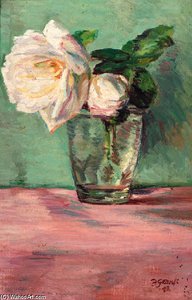
Duncan Grant, 1885 – 1978

100 nejznámějších obrazů autora Duncan Grant

Obrazem, díky němuž se Duncan Grant stal slavným, je Still Life, Asheham House. Vanessa Bell in a Red Headscarf (1917) a Composition with Two Women, A Boy with Basket and Three Men (one an Old Jew) (1910) následují v srdcích sběratelů i návštěvníků muzeí. Z 413 děl umělce Duncan Grant v našem katalogu je těchto 100 nejoblíbenějších, z nichž každé je uvedeno s datem vzniku, muzeem a unikátními rysy.

Seřazeno podle našeho skóre popularity, které kombinuje počet vyhledávání, návštěv a objednávek u každého díla. Aktualizováno říjen 2026.

Portrét Duncan Grant
Duncan Grant · 1885 – 1978
Narozen · zemřel
1885 – 1978, Rothiemurchus
Směr
Post-impressionism
Díla v našem katalogu
413
Nejslavnější
Still Life, Asheham House
Nejvíce děl v
Monk's House

Duncan Grant: deset mistrovských děl

Více děl mistrů Duncan Grant, od 11 do 100

Design for Lilypond Table (1913) od Duncan Grant
#59

Design for Lilypond Table

1913

Duncan Grant was the most individually varied of the Bloomsbury painters. In 1911 he emerged into sudden maturity. Around 1914 he evolved a personal blend of influences from…

Obrazy umělce Duncan Grant podle období

Témata, která Duncan Grant maloval nejčastěji

Čtyři témata, která se v těchto dílech objevují nejčastěji, spolu s nejlepším příkladem každého z nich.

Kde vidět obrazy autora Duncan Grant

8 muzea, v nichž je umístěno nejvíce obrazů z této stránky.

Muzea Město Díla autora Duncan Grant Obrazy z tohoto seznamu
Monk's HouseMonk's House 3 Composition with Two Women, A Boy with Basket and Three Men (one an Old Jew), Monk's House, Lewes, East Sussex, Monk's House Garden and St Peter's Church, Rodmell
Národní galerie Kanady, OttawaNárodní galerie Kanady Ottawa 2 View of the Backs, Cambridge, Market Day
Fenton House, LondonFenton House London 1 Woman Sewing (possibly Mary 'Molly' McCarthy [1882-1953])
Metropolitan Museum of Art, New YorkMetropolitan Museum of Art New York 1 The Coffee Pot
The Phillips Collection, Washington, D.C.The Phillips Collection Washington, D.C. 1 Landscape with Bridge
Fitzwilliam MuseumFitzwilliam Museum 1 Miss Mary Coss
Toledo Museum of Art, ToledoToledo Museum of Art Toledo 1 A Sussex Farm
Coleton FishacreColeton Fishacre 1 Mediterranean Scene with Olive Trees and Figures by the Sea

Duncan Grant, dekáda po dekádě: klíčové dílo každého období

  1. 1910s
  2. 1920s
  3. 1930s
  4. 1940s
  5. 1960s

Díla mistrovská umělce Duncan Grant: otázky a odpovědi

Kterým obrazem je Duncan Grant nejznámější?Zobrazit odpověď

Still Life, Asheham House. Následují Vanessa Bell in a Red Headscarf (1917) a Composition with Two Women, A Boy with Basket and Three Men (one an Old Jew) (1910).

Jakých deset nejvýznamnějších obrazů má Duncan Grant?Zobrazit odpověď

Still Life, Asheham House, Vanessa Bell in a Red Headscarf, Composition with Two Women, A Boy with Basket and Three Men (one an Old Jew), Monk's House, Lewes, East Sussex, Paul Roche Reclining, Still Life With Carrots, The French Window, Charleston, The Cat, Opussyquinusque, Boats, St Tropez a Bea Howe. Výše uvedené pořadí uvádí rok a muzeum každého díla.

Kolik děl namaloval/a Duncan Grant?Zobrazit odpověď

Náš katalog obsahuje 413 děl autora Duncan Grant z let 1910 až 1967.

V kterých muzeích mohu vidět díla mistrovská umělce Duncan Grant?Zobrazit odpověď

Většina z nich se nachází v Monk's House, Národní galerie Kanady (Ottawa) a Fenton House (London). V tabulce výše jsou jednotlivé muzea uvedeny postupně.

Kdy Duncan Grant namaloval svá díla?Zobrazit odpověď

V období 1910s: 7 z 100 děl na této stránce pochází z tohoto období, z nich Vanessa Bell in a Red Headscarf.

Jaká jsou první a poslední slavná díla umělce Duncan Grant?Zobrazit odpověď

Nejstarší dílo na této stránce pochází z Composition with Two Women, A Boy with Basket and Three Men (one an Old Jew) (1910), nejnovější z Artist's Study at Charleston (1967).

Jakými tématy se Duncan Grant nejčastěji zabýval/a?Zobrazit odpověď

Portrait (8), Reflection (7) a Nudes (6), z celkových 100 děl na této stránce.

K jakému uměleckému směru patří Duncan Grant?Zobrazit odpověď

Post-impressionism, jak dokazují obrazy na této stránce.

Která díla od Duncan Grant jsou vystavena v Monk's House?Zobrazit odpověď

Composition with Two Women, A Boy with Basket and Three Men (one an Old Jew), Monk's House, Lewes, East Sussex a Monk's House Garden and St Peter's Church, Rodmell patří mezi 3 děl na této stránce, která má v zastarání Monk's House.

Život umělce Duncan Grant

Early Life and the Seeds of Artistic Vision

Duncan James Corrowr Grant, born in 1885 amidst the rugged beauty of Rothiemurchus Forest District in Scotland, embarked on a life that would indelibly mark the landscape of British art. His early years were far from conventional, shaped by his father’s military service and extended periods spent in India and Burma. This exposure to diverse cultures, vibrant colors, and exotic landscapes subtly infused his artistic sensibilities, laying the groundwork for a style that would later embrace bold experimentation and decorative flair. Though destined for a military career by family expectation, Grant's innate talent for art quickly asserted itself. He received encouragement from those who recognized his potential, leading him to Westminster School of Art in 1902, where he began formal training under the guidance of Simon Bussy, a connection that would prove pivotal in introducing him to the burgeoning world of modern French painting. His education continued with studies in Italy and Paris, absorbing influences from masters like Masaccio and Matisse, experiences which ignited his passion for capturing light, color, and form.

Bloomsbury and the Forging of a Unique Style

The year 1905 proved transformative, marking Grant’s introduction to Vanessa Bell – an encounter that would blossom into a lifelong personal and artistic partnership, and immerse him within the heart of the Bloomsbury Group. This circle of intellectuals, writers, and artists—including figures like Virginia Woolf, Lytton Strachey, and John Maynard Keynes—rejected Victorian conventions in favor of open-mindedness, intellectual freedom, and aesthetic innovation. Grant became a central figure in this vibrant community, his art reflecting their shared values and challenging established norms. The influence of Post-Impressionism, particularly the work of Cézanne and Matisse, became increasingly apparent in his paintings, characterized by flattened perspectives, bold colors, and an emphasis on decorative patterns. This period also saw Grant’s involvement in Roger Fry's groundbreaking exhibitions, which introduced British audiences to the revolutionary art movements unfolding across Europe.

Omega Workshops and a Diversification of Artistic Expression

In 1913, alongside Vanessa Bell, Grant co-founded the Omega Workshops – an experimental venture that sought to break down the barriers between fine and applied arts. This collective aimed to create beautiful, functional objects for everyday life, encompassing furniture, textiles, pottery, and graphic design. The workshops provided a platform for artistic collaboration and experimentation, allowing Grant to explore his talents beyond painting. His designs were characterized by their vibrant colors, stylized forms, and rejection of traditional ornamentation. Though the Omega Workshops faced financial difficulties and ultimately closed in 1919, they left an enduring legacy, influencing British design and paving the way for a more integrated approach to art and craft. Simultaneously, Grant’s artistic practice continued to evolve, with landscapes around Charleston, Sussex – where he lived with Bell for many years – becoming frequent subjects of his work, imbued with a sense of intimacy and personal connection.

Notable Works and Artistic Development

Grant's oeuvre is remarkably diverse, encompassing portraits, landscapes, still lifes, and decorative designs. His paintings often feature bold color palettes and dynamic brushwork, reflecting the influence of Matisse and Cézanne. Key works include *Lucca*, a vibrant depiction of a Venetian scene, and *Tents*, which captures the energy and movement of a seaside gathering. His later work demonstrates a shift towards greater abstraction and a more intimate exploration of domestic interiors. He was particularly adept at capturing light and atmosphere, creating paintings that evoke a sense of mood and emotion. His designs for the Omega Workshops showcased his talent for pattern making and textile design, contributing significantly to the aesthetic of the era.

Legacy and Enduring Influence

Duncan Grant's contribution to 20th-century British art extends far beyond his individual paintings and designs. He remains a pivotal figure within the Bloomsbury Group, embodying their spirit of artistic freedom and intellectual curiosity. His work reflects a rejection of Victorian constraints and an embrace of modernism’s experimental energy. His influence can be seen in the vibrant colors, decorative patterns, and expressive brushwork that characterize much of British art and design from this period. Grant's versatility—his ability to seamlessly transition between painting, drawing, stage design, and textile design—demonstrates a remarkable artistic range. His paintings, such as *Lucca* and *Tents*, continue to captivate viewers with their vibrant colors and evocative atmosphere. His legacy is preserved in museums worldwide, including the Musée des Arts Décoratifs in Paris and numerous collections within the United Kingdom. He died in 1978, leaving behind a body of work that continues to inspire artists and art enthusiasts alike, solidifying his place as a significant figure in the history of modern art.
  • Notable works include: *Nude*, *Lucca*, and *Tents*.
  • He was a key member of the Bloomsbury Group alongside Vanessa Bell, Virginia Woolf, and Lytton Strachey.
  • Co-founded the Omega Workshops with Vanessa Bell in 1913.

Všechna díla od Duncan Grant: 413 →