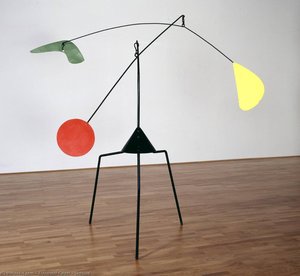
Alexander Calder, 1898 – 1976

Obrazy autora Alexander Calder: 98 nejznámějších děl seřazených podle popularity

Nejslavnějším dílem umělce Alexander Calder je obraz Untitled v muzeu Biennale Internazionale dell'Antiquariato di Firenze v Florencie. Díky Mobile (1932) a Romulus and Remus (1928) tvoří celek tří děl, která každý rozpozná. Náš katalog obsahuje 98 děl umělce Alexander Calder; níže je 98 děl, na která se svět dívá nejčastěji, každé s uvedeným rokem vzniku, muzeem, které jej uchovává, a důvodem jeho významu.

Seřazeno podle našeho skóre popularity, které kombinuje počet vyhledávání, návštěv a objednávek u každého díla. Aktualizováno říjen 2026.

Portrét Alexander Calder
Alexander Calder · 1898 – 1976
Narozen · zemřel
1898 – 1976, Aberdeen
Směr
Abstract expressionism
Díla v našem katalogu
98
Nejslavnější
Untitled
Nejvíce děl v
Biennale Internazionale dell'Antiquariato di Firenze

10 nejslavnějších obrazů autora Alexander Calder

Romulus and Remus (1928) od Alexander Calder
3

Romulus and Remus

Alexander Milne Calder's "Romulus and Remus," crafted in 1928, isn’t merely a sculpture; it’s a distilled essence of myth rendered in delicate wire. This piece, a testament to the artist’s pioneering approach to three-dimensional form, transcends its subject matter – the legendary founders of Rome – to become a profound meditation on beginnings, brotherhood, and the very act of creation itself. Calder, deeply influenced by Constructivism and early Modernism, sought…

Red Lily Pads (Nénuphars rouges) (1956) od Alexander Calder
5

Red Lily Pads (Nénuphars rouges)

1956 · Acrylic · Solomon R. Guggenheim Museum, New York

Alexander Milne Calder's "Red Lily Pads (Nénuphars rouges)" isn’t merely a depiction of a serene pond; it’s an invitation to lose oneself in the delicate balance of form, color, and movement. Created in 1956, this captivating sculpture – captured through a masterful photograph – embodies Calder's signature approach: embracing chance and celebrating the ephemeral beauty of nature within a distinctly modern aesthetic. The piece resides within a contemporary architectural space,…

Black Sun (1953) od Alexander Calder
9

Black Sun

1953 · Acrylic On Canvas · Tate Britain, Londýn

Alexander Milne Calder's "Black Sun," painted in 1953, isn’t merely a depiction of abstract forms; it’s an invitation to contemplate the interplay between chaos and order, darkness and light. Born in Aberdeen, Scotland, and later establishing himself as a pivotal figure in American sculpture alongside his son Alexander Stirling Calder and grandson Alexander ‘Sandy’ Calder, Milne Calder possessed a singular vision – one that sought to capture dynamic movement and…

Colored Spots (1970) od Alexander Calder
10

Colored Spots

1970 · Gouache

In Colored Spots, created in 1970, we encounter a moment of pure rhythmic energy. This gouache work moves away from the heavy permanence of sculpture to explore the lightness of color and shape. The composition is defined by a series of circles, varying in scale, that appear to drift across the surface. There is a specific tension in how these forms are placed; they do not sit static but seem…

Alexander Calder, obrazy od 11 do 98

Calder's Circus (1931) od Alexander Calder
#11

Calder's Circus

1931 · Whitney Museum of American Art

Alexander Milne Calder’s “Calder’s Circus,” created in 1931, is more than just a charming miniature scene; it’s a meticulously crafted meditation on movement, spectacle, and the enduring allure…

Červený Slunce (1968) od Alexander Calder
#12

Červený Slunce

1968 · Des Moines Art Center

Alexander Milne Calderův Červeně Slunceňák představuje vrchol minimalistické abstrakce a fascinující estetiku kinetického sochařství. Tento černobílý linoryt vytvořil roku 1968 a oslavuje ducha Pop Art umění při současném…

Lobster Trap and Fish Tail (1939) od Alexander Calder
#13

Lobster Trap and Fish Tail

1939 · MoMA - Museum of Modern Art

Alexander Milne Calder's "Lobster Trap and Fish Tail," created in 1939, isn’t merely a depiction of marine life; it’s an embodiment of movement captured within a strikingly reductive…

Violin (1960) od Alexander Calder
#14

Violin

1960

In the evocative realm of mid-century graphic expression, Alexander Milne Calder’s "Violin" emerges as a mesmerizing dialogue between form and abstraction. Created in 1960, this striking screenprint transcends…

Untitled (1948) od Alexander Calder
#20

Untitled

1948 · The Phillips Collection
A R od Alexander Calder
#40

A R

The artwork titled "A R" is a metal piece featuring the letter A. Created by the sculptor Alexander Milne Calder, this work is crafted from a silver material.…

Untitled (1968) od Alexander Calder
#42

Untitled

1968 · Buffalo AKG Art Museum
Crosshatch od Alexander Calder
#55

Crosshatch

A Striking Encounter: "Crosshatch" by Alexander Milne Calder This captivating painting, currently residing within the esteemed Smithsonian American Art Museum, presents a unique and visually arresting depiction of…

Fish at Sunrise (1974) od Alexander Calder
#56

Fish at Sunrise

1974

The artwork 'Fish at Sunrise' by Alexander Milne Calder is a mesmerizing piece that showcases the artist's unique style and technique. Created in 1974, this gouache painting measures…

Nemo od Alexander Calder
#95

Nemo

Biennale Internazionale dell'Antiquariato di Firenze

Nemo by Alexander Calder presents an intricate arrangement of geometric forms. The composition is built upon a series of overlapping circles and squares. Large circles act as central…

Red, Yelloe and Blue Gongs od Alexander Calder
#96

Red, Yelloe and Blue Gongs

Ca' Pesaro - Mezinárodní galerie moderního umění

Red, Yellow and Blue Gongs – Alexander Milne Calder Alexander Milne Calder’s “Red, Yellow and Blue Gongs” stands as a testament to the sculptor's pioneering exploration of kinetic…

Tache Bleu od Alexander Calder
#97

Tache Bleu

The painting Tache Bleu is a remarkable work of art created by the talented artist Alexander Milne Calder. This stunning piece is a tapestry, measuring 103 x 152…

Red Mobile od Alexander Calder
#98

Red Mobile

Galleria Civica di Arte Moderna e Contemporanea Torino

Between the 1920s and ‘30s, Calder regularly made long study and work trips to Paris, where he began to participate in the Abstraction-Création group. Finally, in 1932, at…

Obrazy umělce Alexander Calder podle období

Témata, která Alexander Calder maloval nejčastěji

Čtyři témata, která se v těchto dílech objevují nejčastěji, spolu s nejlepším příkladem každého z nich.

Kde vidět obrazy autora Alexander Calder

8 muzea, v nichž je umístěno nejvíce obrazů z této stránky.

Muzea Město Díla autora Alexander Calder Obrazy z tohoto seznamu
Biennale Internazionale dell'Antiquariato di Firenze, FlorencieBiennale Internazionale dell'Antiquariato di Firenze Florencie 2 Untitled, Nemo
Solomon R. Guggenheim Museum, New YorkSolomon R. Guggenheim Museum New York 2 Romulus and Remus, Red Lily Pads (Nénuphars rouges)
The Phillips Collection, Washington, D.C.The Phillips Collection Washington, D.C. 2 Untitled, Red Polygons
Tate Britain, LondýnTate Britain Londýn 1 Black Sun
Whitney Museum of American Art, New YorkWhitney Museum of American Art New York 1 Calder's Circus
Des Moines Art Center, Des MoinesDes Moines Art Center Des Moines 1 Červený Slunce
MoMA - Museum of Modern Art, New YorkMoMA - Museum of Modern Art New York 1 Lobster Trap and Fish Tail
Metropolitan Museum of Art, New YorkMetropolitan Museum of Art New York 1 "Calder #1" Textile (Model No. 1-145)

Nejslavnější obraz každého desetiletí umělce Alexander Calder

  1. 1920s
    Romulus and Remus (1928) od Alexander Calder
    Pořadí 3 / 98

    Romulus and Remus

    Věk 22 – 31 · Solomon R. Guggenheim Museum

    Alexander Milne Calder's "Romulus and Remus," crafted in 1928, isn’t merely a sculpture; it’s a distilled essence of myth rendered in delicate wire. This piece, a testament to…

  2. 1930s
    Mobile (1932) od Alexander Calder
    Pořadí 2 z 98

    Mobile

    Věk 32 – 41
  3. 1940s
    Untitled (1948) od Alexander Calder
    Pořadí 20 / 98

    Untitled

    Věk 42 – 51 · The Phillips Collection
  4. 1950s
    Red Lily Pads (Nénuphars rouges) (1956) od Alexander Calder
    Pořadí 5 z 98

    Red Lily Pads (Nénuphars rouges)

    Věk 52 – 61 · Solomon R. Guggenheim Museum

    Alexander Milne Calder's "Red Lily Pads (Nénuphars rouges)" isn’t merely a depiction of a serene pond; it’s an invitation to lose oneself in the delicate balance of form,…

  5. 1960s
  6. 1970s
    Colored Spots (1970) od Alexander Calder
    Pořadí 10 z 98

    Colored Spots

    Věk 72 – 78

    In Colored Spots, created in 1970, we encounter a moment of pure rhythmic energy. This gouache work moves away from the heavy permanence of sculpture to explore the…

Otázky k obrazům autora Alexander Calder

Který obraz je nejznámější dílem Alexander Calder?Zobrazit odpověď

Untitled, Biennale Internazionale dell'Antiquariato di Firenze, Florencie. Následují Mobile (1932) a Romulus and Remus (1928).

Jakých je 10 nejlepších obrazů autora Alexander Calder?Zobrazit odpověď

Untitled, Mobile, Romulus and Remus, Abstraction, Red Lily Pads (Nénuphars rouges), Orange and Black Composition, Puppet Man, Slanting Red Nose, Black Sun a Colored Spots. Výše uvedené pořadí uvádí rok a muzeum každého díla.

Kolik obrazů vytvořil/a Alexander Calder?Zobrazit odpověď

Náš katalog obsahuje 98 děl autora Alexander Calder z let 1928 až 1975.

Kde se nacházejí nejznámější obrazy umělce Alexander Calder?Zobrazit odpověď

Většina z nich se nachází v Biennale Internazionale dell'Antiquariato di Firenze (Florencie), Solomon R. Guggenheim Museum (New York) a The Phillips Collection (Washington, D.C.). V tabulce výše jsou jednotlivé muzea uvedeny postupně.

Kdy Alexander Calder namaloval svá nejznámější díla?Zobrazit odpověď

V období 1960s: 17 z 98 děl na této stránce pochází z tohoto období, z nich Abstraction.

Jaká jsou nejstarší a nejnovější slavná díla umělce Alexander Calder?Zobrazit odpověď

Nejstarší dílo na této stránce pochází z Romulus and Remus (1928), nejnovější z Pyramids (1975).

Co nejčastěji maloval/a Alexander Calder?Zobrazit odpověď

Sculpture (6), Geometric (5) a Geometric design (5), z celkových 98 děl na této stránce.

Jakou techniku používal(a) Alexander Calder nejčastěji?Zobrazit odpověď

Acrylic On Canvas: 4 z 98 děl na této stránce.

K kterému uměleckému směru patří Alexander Calder?Zobrazit odpověď

Abstract expressionism, jak dokazují obrazy na této stránce.

Která díla Alexander Calder mohu vidět v Biennale Internazionale dell'Antiquariato di Firenze?Zobrazit odpověď

Untitled a Nemo patří mezi 2 děl na této stránce, která má v zastarání Biennale Internazionale dell'Antiquariato di Firenze, Florencie.

O umělci Alexander Calder

Introduction to Alexander Milne Calder

Alexander Milne Calder (August 23, 1846 – June 14, 1923) was a Scottish-American sculptor renowned for architectural masterpieces like Philadelphia City Hall. His legacy extends beyond his own work, as both his son and grandson became prominent sculptors in the 20th century. Calder’s artistic journey began in Aberdeen, Scotland, where he honed his craft under the tutelage of his father, a stonemason—a profession that instilled in him a lifelong appreciation for material and form. He pursued formal education at the Royal Academy in Edinburgh, immersing himself in classical sculpture traditions before venturing into London's vibrant art scene.
  • Early Life and Education:
  • Born August 23, 1846, Aberdeen, Scotland
  • Attended Royal Academy in Edinburgh
  • Studied with John Rhind (sculptor)

Career Highlights

Calder’s professional life unfolded during a period of significant artistic innovation. He gained invaluable experience collaborating on monumental sculptures for Philadelphia City Hall—a project that demanded meticulous planning and execution over two decades. This ambitious undertaking cemented his reputation as a visionary architect and sculptor, pushing the boundaries of conventional design. Notably, he created William Penn, a colossal bronze statue commemorating Pennsylvania’s founding father, demonstrating his mastery of large-scale sculptural techniques. Furthermore, Calder's fascination with kinetic art culminated in the creation of *Indian Figure*, a striking sculpture that embodies movement and dynamism—a precursor to his groundbreaking mobiles.
  • Philadelphia City Hall:
  • Commissioned project requiring 250 pieces in marble and bronze
  • William Penn Statue:
  • Colossal bronze statue honoring Pennsylvania’s founder
  • *Indian Figure*:
  • Sculpture embodying movement and dynamism
  • Influence and Legacy

    Alexander Stirling Calder (1898–1976), Calder's son, carried forward his father’s artistic spirit, establishing himself as a celebrated sculptor in his own right. Similarly, Alexander “Sandy” Calder—Calder’s grandson—became a respected artist known for his innovative approach to sculpture and installation art. Calder’s influence resonated throughout the 20th century, shaping movements like Abstract Expressionism and inspiring generations of artists to explore new forms of artistic expression. His enduring contribution to modern art is commemorated in museums worldwide, ensuring that Calder's vision continues to captivate audiences and inspire creativity.
    • Alexander Stirling Calder:
    • Sculptor who followed in his father’s footsteps
  • Alexander “Sandy” Calder:
  • Artist known for innovative sculpture and installation art
  • ## Notable Achievements Calder's artistic achievements stand as testaments to his dedication and ingenuity. He achieved recognition as a sculptor by creating monumental sculptures like Philadelphia City Hall and William Penn, demonstrating exceptional skill in architectural design and bronze casting. His pioneering work with mobiles revolutionized the art world, introducing a new dimension of movement and balance into sculpture—a concept that profoundly impacted subsequent artistic explorations. Calder’s enduring legacy is celebrated through exhibitions and publications, solidifying his place as one of the most influential sculptors of his era.
    • Philadelphia City Hall:
    • Commissioned project showcasing architectural innovation
  • William Penn Statue:
  • Monumental bronze statue commemorating Pennsylvania’s founding father
  • Mobile Art:
  • Revolutionary contribution to sculpture, introducing movement and balance
  • ## Conclusion Alexander Milne Calder's artistic journey spanned decades of experimentation and innovation—leaving an indelible mark on the history of art. From his formative years in Scotland to his groundbreaking sculptures and the influence he exerted on subsequent generations of artists, Calder’s legacy continues to inspire creativity and appreciation for sculptural artistry. His enduring contribution ensures that Alexander Milne Calder remains a pivotal figure in the artistic landscape of the 20th century.

    Všechna díla od Alexander Calder: 98 →