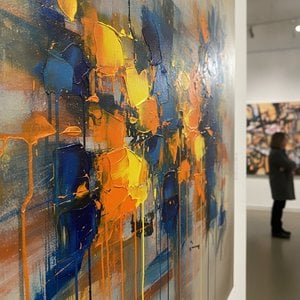
Theodoros Stamos: A Pioneer of Color Field Painting
Theodoros Stamos (1922-1997) stands as a cornerstone figure in the evolution of American Abstract Expressionism, embodying its restless spirit of experimentation and its profound quest for new visual languages. Born on December 31, 1922, in New York City to Greek immigrant parents – his mother from Sparta, his father from Lefkada – Stamos’ artistic trajectory was shaped by both his heritage and the vibrant energy of a burgeoning American art scene.
His early life was marked by exposure to European avant-garde artists like Arshile Gorky and Fernand Léger through connections made during these formative years, seeding his artistic imagination with possibilities beyond the traditional. A scholarship to the American Artists School in 1936 proved invaluable, where he initially focused on sculpture before gravitating towards painting – a medium that would ultimately become his defining voice.
Early Influences and Artistic Formation
Stamos’ formative years were profoundly impacted by Joseph Solman, a member of “The Ten,” who championed Stamos's artistic vision. Solman encouraged him to explore the world of art beyond New York City, introducing him to Alfred Stieglitz’s influential An American Place Gallery and fostering connections with artists like Arthur Dove and Georgia O’Keeffe – figures whose aesthetic sensibilities profoundly influenced his early work.
His exposure to European avant-garde artists like Arshile Gorky and Fernand Léger through connections made during these formative years, seeding his artistic imagination with possibilities beyond the traditional. A scholarship to the American Artists School in 1936 proved invaluable, where he initially focused on sculpture before gravitating towards painting – a medium that would ultimately become his defining voice.
From Biomorphic Beginnings to Color Field Exploration
Stamos’ artistic journey wasn't a sudden leap into abstraction but rather a gradual unfolding. His earliest works, emerging in the 1940s, were characterized by muted earth tones and biomorphic imagery – forms suggestive of geological shapes or organic life. These paintings reflected an early fascination with natural history and a desire to tap into primal visual languages.
Around 1950, Stamos embarked on *The Tea House Series*, a captivating body of work inspired by East Asian aesthetics. These paintings showcased softly defined geometric forms overlaid with dark calligraphic brushwork, creating an atmosphere of serene contemplation. This series revealed a willingness to embrace minimalism and explore the expressive potential of line and space.
Color Field Painting and Legacy
However, it was in the 1950s onwards that Stamos truly found his signature style: Color Field painting. Increasingly focused on reductive compositions, he employed layers of thin pigment to create depth within broad expanses of color. These weren’t simply paintings *of* color; they were immersive experiences *in* color, inviting viewers to lose themselves in the subtle nuances and emotional resonance of hue and tone.
The culmination of this exploration arrived with *Infinity Field Series*, beginning in 1971. Characterized by vast areas of color delineated by slim lines or shapes, these paintings evoked a meditative and expansive feeling, suggesting limitless space and boundless possibility. Within this series, the *Lefkada* sub-series held particular significance, drawing direct inspiration from his ancestral homeland and reflecting a deep connection to place and memory.
Stamos’ work contributed significantly to the evolution of abstract art in America, demonstrating a continuous refinement of form and a deepening exploration of color's expressive power. He left an enduring impact on subsequent generations of artists through his dedicated teaching career at institutions like the Art Students League. His paintings are not merely objects to be viewed; they are invitations to experience a world beyond representation – testaments to the power of abstraction to evoke profound human experiences.
Otázky a odpovědi
Jak je kariéra umělce Theodoros Stamos rozdělena do období?
Kariéra umělce Theodoros Stamos se na stránce Kronika odvíjí období po období: jako horizontální časová osa děl uspořádaných do kapitol podle tvůrčích etap.
Jaké barvy používal/a Theodoros Stamos nejčastěji?
Použití barev u děl umělce Theodoros Stamos uvedených na tento web lze prozkoumat na stránce Genom palety umělce.
V jakém historickém období působil/a Theodoros Stamos?
Theodoros Stamos působil v období Modernismus. Toto období historicky vymezuje uměleckou činnost tohoto autora.