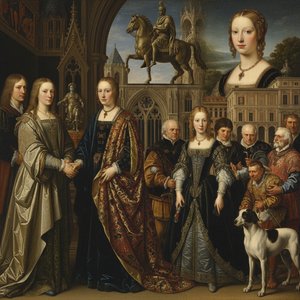
The Shadow of the Throne: Sukjong, Patron and Politician
Sukjong (1661-1720), a name synonymous with both power and political intrigue within the Joseon Dynasty, was far more than just a king. Born Yi Sun in Seoul, he ascended to the throne at the tender age of thirteen, inheriting a kingdom teetering on the brink of internal conflict and external threats. His reign, spanning nearly half a century, witnessed a complex dance of shifting political factions – the Namin (Southerners), Seoin (Westerners), Soron (New Learning), and Noron (Old Learning) – each vying for influence at the heart of the Joseon court. This constant maneuvering shaped not only his policies but also profoundly impacted the artistic landscape of his era, leaving behind a legacy interwoven with both grand ambition and subtle restraint.
A King Forged in Political Fire
Sukjong’s early life was marked by the tumultuous events surrounding the death of his father, King Hyeonjong. The succession crisis that followed saw him crowned as Crown Prince Myeongbo, a position fraught with political maneuvering and suspicion. His subsequent elevation to the throne at 13 ushered in an era defined by relentless factional struggles. Unlike many monarchs who sought stability through centralized control, Sukjong skillfully exploited these divisions, repeatedly shifting allegiances to maintain his authority. This wasn’t born of malice, but rather a pragmatic understanding that absolute power was fragile and easily challenged within the intricate web of Joseon court politics. The “Hwanguk,” or regime changes, became a recurring feature of his reign – a calculated dismantling of one faction followed by the rise of another, often with dramatic consequences for those involved. The Gyeongsin Hwanguk (1680), where Heo Jeok and Yun Hyu were executed after being accused of treason by the Western faction, stands as a stark example of this ruthless approach to maintaining control. Similarly, the Gisa Hwanguk (1694) saw the Southern faction purged in retaliation for attempting to overthrow Queen Min, demonstrating Sukjong’s willingness to employ extreme measures when his position was threatened.
The Art of Diplomacy and Patronage
Despite the turbulent political climate, Sukjong's reign wasn’t solely defined by conflict. He possessed a keen intellect and a surprising appreciation for the arts, transforming himself into a significant patron of Korean painting and calligraphy. His court became a hub for artistic innovation, fostering a style that blended traditional Joseon aesthetics with influences from the West – particularly in landscape painting. The most celebrated example of this patronage is undoubtedly “Gyeseongsa” (Pictures of Gyeseong), a monumental scroll painting commissioned around 1709 by Sukjong himself. This work, now housed at the National Palace Museum of Korea, exemplifies the king’s aesthetic sensibilities: it combines meticulous detail with a sense of serene grandeur, reflecting his desire to project an image of strength and stability while simultaneously embracing artistic refinement. The painting's intricate depiction of Gyeseong (the capital city) showcases not only technical skill but also Sukjong’s deep connection to his kingdom and its history.
Beyond the Court: A Poet at Heart
Sukjong was more than just a ruler; he possessed a sensitive artistic soul, evident in his own poetry. The “Poem Written by King Sukjong (Gyeseongsa)” – often referred to as “The Poem of Gyeseong” – offers a glimpse into the king’s contemplative nature and his deep appreciation for beauty and tranquility. This short poem, executed in meticulous calligraphy, reflects themes of longing for home, reflection on the passage of time, and a yearning for connection with nature. It reveals a side of Sukjong rarely seen in official chronicles—a man who found solace and inspiration in the simple pleasures of life. The poem’s inclusion within “Gyeseongsa” underscores its significance as a testament to the king's artistic sensibilities and his desire to elevate the status of poetry within the court.
Legacy and Historical Significance
Sukjong’s reign, though marked by political instability and ruthless power plays, ultimately contributed to a period of relative prosperity and cultural flourishing in Joseon Korea. His skillful navigation of the complex factional dynamics ensured the dynasty's survival during a critical juncture in its history. While his methods were often controversial, Sukjong left an indelible mark on Korean art and culture through his patronage and his own artistic endeavors. He is remembered as a king who skillfully wielded power, balancing the demands of statecraft with a genuine appreciation for beauty and intellectual pursuits – a complex and fascinating figure whose legacy continues to be debated and reinterpreted by historians today. His story serves as a potent reminder that even within the confines of absolute monarchy, individual personalities and artistic sensibilities could profoundly shape the course of history.