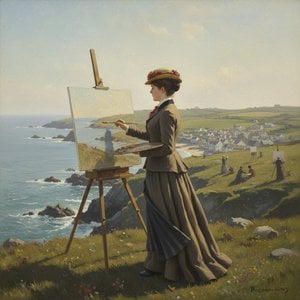
Thomas Luny: A Master of Maritime Visions
Born in Cornwall, England, in 1759, Thomas Luny’s artistic journey began amidst the rugged beauty of the British coastline. His early life, marked by a move to London at the age of eleven, proved pivotal, setting him on a path toward becoming one of the most celebrated marine artists of his era. Luny's formative years were spent as an apprentice under Francis Holman, a respected figure in the London art scene and a master of capturing the drama and power of the sea. Holman’s influence was profound, shaping Luny’s technique and instilling within him a deep appreciation for depicting the ocean’s ever-changing moods.
Luny's artistic development unfolded through a series of significant moves and experiences. Initially apprenticed to Holman until 1780, he embarked on a brief sojourn to France in 1777, an expedition that likely exposed him to continental artistic styles and broadened his perspective. Returning to London, he continued to hone his skills, exhibiting at the Society of Artists in 1778 with “A distant view of the island of Madeira and Porto Santo,” a painting indicative of his burgeoning talent for capturing atmospheric landscapes and maritime scenes. He later relocated to Leadenhall Street in 1783, establishing himself within a thriving artistic community centered around the British East India Company, a connection that provided him with lucrative commissions and opportunities to document voyages and exotic locales.
The late 18th and early 19th centuries witnessed Luny’s increasing prominence as an artist. He consistently exhibited at the Royal Academy between 1780 and 1802, producing a remarkable body of work that showcased his mastery of watercolor and gouache techniques. His paintings frequently depicted scenes from naval engagements, coastal landscapes, and portraits of prominent figures, reflecting both the practical needs of the East India Company and his own artistic interests. Notably, Luny’s travels – documented in works like depictions of Naples, Gibraltar, and Charleston – provided him with invaluable firsthand experience and inspiration for his compositions, imbuing them with a remarkable sense of realism and authenticity.
The Influence of Holman and the Rise of Marine Art
Thomas Holman's mentorship was undeniably crucial to Luny’s artistic trajectory. Holman’s established reputation and studio provided Luny with an invaluable foundation in marine painting, teaching him not only technical skills but also a deep understanding of how to capture the essence of the sea – its power, its beauty, and its inherent drama. Holman's emphasis on dramatic lighting and dynamic compositions clearly resonated with Luny, shaping his own artistic style and approach.
Luny’s work emerged during a period when marine art was gaining increasing recognition as a legitimate genre within the British art world. The rise of naval power and exploration fueled a demand for accurate and evocative depictions of maritime scenes, creating opportunities for artists like Luny to establish themselves. His paintings were frequently commissioned by the East India Company, which sought to document its voyages and promote its interests through visually compelling representations of distant lands and encounters with foreign cultures.
A Portfolio of Notable Works
Luny’s artistic output spanned a diverse range of subjects, reflecting both his professional obligations and his personal passions. His depictions of naval battles, such as those illustrating the Battle of the Nile (though details remain somewhat uncertain) and the Bombardment of Algiers in 1816, are particularly noteworthy for their dramatic intensity and attention to detail. These works demonstrate Luny’s ability to capture the chaos and heroism of warfare at sea.
Beyond naval scenes, Luny produced a wealth of captivating coastal landscapes, showcasing his skill in rendering the textures of rock, sand, and water. His paintings of Cornwall, Devon, and other regions of England are characterized by their atmospheric quality and evocative sense of place. He also created numerous portraits, often commissioned by members of the East India Company, capturing the likenesses of prominent officials and officers with a keen eye for detail and character.
Later Years and Legacy
In 1807, Luny relocated to Teignmouth in Devon, seeking a quieter life and continuing his artistic practice. Despite facing challenges due to arthritis, he remained productive, producing numerous works that celebrated the local coastline and its maritime heritage. Thomas Luny died in Teignmouth on September 30th, 1837, leaving behind a substantial body of work that continues to be admired for its realism, dramatic flair, and evocative portrayal of the sea.
Today, Luny’s paintings are held in prestigious collections around the world, including the National Maritime Museum at Greenwich and the Royal Albert Memorial Museum in Exeter. His legacy as one of the most important marine artists of his era is firmly established, and his works continue to captivate viewers with their timeless beauty and dramatic power.