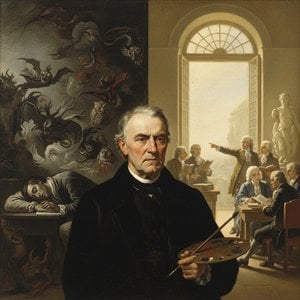
Sir Thomas Little Heath: Bridging Antiquity and Modern Mathematics
Sir Thomas Little Heath (1861-1940) stands as a pivotal figure in the intersection of classical scholarship, mathematical history, and British intellectual life. More than simply a translator, he was a meticulous scholar who breathed new life into the ancient world’s mathematical achievements, making them accessible to a wider audience and profoundly shaping our understanding of Greek thought. His work wasn't merely academic; it reflected a deep appreciation for the elegance and ingenuity of these early mathematicians, a sentiment that continues to resonate within the field today.
Born in Barnetby-le-Wold, Lincolnshire, into a farming family, Heath’s intellectual curiosity was nurtured from an early age. His father, a man with a passion for classical learning himself, instilled in him a love of both languages and mathematics – a rare combination that would define his career. Educated at Caistor Grammar School and Clifton College, he excelled academically, demonstrating a particular aptitude for the rigorous demands of Trinity College, Cambridge, where he earned degrees in Classics and Mathematics, securing a coveted place amongst the “wranglers” – those who achieved top marks in the mathematical tripos.
The Translator’s Art: Unlocking Ancient Wisdom
Heath's most enduring legacy lies in his masterful translations of key works from ancient Greek mathematics. He didn’t simply render words; he painstakingly reconstructed the logic and intent behind Euclid’s *Elements*, Apollonius of Perga’s treatise on conic sections, Aristarchus of Samos’ astronomical observations, and Archimedes’ groundbreaking explorations of mechanics and hydrostatics. These weren't mere copies; they were scholarly editions that incorporated Heath’s own commentary, clarifying complex concepts and providing invaluable historical context. His 1908 edition of Euclid’s *Elements*, for instance, remains the standard English translation to this day, a testament to its accuracy and clarity.
Crucially, Heath recognized the importance of understanding the mathematical landscape *before* these figures wrote their works. He meticulously researched earlier Greek texts, revealing that Archimedes' celebrated “method” – his approach to solving geometric problems – had been developed centuries before he is often credited with inventing it. This meticulous historical reconstruction significantly altered our perception of Archimedes’ intellectual lineage and his place in the history of mathematics.
Beyond Translation: A Historian of Mathematical Thought
Heath's contributions extended far beyond translation. He authored *A History of Greek Mathematics*, a comprehensive survey that illuminated the evolution of mathematical ideas from the pre-Socratic philosophers to the Hellenistic period. This work demonstrated his deep understanding of not just the mathematics itself, but also the cultural and philosophical context in which it was developed. His meticulous research and insightful analysis established him as a leading authority on the subject.
His 1920 edition of Book I of Euclid’s *Elements*, written in Greek, further showcased his commitment to preserving and understanding the original sources. This ambitious project aimed to encourage a deeper engagement with the foundational text of Western mathematics, providing scholars with direct access to Euclid's own words.
A Civil Servant and Mountaineer: A Multifaceted Life
While renowned for his scholarly pursuits, Heath led a remarkably diverse life. He served as a civil servant for much of his career, rising through the ranks of the Treasury before becoming Joint Permanent Secretary in 1913. This role demanded meticulous attention to detail and an unwavering commitment to public service – qualities that undoubtedly informed his rigorous approach to scholarship. Interestingly, Heath was also an avid mountaineer, finding solace and challenge in the rugged landscapes of the Peak District.
Sir Thomas Little Heath’s life exemplifies a rare combination of intellectual rigor, historical sensitivity, and practical engagement with the world. His translations and scholarly works have profoundly shaped our understanding of ancient Greek mathematics, ensuring that the legacy of these brilliant thinkers continues to inspire mathematicians and historians alike. His dedication to preserving and interpreting their work stands as a powerful reminder of the enduring value of classical scholarship.