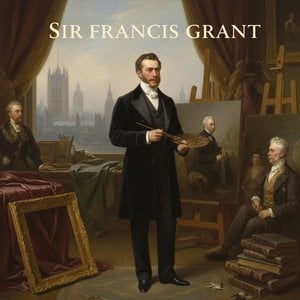
Sir Francis Grant PRA (1803 - 1878): Celebrated Scottish Portrait & Sporting Painter and Royal Academy President
Sir Francis Grant, a name synonymous with refined portraiture and dedicated service to the British art establishment, emerged as one of the most sought-after artists of his era. Born in Edinburgh, Scotland, on January 18, 1803, into a landed family—the fourth son of Francis Grant, Laird of Kilgraston near Bridge of Earn—his early life foreshadowed a path diverging from conventional expectations. While initially inclined towards law, the irresistible allure of artistic expression swiftly superseded legal ambitions. Remarkably self-taught, Grant benefited from brief instruction under Alexander Nasmyth in Edinburgh, laying an initial foundation for his burgeoning talent. This formative period instilled within him a profound appreciation for observation and meticulous detail—qualities that would characterize his entire oeuvre.Early Artistic Explorations: Sporting Scenes and Initial Recognition
Grant’s artistic journey commenced with captivating depictions of rural life – sporting scenes that captured the dynamism and spirit of fox-hunting and other pursuits popular amongst the British aristocracy. His debut painting, *Melton Breakfast* (1834), immediately garnered acclaim for its masterful composition and nuanced portrayal of light and texture. This artwork showcased Grant’s burgeoning skill in conveying atmosphere and capturing the essence of his subjects—a hallmark that would persist throughout his career. However, it was through his marriage to Amelia Farquharson that Grant gained access to a privileged social circle centered around Melton Mowbray’s hunting society. Under the tutelage of John Ferneley, a celebrated equestrian artist, he honed his technique specifically for portraying horses and hounds—subjects that would initially define his artistic reputation and solidify his position as a prominent figure in Victorian art.The Rise of Portraiture: Capturing Character and Status
Grant’s artistic evolution wasn't merely a stylistic shift; it represented a deliberate redirection towards portraiture – an endeavor where he excelled at capturing not just physical likeness but also the inner character and social standing of his sitters. This skill proved invaluable in an era deeply invested in establishing prestige and projecting image—a preoccupation that resonated powerfully with Grant’s sensibilities. Commissions poured in from influential members of British society, including Queen Victoria herself – a moment that elevated Grant to the pinnacle of artistic achievement and cemented his legacy as one of the foremost portraitists of his time. His portrayal of Lady Glenlyon (1842) stands as a watershed illustration, demonstrating Grant’s ability to infuse his canvases with psychological depth and conveying an impression of grace and refinement. He skillfully blended Neoclassical elegance with subtle Romantic influences—a stylistic fusion that distinguished him from many contemporaries.Royal Patronage and Artistic Influence
Grant's unwavering dedication to artistic excellence was recognized by the Royal Academy, where he served as president for nearly four decades – a testament to his respected standing within the art world and his profound contribution to British cultural heritage. During his presidency, Grant championed innovative approaches to artistic presentation—introducing the groundbreaking practice of major loan exhibitions that expanded the Academy’s reach and fostering greater engagement with the public. He wasn't merely upholding tradition; he actively sought to broaden horizons and elevate standards within the realm of art. Furthermore, Grant’s influence extended beyond his own work, inspiring artists such as Martin Archer Shee and Solomon Alexander Hart—demonstrating the ripple effect of artistic vision across generations.A Legacy Enduring Through Art: Notable Works and Lasting Significance
Grant's artistic output spanned a remarkable breadth of subjects – encompassing equestrian portraits of Queen Victoria alongside depictions of aristocratic families and political figures. His paintings are housed in collections worldwide, including the Walker Art Gallery in Liverpool—a tangible reminder of his enduring legacy as a master artist. Through his canvases, Grant offers an unparalleled glimpse into Victorian society—capturing not only visual splendor but also the social dynamics and intellectual currents that shaped the era. He remains a pivotal figure in British art history – a skilled portraitist, a visionary leader, and a chronicler of his time. His work continues to fascinate audiences today, prompting contemplation on beauty, character, and the enduring power of artistic expression. Grant’s meticulous attention to detail and masterful use of light—traits evident throughout his oeuvre—solidify his place as one of Scotland's most celebrated artists.Otázky a odpovědi
Kolik děl umělce Francis Grant je možné si prohlédnout?
Na stránce Všechná umělecká díla si můžete prohlédnout 269 uměleckých děl děl autora Francis Grant.
Existuje kompletní seznam děl umělce Francis Grant?
Veškerá díla umělce Francis Grant na tato webová stránka si můžete prohlédnout na jeho stránce Všechná umělecká díla.
Kde a v jakém roce se narodil/a Francis Grant?
Francis Grant se narodil(a) v roce 1803 ve městě Perth and Kinross.