Richard Victor Julien (1864 – 1937): A Breton Impressionist’s Vision of Bohemian Life
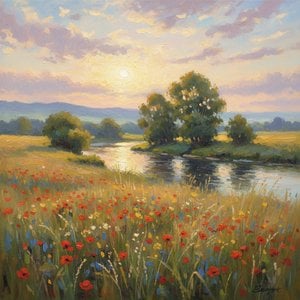
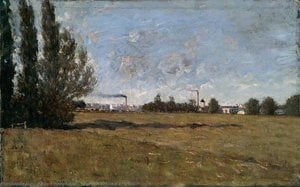
Richard Victor Julien, born in Nantes, Brittany, was enveloped in an artistic environment from his earliest years—a legacy profoundly shaped by his father, Eugène Julien, a respected watercolorist. This formative influence instilled within young Richard an enduring appreciation for capturing fleeting moments of beauty—a passion that would become the cornerstone of his entire artistic vocation. Despite confronting considerable adversity during his youth – tragically losing his parents at a young age – Julien persevered with unwavering determination, fueled by an innate desire to honor their memory and pursue his own creative aspirations. His artistic journey commenced formally after enrolling in the École Supérieure des Beaux-Arts in Paris, where he honed his skills under the tutelage of Gustave Moreau—a luminary of the Symbolist movement whose teachings indelibly imprinted Julien’s aesthetic sensibilities. Moreau championed exploration of mythological themes and dreamlike imagery—elements that would subsequently permeate Julien's canvases as recurring motifs. However, Julien swiftly distanced himself from the restrictive dogma of Symbolism, gravitating toward Impressionism’s liberating embrace of spontaneity and direct observation of nature—a decisive choice solidifying his artistic identity as a Breton Impressionist specializing in landscapes imbued with vibrant color palettes and atmospheric effects. Julien's oeuvre predominantly centered on depictions of Brittany’s coastline – particularly around Le Croisic and Piriac – meticulously capturing the rugged grandeur of granite cliffs, tumultuous waves, and windswept beaches. His technique involved layering thin washes of pigment to achieve luminous textures and subtle gradations of color—a masterful emulation of the shifting moods conveyed by the Breton seascape. Employing plein air painting methods with unwavering dedication, Julien immersed himself in the immediacy of the natural world—a practice championed by Impressionist masters like Claude Monet and Pierre-Auguste Renoir. This commitment to capturing the essence of nature manifested in canvases brimming with radiant hues and evocative atmospheric conditions. Among his most celebrated achievements is “Lunch in the Studio,” completed in 1864 – a monumental canvas portraying a bohemian gathering of artists and intellectuals at a table laden with provisions—a testament to Julien’s fascination with representing human interaction within an artistic milieu. Critics lauded Julien's bold brushwork and masterful manipulation of color—particularly his ability to convey warmth and intimacy—capturing the spirited exchange of ideas characteristic of Parisian studios during the Belle Époque. This artwork stands as a poignant emblem of Julien’s artistic vision—a celebration of creativity and intellectual discourse interwoven within a captivating visual narrative. Furthermore, Julien's artistic output extended beyond landscape panoramas; he produced numerous portraits capturing the faces of prominent figures from Breton society and intellectual circles – demonstrating his meticulous attention to detail—capturing subtle expressions and nuances of character with remarkable precision. His work reflects a broader engagement with Symbolist aesthetics, incorporating mythological references and dreamlike symbolism into his artistic vocabulary. Julien’s enduring legacy as a Breton Impressionist continues to inspire artists today—a testament to his unwavering devotion to translating beauty and emotion into masterful artistic execution.- Notable Works: “La côte entre Le Croisic et Piriac,” “Lunch in the Studio,” Numerous Portraits
- Influences: Gustave Moreau (Symbolism), Claude Monet, Pierre-Auguste Renoir (Impressionism)
- Technique: Plein Air Painting, Layered Washes of Pigment, Luminosity and Atmospheric Effects
- Themes: Breton Landscape, Bohemian Life, Mythological Imagery
- Historical Significance: Represents a pivotal moment in Impressionist art history; Celebrates Breton cultural heritage.