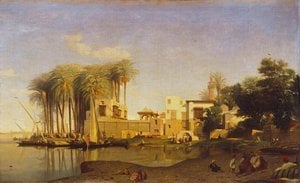
Antoine-George-Prosper Marilhat: A Painter of the Orient’s Echoes
Prosper Marilhat (1811-1847), a name perhaps less familiar than many of his contemporaries, remains a captivating figure in 19th-century French art. He was an Orientalist painter, deeply immersed in the burgeoning fascination with the Middle East that swept across Europe during this era. His legacy isn’t one of grand, monumental works, but rather a collection of intensely evocative scenes—ruined mosques bathed in golden light, bustling marketplaces teeming with life, and solitary figures contemplating the vastness of desert landscapes—that capture the spirit and romance of Egypt and Syria. Marilhat's art is not merely a record of places; it’s an emotional response to them, imbued with a sense of longing, mystery, and a profound appreciation for the beauty of the unfamiliar.
Early Life and Artistic Beginnings
Born in Vertaizon, a small village in the Puy-de-Dôme region of France, Marilhat’s artistic journey began not with grand ambitions but with humble roots. His parents, involved in the cutlery business of Thiers, envisioned a practical future for their son—a life far removed from the world of paint and canvas. However, the Baron de Barante, a prominent figure who recognized Marilhat's innate talent and passion, intervened, advocating for his artistic pursuits. This pivotal moment propelled young Prosper to Paris in 1829, where he enrolled under the tutelage of Camille Roqueplan, a respected academic painter. His debut at the Paris Salon in 1831 with *Site d’Auvergne* marked the beginning of his career, showcasing an early talent for capturing the rugged beauty of the French countryside. This initial success, however, was merely a prelude to the transformative experiences that awaited him in Egypt.
The Egyptian Years: Sketches as Foundations
In May 1831, Marilhat’s life took an extraordinary turn when he joined Charles von Hügel on an expedition to Egypt. While the journey itself was brief, it proved to be a watershed moment. He accompanied Hügel only as far as Alexandria, but during the subsequent months—from October 1831 to May 1833—he embarked on a prolific sketching campaign, producing ten albums filled with detailed drawings that would later serve as the basis for his most celebrated paintings. These sketches weren’t simply preparatory studies; they were deeply felt impressions of the landscape, architecture, and people he encountered. The meticulous detail evident in these works reveals Marilhat's keen observational skills and his ability to translate fleeting moments into enduring images. Crucially, it was during this period that he developed a distinctive style—a blend of realism and romanticism, characterized by dramatic lighting, vibrant colors, and an emphasis on atmosphere.
A Palette of Ruin and Romance: Major Works and Influences
Marilhat’s artistic output after 1838 is marked by a shift towards larger-scale paintings, often inspired by his Egyptian experiences. *Ruines de la mosquée El-Hakem au Caire* (1840), for example, became renowned for its ability to capture both the monumental scale of the ruined structure and the evocative atmosphere of decay—a testament to the passage of time and the grandeur of a lost civilization. Theophile Gautier, a prominent literary figure of the era, famously described *Place de l’Esbekieh au Caire* as inducing “sickness at heart,” expressing a yearning for the Orient he had not yet explored. This reaction speaks volumes about Marilhat's ability to transport viewers to distant lands and evoke powerful emotions through his art. His work also demonstrates an influence from earlier Romantic painters, particularly in its emphasis on dramatic landscapes and the sublime—a fascination with nature’s power and beauty. Furthermore, he was influenced by the works of Eugène Delacroix, evident in his use of color and dynamic compositions.
Legacy and Lasting Impact
Prosper Marilhat's life was tragically cut short at the age of 36 due to illness—likely syphilis—and he spent his final years in a Parisian asylum. Despite his untimely death, his artistic legacy endures. His paintings, particularly those depicting Egyptian scenes, continue to captivate viewers with their evocative beauty and atmospheric depth. Works like *Arabes syriens en voyage* (1844), now housed at the Musée Condé in Chantilly, remain prized examples of Orientalist art. Marilhat’s contribution lies not just in his individual paintings but also in his role as a pioneer—one of the first French artists to fully embrace and authentically portray the exotic allure of the Middle East, shaping perceptions and fueling the European fascination with this ancient and mysterious region. His meticulous sketches and evocative paintings offer a valuable window into a bygone era, reminding us of the power of art to transcend time and place.
Redakce WahooArt.com
Kvíz o umění
U každé otázky je pouze jedna správná odpověď.
Otázka 1:
Prosper Marilhat is primarily known for his paintings depicting which region?
Otázka 2:
During his time in Egypt, Prosper Marilhat spent approximately how long sketching and creating albums of work?
Otázka 3:
Which Parisian salon did Prosper Marilhat exhibit his works in from 1837 to 1841?
Otázka 4:
What inspired Theophile Gautier to express a strong emotional response to one of Marilhat's paintings?
Otázka 5:
What was a significant factor contributing to Prosper Marilhat's early artistic encouragement?
Explore the mesmerizing world of Orientalist painting. Discover the history, key masters like Gérôme, and the complex cultural legacy behind the captivating allure of the East in art history through our expert-led deep dive into this iconic 19th-century movement.