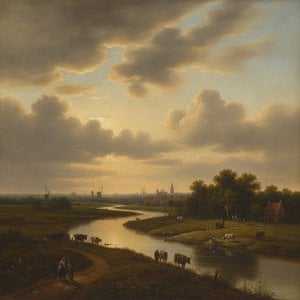
A Refined Vision of the Dutch Golden Age: Pieter van der Werff
Pieter van der Werff, a name perhaps less immediately recognized than those of Rembrandt or Vermeer, nevertheless occupies a significant and fascinating niche within the pantheon of Dutch Golden Age painters. Born in The Hague in 1665 and passing away in Rotterdam in 1722, his career unfolded during a period of immense artistic flourishing in the Netherlands, yet he carved out a distinctive style characterized by elegance, meticulous detail, and an early embrace of innovative pigments. His life was deeply intertwined with that of his older brother, Adriaen van der Werff, who served as both mentor and foundational influence, shaping Pieter’s trajectory from its earliest stages. While Adriaen achieved considerable renown – even securing a prestigious position at the court of the Elector Palatine – Pieter established himself primarily in Rotterdam, becoming the favored portraitist of the city's affluent citizenry and leaving behind a legacy that offers invaluable insights into the social fabric and aesthetic sensibilities of his time.Formative Years and Artistic Development
The artistic education received by Pieter van der Werff was profoundly shaped by familial ties. His older brother, Adriaen, already an established painter, provided not only technical instruction but also a crucial introduction to the prevailing artistic currents of the day. This early tutelage instilled in Pieter a commitment to precision and refinement, qualities that would become hallmarks of his mature style. He quickly distinguished himself through a remarkable ability to capture likenesses with both accuracy and psychological depth. His portraits weren’t merely representations of physical appearance; they were carefully constructed portrayals of status, personality, and social standing. The Baroque aesthetic, dominant during this era, profoundly influenced his work, manifesting in dramatic compositions, rich color palettes, and a heightened sense of emotional intensity. However, Pieter tempered the grandiosity often associated with Baroque art with a distinctly Dutch sensibility – a focus on realism, intimate detail, and a subtle psychological nuance that set him apart from many of his contemporaries. He diligently studied under Adriaen’s guidance, absorbing not only artistic techniques but also an understanding of how to convey complex emotions through visual imagery.Portraits, Mythological Scenes, and a Pioneering Spirit
Van der Werff's artistic output was diverse, encompassing portraiture, mythological scenes, historical narratives, and occasional forays into genre painting. However, it is in the realm of portraiture that he truly excelled. He immortalized prominent figures such as Paulus Verschuur, a Burgomaster of Rotterdam, and even Peter the Great of Russia, demonstrating his ability to convey power and authority through masterful brushwork and astute observation. These portraits aren’t simply historical records; they are compelling studies in character, revealing the inner lives of those who commissioned them. He possessed an exceptional talent for capturing subtle expressions and conveying psychological depth—a skill that elevated his portraits beyond mere likenesses into profound explorations of human emotion. Beyond portraiture, Van der Werff engaged with classical mythology and history, creating works like “Expulsion of Adam and Eve” and “Granida and Diafilo,” which showcase his skill in depicting dramatic narratives and complex compositions. He skillfully employed Baroque techniques to dramatize these stories, utilizing chiaroscuro—the interplay of light and shadow—to heighten emotional impact and create a sense of grandeur. Furthermore, Van der Werff ventured into genre painting, capturing scenes from everyday life with remarkable sensitivity and detail, demonstrating his versatility as an artist.A Master of Color: The Use of Prussian Blue
Perhaps one of Pieter van der Werff’s most significant contributions was his pioneering use of Prussian blue, a newly discovered pigment in the early 18th century. He was among the first Dutch painters to extensively incorporate this vibrant hue into his work, recognizing its potential to add depth, richness, and luminosity to his compositions. This innovative approach became a defining characteristic of his style, setting him apart from other artists of his generation. Prussian blue—a pigment derived from iron pyrite—provided Van der Werff with an unparalleled tool for achieving atmospheric perspective and conveying mood—particularly in landscapes and interiors. Its intense hue contrasted beautifully with warmer tones, creating visual drama and enhancing the expressive power of his paintings. This bold experimentation solidified his reputation as a visionary artist who pushed the boundaries of artistic convention.Legacy and Historical Significance
Pieter van der Werff’s importance extends beyond the aesthetic qualities of his paintings. His work serves as a valuable historical document, offering insights into the lives, fashions, and cultural values of Rotterdam's elite during the Dutch Golden Age. His portraits provide a visual record of the individuals who shaped the city’s political, economic, and social landscape. He became one of Rotterdam’s most celebrated artists, securing commissions from wealthy merchants and civic leaders—a testament to his artistic skill and reputation. His legacy endures as a reminder that even within periods of great artistic innovation, individual voices – like that of Pieter van der Werff – can contribute significantly to our understanding of art history and the human experience. His paintings continue to be admired for their elegance, precision, and psychological depth, offering a captivating glimpse into a pivotal moment in European culture.Otázky a odpovědi
Mohu si díla umělce Pieter van der Werff seřadit podle barvy?
Spektrální index umělce Pieter van der Werff je stránka, která organizuje jeho díla podle jejich barev.
Jaké barvy používal/a Pieter van der Werff nejčastěji?
Barevný profil děl umělce Pieter van der Werff je zobrazen na stránce Genom palety.
Kolik děl umělce Pieter van der Werff je možné si prohlédnout?
V katalogu si můžete prohlédnout 64 děl děl autora Pieter van der Werff na stránce Všechna umělecká díla.
Jak najdu díla umělce Pieter van der Werff na konkrétní téma?
Díla umělce Pieter van der Werff můžete prozkoumat podle klíčových slov na jeho stránce Podle klíčových slov. Každé klíčové slovo seskupuje související umělecká díla.
Kde mohu vidět díla umělce Pieter van der Werff v chronologickém pořadí?
Existuje časová osa děl umělce Pieter van der Werff: stránka Časová osa děl řadí díla podle data jejich vzniku.
Pod jakými dalšími jmény je Pieter van der Werff známý/á?
Pieter van der Werff se vystupuje även pod alternativními jmény Žádné další známé alternativní názvy.
Mohu si prohlédnout díla umělce Pieter van der Werff podle jednotlivých uměleckých směrů?
Umělecká směrečnictví, ve kterých působil/a Pieter van der Werff, si můžete prohlédnout na stránce Všechna umělecká hnutí umělce, která seskupuje díla podle jednotlivých směrů.
Kde najdu díla umělce Pieter van der Werff seskupená podle techniky?
Díla umělce Pieter van der Werff si můžete prohlédnout podle použité techniky na stránce Všechna média pro Pieter van der Werff.