The Soul of Skagen: The Life and Legacy of Michael Peter Ancher
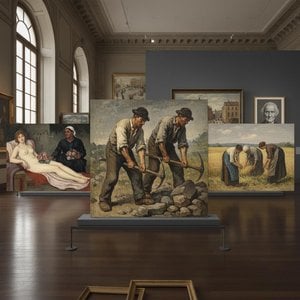
Michael Peter Ancher stands as one of Denmark’s most celebrated realist painters, a master whose brushstrokes are inextricably linked to the artistic fervor of Skagen. This remote fishing village, nestled where the Baltic and North Seas converge in Jutland’s far north, served as more than just a subject for Ancher; it was the very heartbeat of his creative existence. His canvases pulsate with an immediacy that captures not merely visual likeness but also the visceral essence of human experience against the backdrop of rugged coastal landscapes. Through his eyes, we witness the quiet dignity of a community defined by its struggle and its harmony with the unpredictable forces of nature.
Born on June 9th, 1849, in Rutsker, Bornholm, Ancher’s early life was shaped by modest circumstances. While his father’s mercantile struggles curtailed much of his formal schooling, a profound artistic inclination began to emerge within him. This innate talent was nurtured by the keen eyes of fellow painters Theodor Philipsen and Vilhelm Groth, who recognized his potential during their expeditions to Skagen. Though he eventually enrolled at the Royal Danish Academy of Art in Copenhagen, Ancher’s spirit was too restless for the confines of strict academic formality. He chose to depart prematurely, prioritizing the raw, lived experience of his subjects over the polished requirements of graduation, a decision that would ultimately define his authentic approach to realism.
The Painter Colony and the Light of the North
Ancher’s formative years coincided with the rise of the Skagen Painter colony, an influential gathering of artists drawn to the village’s dramatic light and atmospheric shifts. This group, spearheaded by figures like Philipsen, fostered a spirit of collaboration and experimentation that profoundly shaped Ancher’s vision. Alongside his close friend Karl Madsen, Ancher helped cement a movement dedicated to capturing the unique spirit of the North. His life was also deeply intertwined with the social fabric of Skagen; in 1880, he married Anna Brøndum, a fellow artist and daughter of the proprietor of Brøndums Hotel. This union not only connected him to the heart of the local community but also placed him at the center of an artistic hub where creativity and daily life were indistinguishable.
The work of Ancher is characterized by an unflinching portrayal of Skagen’s fishermen—men who embodied courage, resilience, and a profound connection to their ancestral traditions. His technique avoids mere sentimentality, opting instead for a rugged realism that honors the grit and salt of the maritime life. In his paintings, one can almost feel the spray of the sea and the weight of the nets. He possessed a singular ability to render the textures of weathered skin, heavy wool, and the shifting sands of the coast, creating works that serve as both historical documents and emotional portraits of a vanishing way of life.
Historical Significance and Artistic Triumph
The enduring significance of Michael Peter Ancher lies in his ability to elevate the mundane struggles of a small fishing village into the realm of high art. He did not merely paint landscapes; he painted the soul of a people. His major achievements reside in his capacity to capture the tension between human vulnerability and the immense power of the sea. By focusing on the dignity of labor and the quiet moments of repose among the fishing families, he created a visual legacy that remains a cornerstone of Danish national identity.
Today, Ancher’s work continues to resonate with viewers who seek a connection to the authentic and the elemental. His contribution to the Skagen movement ensured that the light and life of Northern Jutland would be preserved for eternity. Through his mastery of light and shadow, he transformed the fleeting moments of coastal existence into timeless monuments of human endurance, securing his place as a titan of 19th-century realism.
Otázky a odpovědi
Kde mohu vidět díla umělce Michael Peter Ancher v chronologickém pořadí?
Stránka Časová osa děl představuje díla umělce Michael Peter Ancher seřazená chronologicky, rok po roce.
Mohu si prohlédnout díla umělce Michael Peter Ancher podle jednotlivých uměleckých směrů?
Díla umělce Michael Peter Ancher si můžete prohlédnout podle jednotlivých směrů na stránce Všechna umělecká hnutí daného umělce.
Mohu si prohlédnout díla umělce Michael Peter Ancher podle nálady?
Stránka Pokoj nálad umělce Michael Peter Ancher umožňuje prohlížet jeho díla rozřazená podle nálady.