Maurice Barraud: A Capturer of Moroccan Light and Shadow
Born in Geneva, Switzerland, in 1889, Maurice Barraud’s artistic journey was one shaped by a restless spirit and an insatiable curiosity for the world beyond his native land. Initially apprenticed to a graphic arts workshop, he quickly discovered a passion for painting, pursuing it alongside his professional duties. This dual pursuit – commerce and art – would inform much of his later work, providing him with both financial stability and a unique perspective on the societies he encountered. Barraud’s career unfolded across decades, marked by extended sojourns in Morocco, France, and Italy, each contributing to the distinctive character of his paintings. He wasn't merely a recorder of landscapes; he was an interpreter of atmosphere, light, and human experience, imbuing his canvases with a palpable sense of place and emotion.
Early Influences and Formation
Barraud’s early artistic development benefited from the tutelage of several influential figures. He began his formal training at the École des Beaux-Arts in Geneva, where he studied under Pierre Pignolat, a student of Barthélemy Menn, and James Vibert, who specialized in modeling. These instructors instilled in him a solid foundation in technique and composition. However, Barraud’s artistic sensibilities were further shaped by his travels and encounters with diverse cultures. His time spent in Brittany, particularly during the 1910s, exposed him to the rugged beauty of the coastline and the traditions of its people – elements that would later find their way into his work. The vibrant colors and dramatic light of Morocco, which he began visiting in the early 1920s, proved to be a transformative influence, profoundly altering his palette and subject matter.
Moroccan Visions: Markets, Interiors, and the Desert
Barraud’s most celebrated work emerged from his years spent living and painting in Morocco. He became deeply immersed in the culture of Marrakech and its surrounding regions, capturing the essence of Moroccan life with remarkable sensitivity. His paintings of bustling marketplaces – such as “Marché Arabe” – are particularly renowned for their dynamic compositions, rich colors, and evocative portrayal of human interaction. These weren’t simply depictions of commerce; they were celebrations of community, color, and sensory experience. Equally compelling are his interiors, often featuring women engaged in everyday activities, bathed in the warm light filtering through intricately carved doorways. He also ventured into the stark beauty of the Moroccan desert, rendering its vastness and solitude with a quiet dignity.
- Key Subjects: Markets, interiors (featuring women), desert landscapes, portraits
- Technique: Employed loose brushstrokes and vibrant colors to capture light and atmosphere. Often used a broken color technique, layering translucent washes of paint to create depth and luminosity.
- Influences: Impressionism, Post-Impressionism, particularly the work of Monet and Renoir; also influenced by Moroccan culture and traditions.
Beyond Morocco: Cassis and French Landscapes
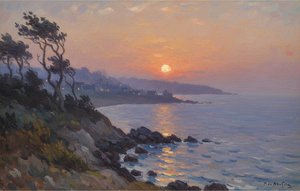
While Morocco remained a central focus for much of his career, Barraud continued to paint extensively in his native Switzerland, particularly in the region of Cassis. His depictions of the Provençal coastline – exemplified by “La Colline Sainte Croix” – reveal a shift towards a more lyrical and atmospheric style. These landscapes are characterized by soft colors, hazy light, and a sense of tranquility. He also produced numerous paintings of the Swiss Alps, capturing their majestic grandeur with a subtle yet powerful hand.
Legacy and Significance
Maurice Barraud’s work is often categorized as Post-Impressionism, though his style possesses a unique character that transcends easy categorization. His paintings are distinguished by their vibrant colors, expressive brushwork, and profound sensitivity to light and atmosphere. He was a master of capturing the fleeting effects of sunlight on surfaces – whether it be the shimmering tiles of a Moroccan marketplace or the rugged slopes of the Swiss Alps. Barraud’s legacy lies not only in his beautiful paintings but also in his ability to transport viewers to distant lands and evoke powerful emotions through his art. His work continues to resonate with audiences today, offering a glimpse into a world both familiar and exotic.