Lucas van Valckenborch I: A Pioneer of Dutch Landscape Painting
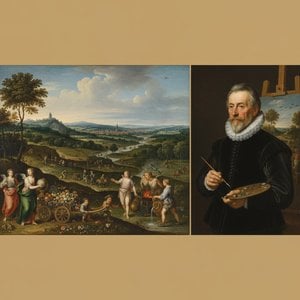
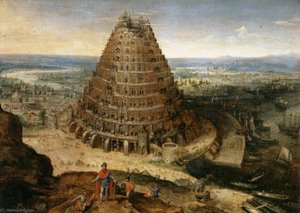
Lucas van Valckenborch I (c. 1535 – 1597) stands as a pivotal figure in the burgeoning landscape genre of the Dutch Golden Age, marking a crucial transition from Mannerism to Baroque aesthetics and establishing himself as one of the foremost topographical painters of his era. Born in Leuven, Belgium—a city steeped in artistic tradition thanks to its Flemish heritage—Valckenborch’s family cultivated an environment profoundly receptive to artistic pursuits, fostering a lineage that would produce several accomplished artists. His brother, Marten van Valckenborch I, and their sons, Frederik and Gillis, were equally influential figures, cementing the Valckenborch name as synonymous with excellence in visual art.
Early Life and Artistic Training: Lucas’s formative years were spent honing his skills amidst the vibrant artistic milieu of Leuven, where he absorbed the techniques championed by masters like Pieter Bruegel the Elder and Hans Bol. These painters, deeply committed to portraying the realities of rural life and employing innovative watercolor methods—a technique Valckenborch himself embraced—provided him with invaluable inspiration and established a stylistic precedent that would permeate his oeuvre. The Guild of Saint Luke in Mechelen recognized his talent early on, granting him membership in 1560, signaling his commitment to professional artistry and aligning him with the influential artistic currents circulating throughout Flanders during this period.
The Turbulent Years: The Dutch Revolt against Spanish rule brought significant upheaval to the Low Countries, impacting artists’ lives and creative endeavors. In 1566, Valckenborch and Marten van Valckenborch fled Antwerp—a Protestant stronghold—seeking refuge in Aachen and subsequently Germany, driven by religious convictions that mirrored those of many fellow artists who had migrated northward for similar reasons. This exodus coincided with the “Beeldenstorm,” a violent iconoclastic outburst targeting Catholic churches across Holland and Flanders, forcing artists to confront challenging ideological debates. Valckenborch’s journey into German territories allowed him to connect with his extended family of painters—a network dedicated to artistic innovation and religious reform—further enriching his artistic perspective.
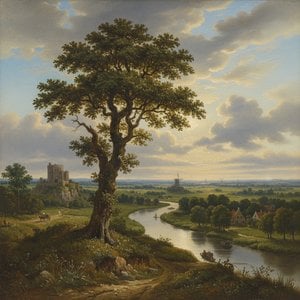
Landscape Painting Innovation: Valckenborch's contribution to landscape painting transcends mere depiction; he elevates it to a form of intellectual exploration. Unlike earlier artists who relied on idealized representations, Valckenborch meticulously documented actual locations with remarkable accuracy, utilizing watercolor techniques to capture subtle nuances of light and atmosphere. His groundbreaking approach—characterized by direct observation and detailed topographical rendering—became a cornerstone of Dutch landscape painting, influencing generations of subsequent artists. Notable works like “View of Huy from Ahin” exemplify his mastery of perspective and tonal modulation, demonstrating an unwavering dedication to capturing the essence of the natural world.
Legacy and Significance: Lucas van Valckenborch I’s legacy extends beyond individual paintings; he fundamentally reshaped artistic conventions and established a new standard for topographical realism. His influence can be discerned in the works of Pieter Savertijnsz., Cornelis van Asselen, and Jacob Savertijnsz., artists who adopted his techniques and stylistic sensibilities. Valckenborch’s unwavering commitment to portraying landscapes with uncompromising fidelity cemented his place as one of the most important landscape painters of the 16th century—a figure whose artistic vision continues to resonate within the annals of art history. His enduring contribution ensures that Lucas van Valckenborch I remains a celebrated exemplar of Dutch Golden Age artistry.