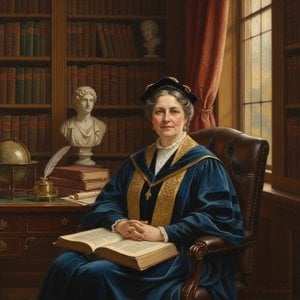
A Life Etched in Portraits: The Lowes Cato Dickinson
Lowes Cato Dickinson, born in Kilburn, London, in 1819, was a figure deeply embedded within the artistic and social currents of Victorian England. Coming from a family intimately connected to the art world—his father, Joseph Dickinson, being a respected lithographer and publisher on Bond Street—Dickinson’s path seemed preordained. Yet, his journey wasn't merely one of inheritance but of active engagement with the evolving aesthetic sensibilities and progressive social movements of his time. One of eleven siblings, he received his early education at Topsham School and Dr Lord's School in Tooting, grounding him in a solid foundation before fully immersing himself within the family business following his father’s death in 1849. He then joined forces with his brothers, Gilbert Bell Dickinson and William Robert Dickinson, to continue the legacy of Dickinson Brothers on Bond Street, a firm that quickly became synonymous with quality art publishing and photography. This early exposure wasn't simply about commerce; it was an apprenticeship in visual culture, shaping his eye for detail and composition—qualities that would define his later work as a portraitist.The Pre-Raphaelite Circle and the Call of Social Reform
Dickinson’s artistic development took a significant turn with a three-year sojourn in Italy around 1850. This period proved formative, exposing him to the masterpieces of the Renaissance and influencing his evolving style. He absorbed the stylistic principles championed by Dante Gabriel Rossetti and John Ruskin—a fervent devotion to nature alongside an insistence on emotional intensity—principles that would become central to his artistic vision. Upon his return to England, he found himself drawn into the orbit of the Pre-Raphaelite Brotherhood, though not formally affiliated with it. Nevertheless, Dickinson cultivated correspondence with key members of this influential group, solidifying his position within its intellectual landscape. This engagement extended beyond mere aesthetic admiration; it encompassed a profound sympathy for humanity and a conviction that art could serve as a catalyst for social betterment. He actively participated in the establishment of the Working Men's College alongside figures like Maurice and Kingsley—a testament to his unwavering belief in the transformative potential of education and his desire to uplift marginalized communities. The college’s walls bear witness to Dickinson’s artistic legacy, adorned with portraits commissioned by him that capture the essence of its founders.A Portraitist of Victorian Society
Dickinson honed his craft as a portrait painter during this period, developing a distinctive technique characterized by meticulous attention to facial expression and subtle shading—a method he often employed in collaboration with fellow artists like Frederic Denison Maurice. He skillfully recreated likenesses from photographs or descriptions, ensuring that memory endured beyond physical presence. His subjects spanned the spectrum of Victorian society: monarchs, statesmen, scientists, writers, and philanthropists—each portrait imbued with Dickinson’s profound understanding of human psychology and his ability to convey character through visual representation. Among his most celebrated commissions were portraits of Queen Victoria herself, Lord Kelvin, Sir Henry Norman, and numerous members of Parliament—works that remain invaluable documents of Victorian culture and intellectual life. His meticulous rendering of faces—a hallmark of his style—demonstrates a remarkable sensitivity to nuance and emotion.Notable Works and Legacy
Dickinson’s oeuvre comprises over fifty portraits, many of which hang prominently in institutions such as the National Portrait Gallery in London and Cambridge University—a testament to his enduring influence on British art history. His magnum opus is arguably the portrait of General Gordon at Khartoum, a monumental canvas that captures the heroic spirit of Victorian exploration and resilience. The meticulous detail with which he rendered Gordon’s visage exemplifies Dickinson's mastery of technique and his ability to convey profound psychological depth. Furthermore, Dickinson’s contribution extends beyond individual artworks; he established the Lowes Dickinson Award—a prestigious prize recognizing excellence in student art—affirming his commitment to fostering artistic talent and promoting creative endeavors. His papers, meticulously archived at Princeton, Oxford, and Cambridge Universities, continue to inspire scholars studying Victorian art, social history, and the intersection of faith and reform. Lowes Cato Dickinson’s life embodies a harmonious blend of artistic brilliance and humanist compassion—a legacy that resonates powerfully through his enduring images and his unwavering dedication to advancing knowledge and fostering social progress.Otázky a odpovědi
Kolik děl umělce Lowes Cato Dickinson je možné si prohlédnout?
Na stránce Všechná umělecká díla si můžete prohlédnout 76 uměleckých děl děl autora Lowes Cato Dickinson.
Kde mohu vidět barevný profil děl umělce Lowes Cato Dickinson?
Stránka Genom palety umělce Lowes Cato Dickinson představuje barevný profil celkového díla tohoto tvůrce.
Mohu si prohlédnout díla umělce Lowes Cato Dickinson podle barevného spektra?
Díla umělce Lowes Cato Dickinson si můžete prohlédnout podle barev na jeho stránce Sestavení podle barev.