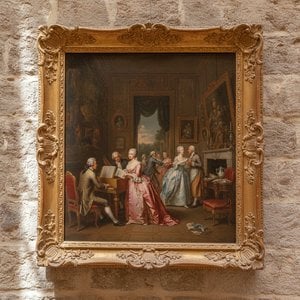
The Quiet Resonance of a French Master
Born in the historic environs of Laon, France, around the turn of the 17th century, Louis Le Nain emerged as a pivotal figure whose brush captured the silent, profound rhythms of existence. Alongside his brothers Antoine and Mathieu, he formed a creative triumvirate that would leave an indelible mark on the landscape of French genre painting. While the broader Baroque era often leaned toward the theatrical and the grandiose, Louis sought beauty in the understated. His life, though spanning only until 1648, was defined by a commitment to a realism that was as much about psychological depth as it was about technical precision. He did not merely paint people; he painted the very essence of their endurance within a period of immense social and religious transformation.
The Art of Observation and Light
The brilliance of Le Nain’s oeuvre lies in his ability to elevate the domestic to the level of the divine. His technique was characterized by a masterful command of light and shadow, a subtle nod to the chiaroscuro traditions of Caravaggio, yet applied with a gentleness that avoided overt drama. In his hands, the textures of a peasant's rough-spun clothing, the glint of a simple ceramic bowl, or the soft warmth of a hearth fire became subjects of intense contemplation.
His compositions often centered on several key elements:
- The Intimacy of the Interior: Creating spaces where families gather around the basic necessities of bread and wine.
- The Weight of Silence: Capturing moments of stillness that suggest a deep, internal emotional life.
- Tactile Realism: Rendering the physical world with such verisimilitude that the viewer can almost feel the grain of the wood or the coolness of the stone.
Symbolism in the Shadows
Beyond the surface level of his realistic depictions, Le Nain’s work is woven with a subtle tapestry of symbolism. Every element within his domestic scenes serves as a quiet narrator of the human condition. A child playing a flute might represent the enduring spirit of joy amidst hardship, while the presence of animals like cats and dogs hints at the complex, harmonious ecosystem of the household.
Through these carefully placed details, he transformed the mundane rituals of survival—the sharing of a meal or the tending of a fire—into profound meditations on lineage, community, and the continuity of life. His legacy remains a testament to the power of looking closely at the world around us, finding the extraordinary within the ordinary, and recognizing the quiet dignity inherent in every human story.
Otázky a odpovědi
Existuje časová osa děl umělce Louis Le Nain?
Díla umělce Louis Le Nain můžete prohlédnout v chronologickém pořadí na stránce Chronologie děl.
Kde najdu díla umělce Louis Le Nain seskupená podle barevné palety?
Chcete-li najít díla umělce Louis Le Nain v určité barevné paletě, navštivte jeho stránku Podle palet.
Existuje přehled všech témat, která Louis Le Nain maloval/a?
Díla umělce Louis Le Nain si můžete prohlédnout podle tématu na stránce Atlas témat.