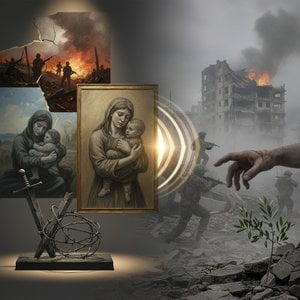
Leslie Cole (1910–1976): British War Artist Documenting WWII’s Realities With Unflinching Realism, From Malta To Bergen-Belsen
Leslie James Cole, born in Swindon, United Kingdom, in 1910, was an artist whose life became inextricably linked with the tumultuous events of the Second World War. Though his name may not be as instantly recognizable as some of his contemporaries, Cole’s contribution to documenting the realities of conflict – and its devastating aftermath – is profoundly significant. His work stands as a powerful testament to human resilience in the face of unimaginable horror, offering a visual record that continues to resonate with viewers today. Cole's artistic journey began with formal training at Swindon Art School from 1927 to 1932, followed by studies at Birmingham College of Art and culminating in a diploma from the Royal College of Art in 1937, where he specialized in mural decoration, fabric painting, and lithography. This diverse foundation equipped him with a versatile skillset that would prove invaluable during his time as an official war artist. Even before the outbreak of war, Cole demonstrated a commitment to both artistic practice and education, beginning his teaching career at Hull College of Art – a dedication he would continue throughout his life.Early Artistic Development & Formal Training
Cole’s formative years were marked by a passion for visual arts nurtured through rigorous academic instruction. Swindon Art School instilled in him foundational principles of draughtsmanship and composition, while Birmingham College of Art broadened his artistic horizons with explorations into diverse mediums and styles. Crucially, his studies at the Royal College of Art cemented his expertise in mural decoration and fabric painting—skills that would later prove instrumental in capturing monumental scenes of wartime activity. The influence of Harold Dearden and Harold Holden, prominent educators during Cole’s formative years, shaped his artistic sensibilities and instilled a dedication to meticulous observation and skillful execution. This grounding in traditional techniques provided him with the tools necessary to confront the challenges posed by the impending conflict with confidence and conviction.A Response To War: From RAF Discharge To Independent Missions
The declaration of World War II dramatically redirected Cole’s artistic trajectory. Despite initially joining the Royal Air Force, medical complications necessitated his discharge—a setback that nevertheless fueled his determination to contribute to the war effort through visual documentation. Facing initial rejection by Sir Kenneth Clark and the War Artists’ Advisory Committee (WAAC), Cole proactively asserted his capabilities, embarking on independent expeditions accompanying trawlers involved in minesweeping and serving aboard destroyers. These self-initiated projects—a testament to his tenacity and talent—captured the gritty realities of naval warfare and garnered considerable acclaim from the WAAC. This recognition ultimately secured him a full-time commission in 1943, propelling him into an extraordinary period where he traveled extensively across Europe and Asia documenting pivotal moments of the conflict.Official War Artist Commissions & Cinematic Documentation
Cole’s involvement with the WAAC yielded remarkable opportunities for artistic engagement and historical record-keeping. He undertook assignments ranging from capturing the siege of Malta—a scene fraught with danger and resilience—to documenting the Normandy landings alongside British Marines, traversing Cairo amidst inter-factional tensions following German withdrawal, and venturing further afield to Singapore, Burma, Borneo, and Java. These expeditions demanded not only artistic skill but also adaptability and courage—qualities Cole embodied admirably. His meticulous attention to detail ensured that his paintings conveyed a palpable sense of immediacy and authenticity, reflecting the urgency of the wartime experience. Furthermore, Cole’s work extended beyond traditional painting; he utilized lithography to produce striking prints that disseminated visual narratives across Britain and abroad.The Bergen-Belsen Series: Confronting Horror With Courageous Realism
Cole's most enduring legacy resides in his harrowing depictions of Bergen-Belsen concentration camp—a project undertaken with profound moral responsibility. His panoramic oil paintings meticulously documented the devastating aftermath of liberation, portraying scenes of unimaginable suffering—survivors grappling with trauma, British troops confronting the horrors of Nazi barbarity, and captured German guards bearing witness to their own crimes. These canvases stand as unflinching portrayals of one of history’s darkest chapters, capturing not only visual details but also the emotional weight of human experience under extreme duress. Cole's artistic style—characterized by a compelling realism tempered with sensitivity—served as a powerful tool for confronting difficult truths and honoring the memory of victims. His work remains a poignant reminder of the importance of bearing witness to history’s most harrowing moments, securing his place among Britain’s foremost war artists.Legacy & Recognition: Enduring Influence Through Art
Cole continued his artistic pursuits after the war establishing a studio in Fulham, London and continuing his teaching role at institutions such as Brighton College of Art. Renewed interest in Cole's contributions emerged in 1985 with an exhibition titled "To the Front Line" at the Imperial War Museum, and again in 2009 when two of his paintings appeared on Antiques Roadshow—demonstrating the enduring fascination with his artistic vision and its profound impact on subsequent generations. Today, Cole’s artworks are held by numerous public collections across Britain, ensuring that his powerful depictions of wartime experiences continue to be seen and appreciated—a testament to his unwavering commitment to artistic excellence and historical remembrance. Leslie Cole's art serves as a vital reminder of the sacrifices made during World War II and the importance of confronting difficult truths with courage and compassionOtázky a odpovědi
Odkud pochází Leslie Cole?
Leslie Cole se narodil(a) v zemi Spojené království.
Jak najdu díla umělce Leslie Cole na konkrétní téma?
Chcete-li najít díla umělce Leslie Cole na konkrétní téma, využijte stránku Podle klíčových slov, která seskupuje umělecká díla podle klíčových slov.
Kolik děl umělce Leslie Cole je možné si prohlédnout?
V katalogu si můžete prohlédnout 65 děl děl autora Leslie Cole na stránce Všechna umělecká díla.