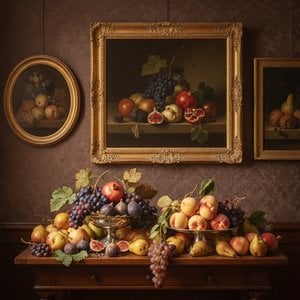
Leendert Claesz: Master of Light and Detail in Dutch Still Life
Leendert Claesz (c. 1607 – 1678) stands as a pivotal figure within the Dutch Golden Age, celebrated primarily for his breathtakingly realistic depictions of fruit arrangements—still lifes that continue to captivate audiences centuries later. While biographical details surrounding his life remain somewhat sparse compared to contemporaries like Rembrandt or Vermeer, Claesz’s artistic output speaks volumes about his skill and unwavering dedication to capturing the subtleties of natural beauty. His work serves as a window into an era defined by prosperity, scientific curiosity, and an almost spiritual reverence for the material world.
The foundations of Claesz's mastery were laid during his formative years in Antwerp. Though precise information regarding his birthdate is elusive, his apprenticeship under Hendrick van Balen I proved transformative. As a renowned painter known for dramatic landscapes and portraits, Balen instilled in Claesz a foundational understanding of Baroque artistic principles. Most notably, Claesz embraced the technique of chiaroscuro—the dramatic use of light and shadow to create volume and emotional depth. This period in Antwerp, spanning roughly from 1630 to 1642, allowed him to absorb the influences of Italian masters like Caravaggio, whose impact on the play of light can be seen in the luminous textures of Claesz's later fruit studies.
The Flourishing of an Amsterdam Master
Around 1642, Claesz relocated to Amsterdam, a move that would mark the most prolific and successful chapter of his career. In this bustling center of global trade, he established himself as one of the city’s leading painters, securing prestigious commissions from wealthy merchants and patrons who sought art that reflected their refined tastes and newfound abundance. It was during this Amsterdam period that his signature style reached its zenith. His canvases became legendary for their meticulously rendered fruit bowls, brimming with luscious peaches, pears, apples, grapes, and citrus fruits that seem almost tangible to the touch.
His technical prowess was matched by an incredible sensitivity to the natural world. Claesz did not merely paint objects; he captured the very essence of life and decay. Through his masterful manipulation of light—often diffused softly across the skin of a ripening plum or the translucent pulp of an orange—he achieved a level of realism that bordered on the miraculous. This dedication to scientific observation, a hallmark of the Dutch Golden Age, allowed him to present nature with both accuracy and profound aesthetic grace.
Legacy and Artistic Significance
The historical significance of Leendert Claesz lies in his ability to elevate the still life genre from mere decorative arrangement to a sophisticated medium of expression. While his works are celebrated for their beauty, they also embody the cultural zeitgeist of 17th-century Holland. His paintings reflect a society that found wonder in the tangible: the glint of silver, the texture of fruit, and the ephemeral nature of time itself. Through his brush, the humble details of daily existence were transformed into enduring monuments of art.
Today, the legacy of Claesz continues to resonate through the museums and collections that house his masterpieces. His contributions helped define the aesthetic boundaries of the Dutch Golden Age, leaving behind an oeuvre that remains a testament to the power of light, detail, and the quiet beauty of the natural world. To look upon a Claesz painting is to experience a moment of stillness, where the fleeting beauty of a summer harvest is captured forever in a dance of shadow and light.
Otázky a odpovědi
Mohu si u Leendert Claesz prozkoumat používání barev napříč všemi jeho díly?
Použití barev v dílech umělce Leendert Claesz uvedených na tato webová stránka můžete prozkoumat na stránce Genom palety tohoto umělce.
Existuje chronologický přehled tvorby umělce Leendert Claesz?
Kronika umělce umělce Leendert Claesz je interaktivní časová osa ovládaná skrolováním, která představuje díla umělce v chronologickém pořadí, rozdělená do kapitol podle jednotlivých období jeho kariéry.
Kde najdu díla umělce Leendert Claesz seskupená podle techniky?
Díla umělce Leendert Claesz si můžete prohlédnout podle použité techniky na jeho stránce Podle techniky.