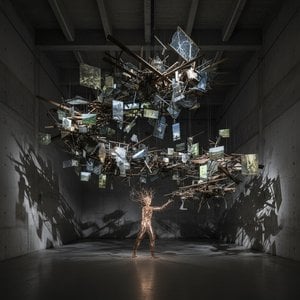
A Dialogue Between Art, Science, and the Ephemeral: The World of Laura Vinícius
Laura Vinícius, born in São Paulo, Brazil, in 1961, is an artist whose work transcends conventional categorization. She doesn’t simply create objects; she orchestrates experiences—immersive installations that invite contemplation on the delicate interplay between art, science, and technology, often underscored by a profound awareness of time's passage and the human relationship with nature. Vinícius’ artistic journey began with formal studies at the Escola de Artes Visuais do Parque Lage and continued at the Escola de Comunicações e Artes da Universidade de São Paulo, laying a foundation that would allow her to seamlessly blend diverse disciplines into a cohesive and compelling practice.
Early Explorations and the Emergence of a Unique Vision
Vinícius’ early work in painting and sculpture quickly evolved beyond traditional boundaries. A pivotal moment came with the 1997 Arte/Cidade Project, where her installation “Sandglass” captured attention for its poetic simplicity and conceptual depth. This piece—a monumental pile of sand slowly trickling through a hole in a floor slab—became emblematic of her fascination with ephemerality and the relentless flow of time. It wasn’t merely about observing a physical process; it was an invitation to reflect on mortality, change, and the inherent impermanence of all things. This early exploration set the stage for much of her subsequent work, which consistently grapples with these themes through innovative means. Her research is based on exploring the relationships between body and space, with an emphasis on ephemerality. In her practice, space emerges as a complex organism, mediating the relationships between the various bodies that compose it, while remaining susceptible to the passage of time.
Sculpture, Installation, and the Language of Light & Shadow
Vinícius’ artistic vocabulary is remarkably diverse, encompassing sculpture, large-scale installations, and site-specific interventions. However, a unifying element runs through all her creations: a masterful manipulation of light and shadow. She doesn't simply *use* light; she sculpts with it, creating ethereal atmospheres that heighten the viewer’s sensory experience. Her work often incorporates unconventional materials—hardware store supplies alongside delicate elements like gold-plated leaves suspended in air—creating intriguing juxtapositions that challenge our perceptions of value and permanence. A recent example of this is her series created for Rosewood São Paulo, where replicas of leaves and branches from the Maternidade Matarazzo gardens were cast in golden chains, transforming corridors into poetic dreamscapes. This project exemplifies her ability to imbue spaces with a sense of wonder and invite contemplation on our connection to the natural world.
Recognition and International Presence
Throughout her career, Laura Vinícius has garnered significant recognition for her innovative approach to artmaking. She has participated in prestigious biennials including those of São Paulo, Mercosul, and Cuenca, Ecuador, extending her reach beyond Brazil’s borders. Her work has been exhibited internationally, with presentations at institutions such as RMIT University in Melbourne, Palazzo delle Papesse in Siena, and the Malba in Buenos Aires, solidifying her position as a prominent figure in contemporary art. She received the Prêmio Sergio Motta de Arte e Tecnologia in 2000 and the Prêmio Funarte de Artes Plásticas in 2006, accolades that acknowledge both the conceptual rigor and aesthetic beauty of her creations.
A Lasting Legacy: Exploring the Void and Beyond
Laura Vinícius’ work is not easily defined—and perhaps that's precisely its strength. She resists categorization, constantly pushing boundaries and challenging conventional artistic norms. Her installations are often described as enigmatic, low-tech, and deeply poetic, combining seemingly disparate elements to create a powerful emotional resonance. As Cynthia Garcia noted in *Newcity Brazil*, her exhibition “Morro Mundo” was destined to be a highlight of São Paulo’s gallery scene, showcasing her ability to blend hardware supplies with immateriality, the void, and time. Her ongoing exploration of these themes—coupled with her masterful use of light, shadow, and unconventional materials—ensures that Laura Vinícius will continue to inspire and provoke audiences for years to come. She invites us not just to *see* art, but to experience it—to feel its weight, to contemplate its meaning, and to recognize the delicate beauty inherent in the ephemeral nature of existence.