A Life Bridging Worlds: The Enigmatic László Mednyánszky
Born into the Hungarian nobility in 1852, in Beckó (modern-day Slovakia), Baron László Mednyánszky was a figure perpetually caught between worlds – of aristocracy and empathy for the common man, of artistic tradition and burgeoning modernism, of national identity and a sense of profound displacement. His lineage, steeped in landowning families like the Szirmays and hinting at Polish and French ancestry, provided him with privilege but did not define his path. Early years spent at his grandfather’s chateau in Nagyőblac (Strážky) fostered a deep connection to the landscape of Upper Hungary, a region that would become both muse and metaphor throughout his career. A pivotal moment arrived in 1863 when he encountered Austrian artist Thomas Ender, an encounter that ignited within him a passion for painting and set him upon a lifelong artistic journey. Though fluent in Hungarian, Mednyánszky’s internal world seemed to resonate with a quiet melancholy, a sense of being both intimately connected to and perpetually estranged from his surroundings – a feeling powerfully reflected in his art.
From Parisian Studios to the Heart of Hungary
Mednyánszky's formal artistic training began at a grammar school in Késmárk (Kežmarok), followed by studies at the Akademie der Bildenden Künste in Munich and, crucially, the École des Beaux-Arts in Paris. In Paris, he found mentorship under Isidore Pils, but ultimately chafed against the constraints of academic tradition. He sought a more personal expression, one that moved beyond mere imitation towards capturing the essence of lived experience. After leaving the École, he briefly practiced independently in Montmartre before returning to Nagyőblac around 1877. This return wasn’t a retreat but rather a re-centering. It allowed him to immerse himself fully in the landscapes and lives that truly moved him, while also affording opportunities for extensive travel throughout Europe. His style began to evolve, initially touched by Impressionism, yet quickly diverging into something uniquely his own – a blend of atmospheric observation, symbolic resonance, and hints of Art Nouveau’s flowing lines. He wasn't simply *recording* what he saw; he was translating emotional truths onto canvas.
The Poetics of Rural Life and the Shadow of War
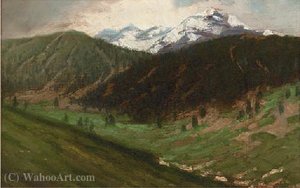
Mednyánszky’s artistic focus centered on the lives of ordinary people, particularly those inhabiting the rural landscapes of Upper Hungary. He depicted scenes of nature imbued with a palpable sense of atmosphere – brooding skies, mist-shrouded mountains, and fields stretching towards distant horizons. His subjects weren't idealized peasants or picturesque scenery; they were individuals weathered by hardship, their faces etched with stories of resilience and quiet dignity. The Carpathian Mountains and the Hungarian plains served as recurring motifs, not merely as backdrops but as integral components of his narratives. He possessed a remarkable ability to capture fleeting moments – the quality of light on a field, the weight of labor in a worker’s posture, the unspoken emotions passing between individuals. This sensitivity extended to his later work during World War I, where he served as a war correspondent documenting the brutal realities of conflict in Galicia, Serbia, and the Southern Tyrol. These wartime paintings are starkly different from his earlier landscapes, yet they share the same underlying empathy for human suffering. His painting “Everywhere a Foreigner and Yet Nowhere a Stranger” encapsulates this lifelong feeling of alienation and searching.
A Legacy of Quiet Contemplation
László Mednyánszky remains an enigmatic figure in Hungarian art history, partly due to his reclusive nature and complex personality, but also because many of his works were lost or destroyed during the tumultuous events of the 20th century. Despite this, his surviving paintings offer a poignant commentary on social conditions and the human condition. His work transcends simple representation; it delves into the psychological and emotional landscapes of its subjects. His art is not about grand narratives or heroic deeds but rather about the quiet dignity of everyday life, the beauty found in hardship, and the enduring power of nature. Today, his paintings are preserved and accessible to the public in both the Slovak National Gallery in Bratislava and the Hungarian National Gallery in Budapest, ensuring that his unique vision continues to resonate with audiences. He attempted political action as well, forming an association with Béla Grünwald to counter pan-Slav movements, revealing a commitment to preserving cultural identity amidst shifting geopolitical forces. He died in Vienna in 1919, weakened by war wounds and illness, leaving behind a body of work that continues to invite contemplation and inspire awe. His legacy is one of quiet power – a testament to the enduring beauty of empathy and the transformative potential of art.