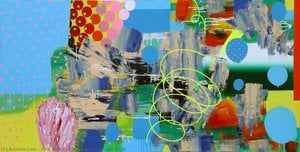
A Visionary of the Abstract Subconscious
Born in Gwangju, South Korea, the contemporary master Kim Ik Mo has carved a singular path in the realm of modern abstraction, creating works that serve as profound meditations on the architecture of the subconscious. His artistry invites viewers into a dreamscape where the rigid boundaries between physical reality and pure imagination dissolve into a rhythmic dance of form and color. Through his canvases, he explores the delicate tension between chaos and order, utilizing geometric precision to anchor much more fluid, ethereal concepts.
The essence of Kim's work often lies in its ability to transcend traditional landscape painting. In his celebrated series, such as the Pleasant Landscapes, he moves beyond mere representation to offer a visual melody composed of light and shape. His compositions frequently feature commanding central motifs—such as luminous orbs or bisected circles—that act as meditative nuclei. Around these focal points, a universe of smaller spheres, polka dots, and intersecting triangles orbits in a state of perpetual motion, suggesting a cosmic energy that is both structured and spontaneous.
Symbolism and the Ethereal Landscape
Kim Ik Mo’s practice is deeply rooted in the exploration of symbolic pictorial concepts. He masterfully integrates various symbols—such as the house, the heart, and even more whimsical elements like a pig's tail—within an abstract space to create layers of meaning. His work often references historical Korean aesthetics, notably drawing inspiration from the concept of a New Dream Journey to the Peach Blossom Land. This connection to classical themes allows him to bridge the gap between traditional Korean sensibilities and modern, abstract expressionism.
In his more expansive works, like the Landscape of Daydream series, the artist explores themes of existence, solitude, and the interconnectedness of life. These pieces often present a sweeping vista that feels simultaneously grounded in a coastal setting and untethered from time. By placing solitary figures within these vast, geometric environments, Kim adds a poignant layer of narrative tension, transforming the viewer into a witness to a quiet, introspective moment caught within an infinite horizon.
Technique and Artistic Legacy
The technical mastery of Kim Ik Mo is evident in his sophisticated layering of shapes and his ability to balance precision with organic fluidity. His method involves a dynamic process where each element feels intentionally placed yet organically scattered, mimicking the spontaneous beauty found in nature. This technique produces a sense of multidimensional space, where flat planes of color interact with subtle gradients to create an immense, breathing scale.
His contribution to contemporary art is marked by several key artistic characteristics:
- Geometric Serenity: The use of precise geometric forms to evoke a sense of calm and structural integrity.
- Atmospheric Depth: A mastery of color and light that suggests an infinite, dreamlike horizon.
- Cultural Synthesis: The seamless blending of modern abstract aesthetics with profound Korean motifs and historical references.
- Kinetic Energy: The creation of a visual cadence that mimics natural movements, such as the pulse of a heartbeat or the drift of wind.
Through his visionary journeys into the landscape of the mind, Kim Ik Mo continues to offer a window into the extraordinary, transforming the mundane into a celestial experience of pure consciousness.
Otázky a odpovědi
Jak najdu díla umělce Kim, Ik Mo v určité barevné paletě?
Stránka Podle barevné palety seskupuje díla umělce Kim, Ik Mo podle jejich barevných palet.
Jak mohu sledovat tvorbu umělce Kim, Ik Mo rok po roce?
Díla umělce Kim, Ik Mo můžete prohlédnout v chronologickém pořadí na stránce Časová osa děl.
Odkud pochází Kim, Ik Mo?
Kim, Ik Mo se narodil(a) v zemi South Korea.
Jak se umění umělce Kim, Ik Mo v čase vyvíjelo?
Chronologický přehled tvorby umělce Kim, Ik Mo je k dispozici na jeho stránce Kronika, kde jsou díla uspořádána v pořadí jejich vzniku v jednotlivých kapitolách.
Pod jakými dalšími jmény je Kim, Ik Mo známý/á?
Kim, Ik Mo se vystupuje även pod alternativními jmény Kim Ikmo.
Kde mohu vidět všechna umělecká díla autora Kim, Ik Mo?
Veškerá díla umělce Kim, Ik Mo na tento web lze prohlédnout na jeho stránce Všechna umělecká díla.
Jaké nálady vyjadřují umělecká díla umělce Kim, Ik Mo?
Díla umělce Kim, Ik Mo si můžete prohlédnout podle nálady na jeho stránce Pokoj nálad, kde jsou umělecká díla uspořádána podle jejich vyvolané nálady.
Mohu si prohlédnout díla umělce Kim, Ik Mo podle použité techniky?
Chcete-li najít všechna díla umělce Kim, Ik Mo v určité technice, navštivte stránku Všechna média tohoto umělce.