A Life Immersed in Light and Landscape
Karel Dujardin, a name resonating softly within the pantheon of Dutch Golden Age masters, was born in Amsterdam in 1626 – though some records suggest 1622. His life unfolded during a period of unprecedented artistic flourishing in the Netherlands, yet his path wasn’t one of immediate acclaim but rather a gradual unfolding of talent nurtured by careful study and extensive travel. Details surrounding his early years remain somewhat elusive, shrouded in the mists of time, however it is widely accepted that he received foundational training under Nicolaes Berchem, a painter celebrated for his idyllic landscapes populated with animals. This mentorship proved pivotal, instilling in Dujardin a deep appreciation for naturalism and a keen eye for capturing the subtle nuances of light and atmosphere. He diligently absorbed Berchem’s techniques—particularly his masterful use of atmospheric perspective—laying the groundwork for his own distinctive artistic style.Early Influences and Artistic Training
Nicolaes Berchem's influence extended beyond mere stylistic imitation; it instilled in Dujardin a profound understanding of how to convey emotion through visual representation. Berchem’s landscapes weren’t merely decorative; they were imbued with spiritual significance, reflecting the humanist ideals prevalent during the era. This ethos permeated Dujardin’s artistic sensibilities, shaping his approach to portraying the natural world and elevating it beyond mere depiction to a form of contemplative observation. Furthermore, Dujardin benefited from exposure to other prominent artists of his time, fostering intellectual curiosity and broadening his artistic horizons.The Roman Period: Bentvueghels and Artistic Transformation
Dujardin’s journey took an unexpected turn when he ventured into Rome in 1650, joining the *Bentvueghels*, a society of predominantly Dutch and Flemish painters who embraced a bohemian lifestyle and often adopted satirical nicknames. This association proved transformative for his artistic development. The Bentvueghels encouraged experimentation and challenged conventional artistic norms, fostering an environment conducive to innovation and self-expression. In Rome, he was known as “Barba di Becco” or "Goat-Beard," a moniker likely referencing his distinctive facial hair—a detail that would later appear in several of his portraits—and it was here that his artistic voice truly began to mature. He immersed himself in the vibrant culture of the Italian Renaissance, absorbing influences from artists like Caravaggio and Raphael, which subtly infused his work with dramatic intensity and compositional sophistication.Italian Landscape Painting: Synthesis and Innovation
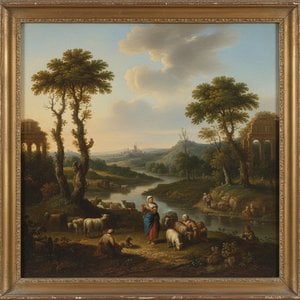
Dujardin’s time in Italy profoundly shaped his artistic style. He wasn't merely replicating the landscapes he encountered; instead, he synthesized them with the Dutch tradition of genre painting, creating a unique blend that captivated audiences on both sides of the Alps. His paintings are characterized by meticulous detail and a remarkable ability to depict scenes of everyday life – rural scenes brimming with animals, peasants engaged in their daily routines, and tranquil pastoral settings. He possessed an exceptional talent for capturing the play of light and shadow, imbuing his canvases with a sense of warmth and realism. Like Berchem before him, Dujardin skillfully employed atmospheric perspective—a technique perfected by Rembrandt—to create depth and illusionism, transporting viewers into immersive landscapes that resonated with psychological complexity.Notable Works and Legacy
Among Dujardin’s most celebrated paintings are *Woman Milking a Red Cow*, *Farm Animals in the Shade of A Tree With A Boy And A Sleeping Child*, *Rest at an Italian Inn*, *The Regents of the Spinhuis and Nieuwe Werkhuis, Amsterdam (1669)*, and *Self-Portrait (1662)*. These works exemplify his mastery of genre painting—a genre that flourished during the Dutch Golden Age—and demonstrate his ability to convey profound emotion through subtle visual cues. His meticulous attention to detail—particularly in depictions of animal anatomy—reflects a commitment to scientific observation, aligning him with the burgeoning spirit of empiricism prevalent during his era. Karel Dujardin’s legacy extends far beyond the confines of his lifetime; he remains an enduring symbol of Dutch artistic excellence and continues to inspire admiration for his masterful technique and evocative vision. His paintings are held in prestigious collections worldwide—including the Mauritshuis Royal Picture Gallery in The Hague and the National Gallery in London—testament to their enduring appeal and artistic merit.Otázky a odpovědi
Odkud pochází Karel Dujardin?
Karel Dujardin se narodil(a) v Nizozemsko.
Pod jakými dalšími jmény je Karel Dujardin známý/á?
Karel Dujardin se vystupuje även pod alternativními jmény Karel-du-Jardin, Bockbaert Dujardin, Carl du Jardin zvaný Bocksbart, Carl Dujardin.
Kde mohu vidět barevný profil děl umělce Karel Dujardin?
Stránka Genom palety umělce Karel Dujardin představuje barevný profil celkového díla tohoto tvůrce.