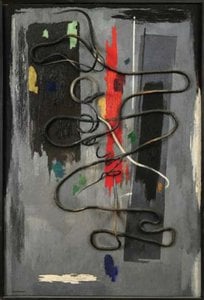
Yury Annenkov: A Life Painted in the Shadows and Light of Revolution
Yury Pavlovich Annenkov (1889-1974) remains a captivating, yet somewhat elusive figure within the pantheon of Russian avant-garde artists. His life was inextricably linked to the tumultuous currents of 20th-century Russia – from the fervent revolutionary spirit of his youth to the quiet exile in Paris and the subsequent embrace of Soviet artistic patronage. Annenkov’s oeuvre is a rich tapestry woven with threads of political commentary, personal introspection, and a remarkable technical skill that consistently elevates his work beyond mere illustration, revealing instead a profound understanding of composition, color, and human psychology. He wasn't merely documenting history; he was actively shaping its visual narrative.
Born in Petropavlovsk (now Vladivostok) in the Far East of Russia, Annenkov’s early life was marked by political upheaval. His father, Pavel Annenkov, a former member of the revolutionary group “People’s Will,” was exiled to Siberia for his radical views. This familial history instilled in young Yuri a deep-seated awareness of social injustice and fueled a rebellious streak that would manifest throughout his artistic career. Returning to St. Petersburg with his family in 1893, Annenkov's childhood was spent amidst a vibrant cultural milieu, surrounded by artists, writers, and intellectuals – an environment that profoundly shaped his aesthetic sensibilities. He began drawing at a young age, honing his skills through private lessons and absorbing the influences of the era’s artistic trends.
The Parisian Years: Experimentation and Early Recognition
In 1908, Annenkov entered Saint Petersburg University Law Department, but soon abandoned his studies to pursue his artistic ambitions. He moved to Paris in 1911, a pivotal decision that marked the beginning of a transformative period in his life and work. The Parisian art scene offered him unprecedented opportunities for experimentation and exposure to groundbreaking movements like Cubism and Futurism. He enrolled in the studios of Maurice Denis, a key figure in the Neo-Classical revival, and Félix Vallotton, known for his sharp realism and psychological depth. These encounters profoundly influenced Annenkov’s approach to composition, color theory, and the depiction of human form.
His early Parisian works, exhibited at the 1913 Salon des Artistes Indépendants, showcased a nascent stylistic maturity – a blend of traditional academic drawing with hints of avant-garde experimentation. Crucially, it was during this period that Annenkov developed his distinctive style: characterized by bold lines, dramatic contrasts, and an uncanny ability to capture the essence of his subjects through simplified forms and evocative color palettes. He began working as a model, supplementing his income while diligently studying artistic techniques.
Revolution and Artistic Service
Returning to St. Petersburg in 1914, Annenkov quickly became involved with the burgeoning revolutionary movement. He embraced the Bolshevik Revolution of 1917 with enthusiasm, dedicating his art to the service of the new Soviet state. This period witnessed a dramatic shift in his artistic style – moving towards stark monochrome palettes and monumental compositions that reflected the intensity and urgency of the era. He designed book illustrations for prominent authors like Alexander Blok’s revolutionary poem “The Twelve,” a work that cemented his reputation as a politically engaged artist. His designs for Nikolai Evreinov's mass spectacle commemorating the third anniversary of the storming of the Winter Palace further demonstrated his ability to translate complex political narratives into visually compelling imagery.
Annenkov’s portraits, particularly those of Vladimir Lenin and Leon Trotsky, are arguably the most enduring legacy of this period. These aren’t simply likenesses; they are powerful psychological studies that capture the subjects' intensity, determination, and inherent contradictions. His use of stark contrasts, dynamic lines, and a deliberate simplification of form conveys a sense of urgency and revolutionary fervor.
Later Years: Cinema, Design, and a Parisian Exile
Following the death of Lenin in 1924, Annenkov chose to relocate permanently to Paris, seeking refuge from the increasingly turbulent political climate in Russia. He continued his artistic practice, working as a stage designer for numerous theatrical productions and contributing significantly to the design of over fifty films, including Jean Cocteau’s iconic “The Eternal Return.” His work on this film, particularly the stylized costumes and sets, established him as a leading figure in European cinema design.
Despite his exile, Annenkov remained deeply connected to the Russian artistic community. He continued to produce book illustrations, portraits, and abstract compositions throughout his life, demonstrating an unwavering commitment to his craft. His later works often reflect a sense of melancholy and nostalgia, perhaps a consequence of his displacement from his homeland and the loss of a bygone era. Yuri Pavlovich Annenkov died in Paris in 1974, leaving behind a body of work that continues to fascinate and inspire.
Legacy and Significance
Yury Annenkov’s artistic legacy is complex and multifaceted. He was a product of his time – deeply influenced by the political and social upheavals of 20th-century Russia, yet also possessed of a unique artistic vision that transcended ideological boundaries. His work stands as a testament to the power of art to reflect, shape, and ultimately challenge the course of history. While often overshadowed by more prominent figures in the Russian avant-garde, Annenkov’s contributions deserve greater recognition for their stylistic innovation, political engagement, and enduring emotional resonance.
Otázky a odpovědi
V jakém městě a z jaké země pochází Jury Annenkov?
Jury Annenkov se narodil(a) ve městě Vladivostok v zemi Rusko.
Mohu si prohlédnout díla umělce Jury Annenkov podle barevného spektra?
Spektrální index umělce Jury Annenkov je stránka, která organizuje jeho díla podle jejich barev.
Kde a kdy se narodil/a Jury Annenkov?
Jury Annenkov se narodil(a) ve městě Vladivostok v roce 1889.
Odkud pochází Jury Annenkov?
Jury Annenkov se narodil(a) v zemi Rusko.
V jakém historickém období působil/a Jury Annenkov?
Jury Annenkov působil v období Modernismus. Toto období historicky vymezuje uměleckou činnost tohoto autora.
V jakých směrech působil/a Jury Annenkov?
Stránka Všechna umělecká hnutí seskupuje díla umělce Jury Annenkov podle jednotlivých uměleckých směrů.
Existuje kompletní seznam děl umělce Jury Annenkov?
Veškerá díla umělce Jury Annenkov na tento web lze prohlédnout na jeho stránce Všechna umělecká díla.