Julius Henry Fournier (1830-1919): A Pioneer of Parisian Illustration
Henry Fournier was born in Bourges, France, in 1830, a son of François Ernest Fournier and Rose Marie Aimée Richard. He embarked on his artistic journey as a racing driver initially focusing on motorcycles and tricycles—a passion that would later intertwine with his fascination for aviation. This early experience instilled in him a meticulous attention to detail and an understanding of movement, qualities he would translate into his distinctive visual style.
Fournier’s career took root in the vibrant artistic milieu of Paris during the Belle Époque, where he honed his skills as an illustrator and lithographer. He quickly gained recognition for capturing the essence of Parisian life—the elegance of ballroom dancing, the bustle of city streets, and the charm of everyday scenes—primarily through collaborations with journals like Le Sourire and La Vie Parisienne. His work wasn't merely decorative; it was imbued with a keen observation of human behavior and an ability to convey emotion through subtle gestures and expressions.
A pivotal moment in Fournier’s artistic trajectory arrived with his involvement in the inaugural air races of 1901. He championed innovation, piloting a motorcycle—a daring feat for its time—and demonstrating unwavering enthusiasm for exploring new frontiers. This adventurous spirit mirrored his broader artistic vision: a desire to push boundaries and capture fleeting moments of beauty and dynamism.
Fournier’s stylistic evolution can be traced through his prolific output during the early 20th century, characterized by precise linework and tonal shading that created depth and atmosphere. He drew inspiration from artists like Jean-François Millet—particularly Millet's depictions of rural life—whose earthy palette and expressive brushstrokes resonated with Fournier's own aesthetic sensibilities. His meticulous technique allowed him to convey a remarkable sense of realism while maintaining an artistic vision rooted in Impressionistic principles.
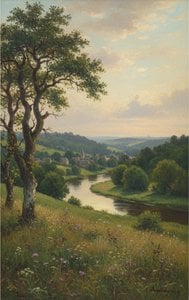
Beyond his artistic accomplishments, Fournier’s legacy extends to the Musée Thomas-Henry in Évreux, where his paintings—primarily landscapes and portraits—are proudly displayed as part of a collection celebrating French art from the 15th to 19th centuries. This museum serves as a testament to Fournier's contribution to the artistic heritage of France, ensuring that his evocative works continue to inspire admiration for generations to come. Furthermore, Fournier’s influence can be seen in the broader context of Évreux’s cultural landscape and its commitment to preserving artistic treasures.
- Notable Works: Tango (1912), Landscapes depicting Cherbourg and Évreux.
- Influences: Jean-François Millet, Impressionism.
- Technique: Precise linework and tonal shading; meticulous attention to detail.
Further Exploration
You can delve deeper into Fournier’s artistic world by visiting the Musée Thomas-Henry (
Museé Thomas-Henry) and exploring online resources like Artvee (
Artvee) and Wikitree (
Wikitre) for biographical information and a catalog of his paintings.