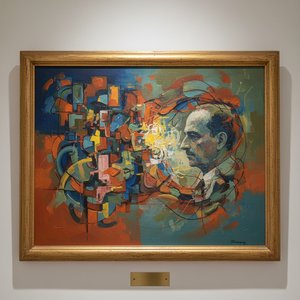
A Dual Legacy: The Canvas and the Pitch
The life of Jorge Alberto Mendonça Paulino, known to much of the world simply as Mendonça, represents a rare and beautiful intersection of physical prowess and contemplative artistry. While history books often remember him for his prolific era as a legendary striker in Spanish football, those who look closer find a man whose soul was equally engaged with the stroke of a brush. Born in 1938 in the vibrant, colonial atmosphere of Luanda, Angola, Mendonça’s early years were shaped by a landscape that would later serve as a profound wellspring for his creative expression. His journey is not merely one of athletic triumph, but a narrative of how personal identity and spiritual conviction can shape an artist's vision.
His ascent in the world of sport was nothing short of meteoric. Moving from the Portuguese club SC Braga to the intense competitive arena of Spain in 1958, he became a cornerstone of Atlético Madrid. During his twelve-season tenure with the Colchoneros, he achieved legendary status, securing five major titles including two prestigious European trophies. Yet, even amidst the roar of the crowds and the high-stakes pressure of La Liga, a quiet metamorphosis was occurring. The discipline required for professional football found a surprising parallel in the patience demanded by the canvas. For Mendonça, the stadium and the studio were not opposing worlds, but two different stages upon which he explored the complexities of human emotion and the grandeur of the natural world.
Symbolism and the Spirit of Landscape
Mendonça’s artistic language is deeply rooted in a sense of place and memory. His work often transcends simple representation, moving into the realm of the symbolic to capture the essence of his heritage. One can see this most clearly in his depictions of Morro do Jaraguá, the iconic hill overlooking his birthplace in Luanda. Through his eyes, these landscapes are not merely geographical markers but are imbued with a spiritual resonance that speaks to themes of origin, nostalgia, and the enduring strength of nature. His technique often utilizes vibrant hues and rich textures to evoke the heat, light, and atmosphere of the Angolan landscape, creating a bridge between his African roots and his European experiences.
As his career progressed, his work began to embrace more abstract elements, allowing for an exploration of internal landscapes. The paintings serve as a vessel for emotions that words often fail to capture—memories of a lost colonial era, the solitude of the athlete, and the profound peace found in faith. This shift toward abstraction allowed him to communicate universal truths through form and color, making his work accessible to those who may never have stepped foot in Angola but can recognize the human struggle for meaning within the layers of paint.
Faith, Transition, and Artistic Maturity
The later chapters of Mendonca's life were marked by significant personal transitions that fundamentally altered both his professional path and his creative focus. His conversion to Jehovah’s Witnesses in the late 1960s brought about a period of profound spiritual realignment. This conviction famously led to a clash with the leadership at FC Barcelona, ultimately resulting in his transfer to RCD Mallorca. This era of upheaval, while challenging his standing in the footballing world, provided a fertile ground for artistic introspection. The themes of devotion, steadfastness, and the search for divine truth began to permeate his compositions.
In retrospect, the significance of Jorge Alberto Mendonça Paulino lies in his refusal to be defined by a single dimension. He remains a singular figure in art history—a man who could navigate the physical intensity of a football pitch with the same grace and precision with which he navigated the delicate nuances of a landscape painting. His legacy is a testament to the idea that greatness is not found in choosing one path, but in the courage to pursue many, weaving together the triumphs of the body with the profound explorations of the spirit.