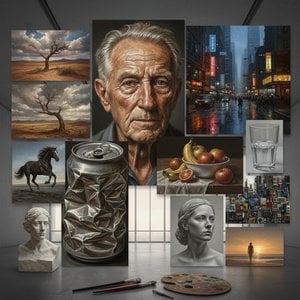
Jolán Gross-Bettelheim: Life and Art
Early Life and Education
Jolán Gross-Bettelheim (January 28, 1900 – July 29, 1972) was a Hungarian artist who navigated a complex artistic journey across Europe and the United States. Born in Nitra, Hungary, she began her formal art training in 1919 at the Budapest School of Fine Art. Her dedication to honing her skills led her to further studies at the Kunstgewerbeschule in Vienna and the Akademie der bildenden Künste in Berlin. She continued her artistic development in Paris between 1922-1924, attending the prestigious Académie de Grande Chaumière.
Settling in America & Artistic Development
In 1925, Gross-Bettelheim married Frigyes Bettelheim, a Hungarian-born radiologist, and immigrated to Cleveland, Ohio. She continued her studies at the Cleveland School of Art under the guidance of modernist painter Henry Keller. This period marked a significant phase in her artistic development as she embraced new techniques and explored modern art principles. She became an active participant in the local art scene, working not only as a painter and printmaker but also creating ceramic objects.
Social Commentary & Political Engagement
Gross-Bettelheim’s artistic vision was deeply intertwined with her social and political beliefs. She actively contributed to leftist publications such as New Masses and The Daily Worker, reflecting her commitment to social realism and portraying the realities of working-class life. Her work often depicted the challenges and complexities faced by individuals within an increasingly industrialized society.
New York City & Artistic Exploration
In 1938, she and her husband relocated to New York City, a move that profoundly impacted her artistic output. The vibrant energy of the metropolis inspired her to experiment with diverse mediums including pastel painting, photography, lithography, and etching. This period saw a broadening of her stylistic range as she sought new ways to capture the essence of modern urban existence.
Recognition & Major Achievements
Gross-Bettelheim’s talent garnered recognition during her time in the United States, most notably with an exhibition of her work at the Museum of Modern Art (MoMA) in 1936. This achievement solidified her position within the American art landscape and demonstrated the significance of her artistic contributions.
Return to Hungary & Legacy
Following World War II, Gross-Bettelheim returned to Hungary in 1956, where she continued to create art until her death in Budapest in 1972. Her work stands as a testament to the power of art to reflect and comment on the human condition within the context of rapid social and technological change.
Themes & Influences
Gross-Bettelheim’s artistic legacy lies in her ability to capture both the allure and alienation inherent in modern urban life. Her work explores themes of:
- The human experience within industrialized society
- The contrast between familiarity and foreignness in a rapidly changing world
- Social commentary on working-class struggles
While specific artistic influences are not extensively documented, her training at leading European art academies and her engagement with social realism suggest an awareness of movements like Expressionism and the Neue Sachlichkeit (New Objectivity). Her work is a compelling example of how artists can use their craft to illuminate the complexities of the modern world.