John Whittall: A Portraitist Bridging Victorian Tradition and Modern Expression
John Whittall (1858 – 3 February 1929) stands as a fascinating figure in British art history, embodying the spirit of his era while simultaneously forging a distinctive artistic path. Born in İzmir, Ottoman Empire, Herbert Octave Whittall descended from a family established in Smyrna during the Napoleonic Wars—a lineage marked by entrepreneurial ventures and connections to international trade.
Early Life & Family Background: Whittall’s upbringing amidst a large family fostered an appreciation for craftsmanship and familial bonds. His father, Charlton Whittall, was a Liverpool-born trader who spearheaded the Whittall & Co. trading company, establishing a foothold in Smyrna and later expanding into Constantinople. This formative experience instilled in Herbert a keen understanding of business acumen and cultural exchange.
- Marriage & Family: He married Louisa Jane Maltass in 1883, creating a family that included four children—Kathleen, Helen, Frederick Edwin, and Linda Frances—each contributing to the Whittall legacy. Notably, his son Herbert James Whittall pursued a distinguished career as a footballer, representing Bournabat FC with distinction during the Victorian period.
Bournabat FC & Sporting Achievements
Whittall’s involvement in Bournabat FC cemented his reputation as a sportsman and businessman. He served as manager of the club for several years, overseeing its success in the late 1890s—a testament to his leadership qualities and dedication to fostering community spirit.
Later Life & Artistic Pursuits
Whittall’s later years were marked by a move to Tunis, Tunisia, where he continued to engage in philanthropic endeavors and pursued artistic interests. He contributed articles to The Times on the Greco-Turkish War of 1897–1898, demonstrating his commitment to public discourse and historical awareness.
Whittall’s Artistic Vision: Impressionistic Techniques & Psychological Insight
Whittall's approach to portraiture distinguished him from many contemporaries, prioritizing not merely likeness but also capturing the essence of his subjects’ inner lives. He embraced Impressionistic techniques—particularly the use of broken color and atmospheric perspective—rejecting academic conventions in favor of capturing fleeting moments and subjective impressions.
- Influence of Impressionism: Whittall's exposure to Impressionist painters like Claude Monet and Pierre-Auguste Renoir profoundly shaped his artistic sensibilities. He adopted their innovative strategies for depicting light and color, rejecting academic conventions in favor of capturing fleeting moments and subjective impressions.
- Psychological Depth & Emotional Expression: Whittall’s portraits transcended mere visual representation, delving into the psychological complexities of his subjects—revealing nuances of emotion and character that conveyed profound insight. He skillfully utilized tonal variations and subtle gestures to communicate inner states with remarkable accuracy.
Notable Portraits & Artistic Recognition
Whittall’s oeuvre comprises a diverse collection of portraits—spanning individuals from the British aristocracy to prominent figures in Ottoman society—each reflecting his artistic vision and technical prowess.
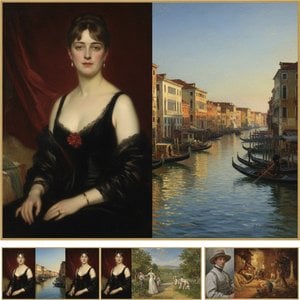
- Portraits of Aristocrats: Whittall produced numerous portraits of aristocratic families—capturing their stately grandeur and conveying an aura of refinement. His canvases showcased impeccable compositional balance and masterful rendering of drapery—elements that underscored his command of classical art principles.
- Ottoman Dignitaries & Cultural Figures: Whittall’s artistic explorations extended beyond British circles—embracing portraits of Ottoman dignitaries and cultural luminaries—demonstrating his cosmopolitan outlook and appreciation for diverse traditions. His canvases conveyed an awareness of historical context and stylistic influences from across Europe.
- Critical Acclaim & Artistic Reputation: Whittall received considerable acclaim during his lifetime—recognized by fellow artists and critics alike for his artistic integrity and technical excellence. His portraits secured a place in museum collections—affirming his enduring legacy as one of Britain’s most accomplished portraitists.
Conclusion
John Whittall’s artistic journey exemplifies the dynamism of Victorian culture—characterized by intellectual curiosity, stylistic experimentation, and a profound engagement with human experience. Through his masterful technique and humanist vision, Whittall secured a place among Britain's most celebrated portraitists—leaving an indelible mark on art history and inspiring artists to explore the complexities of human emotion.