John Northcote Nash: Bridging the Canvas and the Word
Born in London in 1893, John Northcote Nash (1893-1977) emerged as a singular figure within British art – a painter who seamlessly blended landscape with botanical illustration, and a wood engraver whose meticulous detail hinted at a profound understanding of both the natural world and its representation. His life story is one of quiet determination, nurtured by a supportive brother and shaped by a complex family history, ultimately culminating in a body of work that quietly yet powerfully captures the essence of the English countryside and the delicate beauty of its flora.
Nash’s early years were marked by an unusual combination of influences. His mother, suffering from mental illness, resided in an asylum, while his father was a lawyer. This unconventional upbringing fostered a sense of independence and observation within him. He received limited formal artistic training, yet his brother, Paul Nash – already establishing himself as a prominent Modernist painter – recognized his younger sibling’s innate talent for draughtsmanship and encouraged him to develop it. This mentorship proved crucial, providing John with the confidence to pursue his artistic inclinations, initially experimenting with watercolour landscapes and even humorous comic drawings.
The 1913 joint exhibition at the Dorien Leigh Gallery in London marked a pivotal moment. It was here that Nash’s work first gained recognition, attracting the attention of influential figures like Claughton Pellew and Dora Carrington – both of whom would significantly impact his artistic trajectory. Carrington, particularly, became a close friend and confidante, her own artistic sensibilities subtly influencing Nash's approach to composition and color. The London Group, formed in 1914, provided him with a platform for experimentation and collaboration, exposing his work to a wider audience within the burgeoning British avant-garde.
The Shadow of War and Artistic Transformation
World War I dramatically altered Nash’s life and artistic focus. Initially unable to enlist due to illness, he nonetheless found himself drawn into the war effort, joining the Artists' Rifles in 1916. His service as a sergeant on the front lines – particularly at Passchendaele and Cambrai – profoundly shaped his perspective, culminating in his most celebrated work: ‘Over the Top’ (1918). This harrowing depiction of the British infantry’s disastrous counter-attack is not merely a record of battle; it's an intensely emotional portrayal of loss, courage, and the brutal realities of war. The painting’s stark realism and unflinching honesty shocked audiences at the time and continues to resonate today.
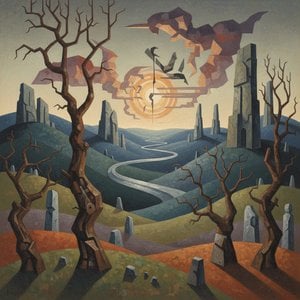
Following the war, Nash shifted his attention towards landscape painting, seeking solace and a return to the beauty he had so meticulously documented during the conflict. He began to explore geometric abstraction, influenced by his brother Paul’s ‘Equivalents for the Megaliths,’ reflecting a desire to capture not just visual likeness but also underlying structures and relationships within nature. His work from this period – exemplified by paintings like 'The Cornfield' – demonstrates a remarkable control of form and color, creating images that are both precise and evocative.
Botanical Precision and the Language of Flowers
Beyond his war art, Nash developed a distinctive skill in botanical illustration. He possessed an encyclopedic knowledge of plant life, meticulously documenting its forms and details with astonishing accuracy. This passion extended to book illustrations, where he created exquisite renderings of flowers, ferns, and other flora, often incorporating intricate scientific notations alongside the artwork. His botanical studies weren’t simply decorative; they reflected a deep appreciation for the natural world and a desire to communicate its complexities through visual language.
His meticulous approach to detail, honed during his war service and further refined through his botanical pursuits, is evident in every brushstroke. He wasn't merely copying nature; he was interpreting it, distilling its essence into a series of carefully constructed images that captured both its beauty and its underlying structure. The influence of Paul Nash’s geometric abstraction can also be seen in these works, creating a unique synthesis between observation and artistic interpretation.
Legacy and Continuing Influence
John Northcote Nash remained active as an artist and art critic until his death in 1977. His work is characterized by a quiet intensity, a profound understanding of the English landscape, and a remarkable ability to convey both beauty and sorrow. While often overshadowed by his more famous brother, Paul Nash, John’s contribution to British art deserves recognition for its distinctive style, technical skill, and emotional depth.
His paintings continue to be exhibited and studied, offering viewers a glimpse into the life of an artist who navigated the complexities of early 20th-century Britain with sensitivity, observation, and unwavering dedication to his craft. Nash’s legacy lies not only in his individual works but also in his embodiment of the spirit of British Modernism – a quiet yet powerful voice that captured the essence of a nation grappling with change and loss.