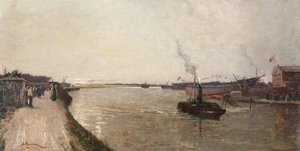
John MacNiven (1819–1895): A Scottish Landscape Painter’s Legacy
John MacNiven, born in Glasgow on September 15, 1819, was a pivotal figure in the Scottish landscape painting movement of the Victorian era. His artistic journey spanned decades, culminating in a prolific output that captured the beauty and spirit of Scotland's Highlands and Lowlands with remarkable sensitivity and detail. MacNiven’s work stands as testament to Romantic ideals blended with meticulous observation—a hallmark of his distinctive style.
Early Life and Artistic Influences
MacNiven descended from a family rooted in Islay, where his father, Dugald McNiven, was a grain storeman. Growing up amidst the Gaelic traditions of Glasgow’s vibrant cultural landscape profoundly shaped his worldview and instilled an appreciation for folklore and storytelling—elements that would subtly permeate his artistic vision. Like many artists of his time, MacNiven absorbed influences from luminaries such as John Constable and William Turner, whose masterful depictions of light and atmosphere served as models for his own explorations of the natural world. His formative years were marked by a fascination with topographical drawing and an early inclination towards capturing landscapes with accuracy and nuance. He diligently studied the works of Constable and Turner, particularly their use of atmospheric perspective—a technique employing subtle tonal variations to simulate the effects of haze and distance—which would become integral to MacNiven’s artistic approach.
Career Highlights: From Watercolor to Oil Paintings
MacNiven began his artistic career with watercolor studies, honing his skills in capturing fleeting moments of light and color. However, he swiftly transitioned to oil painting, achieving considerable renown for his expansive canvases depicting iconic Scottish vistas—including Loch Lomond, Glencoe, and Cairngorms National Park. His landscapes are characterized by a remarkable blend of realism and expressive brushwork, conveying not merely visual impressions but also emotional resonance. MacNiven’s paintings gained recognition from prominent art critics and collectors alike, establishing him as one of Scotland's foremost landscape artists. Notably, he was awarded the RSA Gold Medal in 1853 for his watercolor painting “The Loch Katrine Landscape,” cementing his reputation as a master of tonalism—a technique emphasizing subtle gradations of color to evoke mood and atmosphere. This prestigious honor underscored MacNiven’s dedication to capturing the sublime beauty of Scotland's scenery with unparalleled artistry.
Notable Paintings and Artistic Technique
Among MacNiven’s most celebrated works are “The Cairngorms” (1860), “Ben Nevis” (1873), and “Glencoe” (1875)—each capturing the grandeur of Scotland's mountainous terrain with breathtaking precision. His technique involved layering thin washes of color to build up tonal harmonies, creating luminous surfaces that shimmered with reflected light—a hallmark of his distinctive style. MacNiven’s meticulous attention to detail extended beyond mere topographical accuracy; he imbued his paintings with a palpable sense of place, conveying the textures and moods of the Scottish Highlands with unparalleled artistry. His landscapes are admired for their evocative beauty and enduring appeal, continuing to inspire viewers today. He meticulously recreated the dramatic vistas of Glencoe—a site scarred by the infamous massacre of 1865—capturing the brooding atmosphere and rugged topography with remarkable fidelity.
Legacy and Influence
John MacNiven’s artistic legacy extends far beyond his individual oeuvre—he profoundly impacted the development of landscape painting in Scotland during the Victorian era. He championed tonalism as a means of conveying emotion and atmosphere, influencing subsequent generations of Scottish artists. His paintings remain treasured examples of Romantic idealism blended with scientific observation—a testament to his unwavering commitment to capturing the sublime beauty of the natural world. MacNiven’s contribution to Scottish art history is undeniable, securing his place among Scotland's most revered landscape painters. He solidified his position as a leading figure in Scottish artistic circles and left an indelible mark on the visual culture of his time.