John Henry Lorimer: A Scottish Painter of Domestic Life and Architectural Legacy
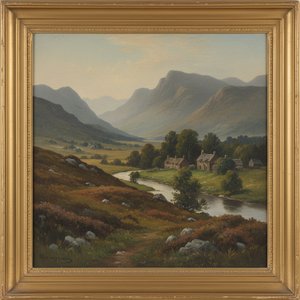
John Henry Lorimer (1856 – 1936) was a Scottish painter whose artistic output primarily focused on capturing the nuances of everyday life—particularly domestic scenes—and celebrating the grandeur of Kellie Castle, a project inextricably linked to his brother’s architectural endeavors. Born in Edinburgh, Lorimer descended from a family steeped in intellectual pursuits; his father, James Lorimer, held a prestigious professorship at Edinburgh University, shaping young John's academic foundation. Educated at Edinburgh Academy and subsequently Edinburgh University, he honed his artistic skills further through studies at the Royal Scottish Academy, mentored by influential figures like Frank McTaggart and William Chalmers. This formative period instilled in him a deep appreciation for Impressionistic techniques and compositional considerations—a stylistic choice that would define much of his oeuvre. Lorimer’s early artistic inclinations were nurtured by familial connections to prominent intellectuals and artists. His brother, Robert Lorimer, was a celebrated architect who collaborated closely with John on the ambitious restoration of Kellie Castle, transforming it from a dilapidated ruin into a magnificent Victorian holiday home—a project that served as both inspiration and practical challenge for their creative partnership. This familial bond extended beyond shared heritage; Robert’s architectural vision profoundly influenced Lorimer's artistic sensibilities, fostering an understanding of spatial harmony and visual storytelling. Between 1877 and 1891, Lorimer embarked on extensive travels across Europe—spanning Spain, Italy, and Algeria—experiences that broadened his artistic horizons considerably. These journeys exposed him to diverse cultural traditions and artistic movements, enriching his visual vocabulary and informing his stylistic explorations. He diligently studied under Charles Duran in Paris, absorbing the principles of Impressionism and honing his observational skills—techniques he would skillfully integrate into his paintings. Lorimer’s prolific output during his lifetime resulted in approximately 123 works exhibited at the Royal Scottish Academy and 43 at the Royal Academy in London—a testament to his unwavering dedication to artistic practice and recognition within the British art world. His celebrated canvases include “The Ordination of Elders in a Scottish Kirk,” which hangs prominently in the National Gallery of Scotland, capturing a moment of solemn ritual with meticulous detail and evocative light; "A Peaceful Art and Kellie Castle Garden," depicting the castle’s serene landscape—a scene that embodies Lorimer's fascination with Romantic ideals of beauty and contemplation. Sold at auction in 2000 for £32,900, this artwork remains a captivating glimpse into Victorian Scotland. Furthermore, Lorimer’s portraits – including those of Lyon Playfair, Joseph Lister, Peter Hately Waddell, and Frederick Guthrie Tait—demonstrate his mastery of capturing human likeness with sensitivity and psychological insight. Lorimer's artistic style is characterized by meticulous realism combined with a lyrical sensibility—a harmonious blend that distinguishes him from more abstract approaches to painting. He excelled in portraying portraits of notable individuals – including Lyon Playfair, Joseph Lister, Peter Hately Waddell – capturing their likenesses with remarkable accuracy while subtly conveying their personalities and inner lives. His landscapes, notably “A Peaceful Art and Kellie Castle Garden,” exemplify the Romantic tradition's fascination with sublime beauty and emotional resonance. Lorimer’s legacy extends beyond his artistic achievements; he played a crucial role in preserving Kellie Castle—a Victorian holiday home transformed into a magnificent architectural masterpiece thanks to Robert Lorimer’s visionary design—and continues to inspire admiration for its enduring aesthetic value. His nephew, Hew Lorimer, upheld the family tradition as a sculptor, perpetuating the Lorimer lineage's commitment to creative excellence.Otázky a odpovědi
Kde najdu díla umělce John Henry Lorimer uspořádaná podle tématu?
Stránka Abeceda témat mapuje díla umělce John Henry Lorimer podle tématu.
Mohu si díla umělce John Henry Lorimer seřadit podle barvy?
Spektrální index umělce John Henry Lorimer je stránka, která organizuje jeho díla podle jejich barev.
Kolik děl umělce John Henry Lorimer je možné si prohlédnout?
V katalogu si můžete prohlédnout 57 děl děl autora John Henry Lorimer na stránce Všechna umělecká díla.