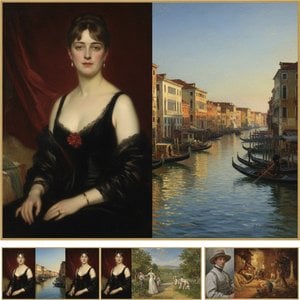
A Legacy in Light and Line: The Life of John Frederick Tayler
The story of John Frederick Tayler is one of profound artistic devotion, a narrative that begins amidst the rolling landscapes of Elstree, Hertfordshire. Born in 1802 into a family of notable social standing, Tayler’s early life was shaped by a tension between tradition and individual passion. While his lineage suggested a path toward the clergy—a destiny hinted at by his education at the prestigious Eton College and Harrow School—the pull of the visual arts proved irresistible. Despite the domestic reservations of a family rooted in scholarly and clerical pursuits, Tayler chose to follow the light, trading the pulpit for the palette. This resolute decision would eventually lead him to become one of the most respected figures in the nineteenth-century English art world.
His formal training was a journey through the very heart of European artistic excellence. After honing his skills at Sass's School and gaining entry to the Royal Academy in 1830, Tayler sought inspiration beyond the borders of England. His time in Paris was particularly transformative; it was here that he forged a lasting bond with the brilliant Richard Parkes Bonington. Together, these two luminaries shared a studio, absorbing the vibrant, atmospheric spirit of the era. This period of intense creativity was further enriched by his exposure to the works of Paul Delaroche and the influence of the French landscape tradition. As he traveled through Italy, particularly in the eternal city of Rome, Tayler immersed himself in the classical ideals that would forever inform the structural elegance of his compositions.
The Mastery of Watercolour and the Romantic Spirit
While Tayler made a striking debut at the Royal Academy with an oil portrait titled “The Band of the Second Life Guards,” it was in the delicate, translucent medium of watercolour that he truly found his voice. He recognized that oil, for all its grandeur, could rarely match the ephemeral magic of light filtering through mist or the soft glow of a setting sun upon a pastoral meadow. This preference for watercolour allowed him to capture the fleeting atmospheric effects that defined the Romantic movement. His works often possess a luminous quality, where the paper itself seems to breathe beneath layers of pigment, creating scenes that feel both grounded in reality and elevated by poetic sentiment.
His subject matter was as varied as his travels, yet always unified by a certain refined grace. Tayler became celebrated for several distinct genres:
- Sporting Scenes: His ability to depict the movement and vitality of horses and hounds brought an elegant energy to the English sporting tradition.
- Pastoral Landscapes: He possessed a singular talent for rendering the quiet, rhythmic beauty of the countryside, often imbuing them with a sense of nostalgic peace.
- Historical and Genre Subjects: Drawing inspiration from the evocative narratives of the Waverley Novels, he created illustrative works that captured the drama and domesticity of historical life.
A Distinguished Career and Enduring Significance
The zenith of Tayler’s professional life was marked by his leadership within the artistic community. His appointment as the President of the Royal Watercolour Society was not merely a personal triumph but a testament to his standing among his peers. Under his guidance, the society continued to flourish, cementing the importance of watercolour as a serious and sophisticated medium in Victorian England. His work bridged the gap between the meticulous detail of traditional engraving and the emotive, fluid brushwork of the burgeoning Romantic style.
Even as the art world shifted toward new movements, Tayler’s commitment to classical composition and atmospheric truth remained steadfast. He left behind a body of work that serves as a window into the nineteenth-century soul—a collection of moments captured in light, from the rugged cattle of the Highlands to the quiet dignity of a waiting page. Today, his legacy persists in the collections of prestigious institutions like the Victoria and Albert Museum, where his ability to weave together history, nature, and emotion continues to captivate the modern eye, reminding us of a time when art was a profound dialogue between the artist and the natural world.
Otázky a odpovědi
Existuje přehled všech témat, která John Frederick Tayler maloval/a?
Stránka Atlas témat umělce John Frederick Tayler umožňuje prohlížet jeho díla podle jejich témat.
Pod jakými dalšími jmény je John Frederick Tayler známý/á?
John Frederick Tayler je známý/á také pod jmény Frederick Tayler.
V jakých uměleckých směrech působil/a John Frederick Tayler?
Umělecká směry, ve kterých John Frederick Tayler působil/a, si můžete prohlédnout na stránce Všechna umělecká hnutí, která seskupuje díla podle jednotlivých směrů.