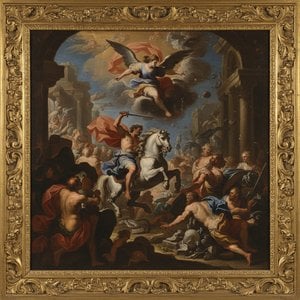
Johann Michael Rottmayr (1654 - 1730): Austrian Baroque Master
Johann Michael Rottmayr, born in Lauf an der Pegnitz, Bavaria around 1654 (sources vary between 1654 and 1656), stands as a pivotal figure in the transition from the High Baroque to the Rococo styles in Central Europe. He wasn’t merely a painter; he was a conduit, skillfully channeling the vibrant energy of Italian Renaissance masters through the lens of burgeoning Austrian artistic sensibilities. Rottmayr's journey began within a family already touched by artistry, providing fertile ground for his innate talents to blossom. His formal training commenced under Johann Carl Loth in Venice – a formative experience that would indelibly shape his aesthetic vision. Loth’s tutelage wasn’t simply about technique; it was an immersion into the world of Titian, Veronese, and Tintoretto, instilling within Rottmayr a deep appreciation for coloristic richness, dramatic composition, and the masterful use of light and shadow. This Venetian influence would remain a cornerstone of his style throughout his career. He wasn’t alone in absorbing Italian influences; Hans Adam Weissenkircher, a contemporary from Lauf, also played a crucial role in bringing these artistic currents northwards, fostering a shared aesthetic dialogue that enriched the region's art scene.Early Life and Artistic Training
Rottmayr’s early life was marked by familial connections to artistry—his father, Friedrich Rottmayer, was a church organist—a circumstance that undoubtedly nurtured his own creative inclinations from a young age. Around 1675 he embarked on a crucial artistic pilgrimage to Venice, entering the workshop of Johann Carl Loth, an expatriate Bavarian who had established himself as a respected painter and teacher there. This encounter proved transformative; Loth’s instruction wasn’t merely about mastering brushstrokes but encompassed a profound understanding of Venetian painting traditions—specifically the monumental works of Titian, Veronese, and Tintoretto—inspiring Rottmayr to emulate their masterful use of color, perspective, and theatrical lighting. This Venetian influence would permeate his subsequent artistic endeavors, shaping his distinctive visual language for decades to come. Loth’s guidance instilled in Rottmayr a deep appreciation for the grandeur and emotional intensity characteristic of the High Baroque, preparing him for the challenges and opportunities that awaited him as he pursued his artistic ambitions.Salzburg and Collaboration with Fischer
Rottmayr swiftly gained recognition for his talent, securing a prestigious position as the general painter to the Prince-Bishop of Salzburg in 1689—a patronage that would propel his career and provide him with consistent commissions. This appointment wasn’t merely lucrative; it represented an endorsement of his artistic abilities within influential circles of Viennese society. He flourished under this support, producing both secular and religious artworks that showcased his growing mastery. Notably, Rottmayr forged a remarkable partnership with Johann Bernhard Fischer von Erlach—a leading architect of the time—collaborating on ambitious projects designed to harmonize architecture and painting into immersive spaces. Their most celebrated achievement is undoubtedly the allegorical frescoes adorning Schloss Frain an der Thaya (now Vranov nad Dyjí in the Czech Republic)—where Rottmayr’s skill in illusionistic ceiling painting truly shone. The compositions weren't merely decorative; they actively engaged with the architectural structure, creating a harmonious and dynamic whole—a testament to their shared vision of artistic excellence. This collaboration cemented Rottmayr’s reputation as one of Austria’s foremost artists, establishing him alongside Fischer as pioneers of Baroque monumental art.Melk Abbey Dome: A Triumph of Illusion
Rottmayr's magnum opus remains the fresco adorning the central dome of Melk Abbey—a breathtaking spectacle that embodies the zenith of Baroque artistic achievement. Completed with unparalleled dedication and technical virtuosity, this monumental artwork depicts a glorious vision of heaven—a swirling vortex of figures, light, and color that seems to dissolve the very boundaries between earth and sky. The sheer scale of the project demanded masterful command of perspective and illusionistic techniques—skills Rottmayr honed to perfection, creating an overwhelming sense of awe and spiritual transcendence for viewers. It stands as a testament to his ability to transform architectural space into a realm of divine beauty—a feat that continues to inspire admiration centuries later. The fresco’s impact extended beyond its aesthetic grandeur; it was chosen as the central motif for a high-value Austrian commemorative coin in 2007—a fitting tribute to an artist whose work embodies the enduring legacy of Baroque art.Legacy and Influence
Johann Michael Rottmayr's significance transcends his individual masterpieces; he played a crucial role in bridging the gap between the Italian Renaissance traditions and the evolving Baroque style in Central Europe. He wasn’t simply imitating Italian art; he was adapting it, infusing it with a distinctly Austrian character—a synthesis that resulted in a uniquely expressive artistic idiom. Rottmayr’s paintings are characterized by dramatic lighting, vibrant colors, and dynamic movement—hallmarks of the Baroque aesthetic—yet they also reveal a growing sensitivity to form and detail, foreshadowing the elegance and refinement of the Rococo period. He is rightfully considered one of Austria's most important painters of the late 17th and early 18th centuries—a figure whose influence reverberated throughout subsequent generations of artists, shaping the artistic landscape of Austria and beyond. His enduring legacy resides not only in his stunning artworks but also in his pioneering spirit—his willingness to embrace innovation while honoring established traditions—a testament to the transformative power of art. He died peacefully in Vienna on October 25th, 1730.Otázky a odpovědi
Jaké nálady vyjadřují umělecká díla umělce Johann Michael Rottmayer?
Stránka Pokoj nálad umělce Johann Michael Rottmayer umožňuje prohlížet jeho díla rozřazená podle nálady.
Jak populární jsou umělecká díla umělce Johann Michael Rottmayer?
Pro umělce Johann Michael Rottmayer existuje stránka Statistiky, která zobrazuje statistiky o dílech tohoto umělce na tento web.
V jakém městě a z jaké země pochází Johann Michael Rottmayer?
Johann Michael Rottmayer se narodil(a) ve městě Laufen an der Salzach v zemi Rakousko.