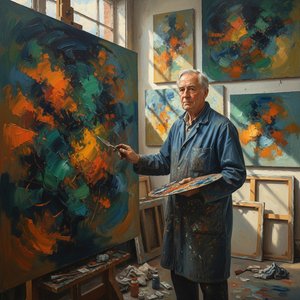
A Life Painted Across Continents: The Journey of Jerry Gordon
Jerry Gordon’s artistic path is one woven from a rich tapestry of experience, travel, and an enduring passion for capturing the essence of place. Born in 1955 in Fleetwood, Lancashire – a bustling fishing town brimming with life – his early years were steeped in creativity, nurtured by a father who was both a fish filleter and a musician. This duality—the tangible world of labor alongside the ethereal realm of artistic expression—would become a defining characteristic of Gordon’s work. From a young age, he demonstrated exceptional talent, consistently achieving top marks in art throughout his schooling. Though formal training beckoned, a desire to remain close to home initially led him towards technical illustration before life took an unexpected turn with the sudden loss of his father. This pivotal moment prompted a period of practical employment at ICI factory, followed by marriage and a commitment to social work—a career path that would ultimately shape his perspective and inform his artistic vision.
From Social Work to Sacred Sites: A Shifting Focus
The 1980s saw Gordon balancing the demands of a burgeoning family life with an unwavering dedication to painting, often working in a small back-room studio. He pursued further studies at art colleges in Birmingham and Liverpool, honing his skills while simultaneously navigating the complexities of social work. This period was marked by a growing restlessness, a yearning for something more than the confines of domesticity allowed. A bold decision led him to embark on a sabbatical, traveling to Palamos, Catalonia, where he immersed himself in painting for eight months, followed by four months exploring the landscapes of the Lake District. These travels were not merely geographical shifts; they represented a fundamental re-evaluation of his priorities and a commitment to pursuing art as a primary vocation. He sold his house, funding further exploration and a desire to document sacred sites around the world through his artwork. This quest for meaning and connection would become a central theme in his oeuvre.
The Pitcairn Island Project and Rising Recognition
The 1990s proved to be a watershed moment in Gordon’s career with the ambitious “Fletcher Christian’s Cave” project on Pitcairn Island. This undertaking, sparked by an intense fascination with the infamous mutineer, quickly gained both national and international attention. The resulting paintings—vibrant impressionistic landscapes rendered with thick impasto and lush detail—evoked a sense of paradise lost and found. The project’s “viral” success led to numerous exhibitions and sales, establishing Gordon as a significant artistic voice. He continued to travel extensively, painting sacred sites across the globe, developing a unique style characterized by bold colors, expressive brushwork, and an ability to capture the spiritual energy of each location. His dedication extended beyond mere representation; he sought to understand the history, culture, and mythology embedded within these places.
A Diverse Body of Work: From Bolton to Blackpool
Throughout his career, Jerry Gordon’s paintings have found a home in prestigious collections, including those at Bolton Museum and Art Gallery, Lancaster Museum and Art Gallery, and Blackpool Grundy Art Gallery, as well as private holdings belonging to prominent families like the Cadogan and Thomas-Davies. His subject matter is remarkably diverse, ranging from intimate portraits of neighborhood life in South Manchester to sweeping landscapes of Trinidad and evocative depictions of Queen’s Park in Bolton. He even ventured into the realm of commercial art, with a painting sold at Bonham’s in 1996 – “Moonlit Bounty Bay”. This breadth of work reflects his versatility as an artist and his ability to find beauty and meaning in a wide range of subjects. His commitment to artistic exploration extended to academic pursuits, completing a four-year Art History degree at the University of London's Birkbeck College while also attending summer schools at the renowned Slade School of Art.
Legacy and Continued Exploration
Jerry Gordon’s journey is far from over. He continues to paint from his studio in Rusholme, documenting the world around him with a keen eye for detail and an unwavering passion for capturing the human spirit. His book, *Little Art Book, Big Ideas*, published in 2014, further demonstrates his commitment to sharing his artistic vision and inspiring others. While balancing his creative pursuits with ongoing social work commitments – often taking on agency roles to provide financial stability for his family – he has consistently produced a body of work that is both visually stunning and deeply meaningful. His paintings are not simply representations of places; they are windows into the soul, reflections of history, culture, and the enduring power of human connection. His life story itself—a testament to resilience, dedication, and an unwavering pursuit of artistic expression—is as captivating as the canvases he creates. Gordon’s work stands as a reminder that art is not merely about skill or technique; it is about seeing the world with fresh eyes and sharing that vision with others.