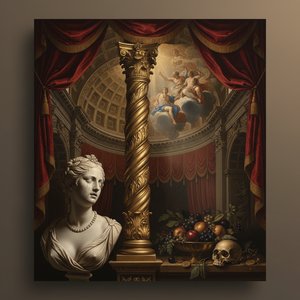
Jean Louis Morin: Bridging Flemish Realism and French Classicism
Jean Louis Morin (c. 1595 – 1650) stands as a fascinating figure in the artistic landscape of 17th-century France, representing a crucial transitional period between the opulent grandeur of Flemish Baroque painting and the burgeoning ideals of French classicism. Born Vincennes, France, his life remains shrouded in relative obscurity compared to contemporaries like Rembrandt or Rubens, yet his contribution to art history is undeniable – he skillfully blended stylistic elements from both traditions, producing works that resonate with a profound sense of drama and intellectual depth.
Morin’s artistic journey began amidst the vibrant cultural milieu of Vincennes, where humanist ideals were gaining traction alongside religious fervor. While biographical details are scarce, evidence suggests he trained under Rubens in Antwerp, absorbing the Flemish master's masterful use of chiaroscuro – dramatic contrasts between light and dark – a technique that would become integral to his own oeuvre. This formative experience instilled in him an appreciation for meticulous observation and anatomical accuracy, characteristics distinctly rooted in the Flemish tradition. However, Morin wasn’t merely replicating Rubensian style; he actively sought to elevate it with a more refined aesthetic sensibility, aligning it with the emerging humanist concerns of the era.
Morin's artistic output spanned portraiture, religious paintings, and etchings, demonstrating versatility within his chosen medium. His portraits captured the dignity and solemnity of aristocratic subjects, reflecting the prevailing social values of the time. Unlike some of his peers who prioritized mere likeness, Morin imbued his canvases with psychological nuance—a subtle awareness of emotion and inner life—a hallmark of French artistic thought developing during this period. He skillfully employed Rembrandt’s technique of tonal modeling to create depth and texture, subtly hinting at the complexities beneath a serene surface.
His religious paintings are particularly noteworthy for their expressive power and symbolic richness. Morin's depictions of biblical scenes – notably those featuring Saint Jerome—were executed with meticulous detail and imbued with profound spiritual contemplation. He skillfully utilized Rubensian color palettes—rich reds, golds, and blues—to convey the majesty of God’s presence and the solemnity of sacred rituals. Yet, he tempered Rubensian exuberance with a restrained elegance, reflecting the humanist emphasis on moral virtue and intellectual understanding that characterized French Baroque art.
Morin's etchings further solidified his reputation as an innovator. He embraced Rembrandt’s etching technique—a method of transferring images onto metal plates using acid—allowing for unprecedented precision and tonal subtlety. His prints explored themes ranging from mythological narratives to biblical scenes, demonstrating a masterful command of line and shading. These works stand apart from the more decorative etchings produced by Rubens and his followers, reflecting Morin's commitment to artistic seriousness and intellectual exploration.
Ultimately, Jean Louis Morin’s legacy resides in his ability to synthesize disparate stylistic influences into a cohesive artistic vision. He wasn’t simply copying Flemish techniques; he internalized them—adapting them to the evolving aesthetic sensibilities of France. By bridging the gap between Flemish realism and French classicism, Morin contributed significantly to shaping the artistic landscape of his time and cementing his place as a pivotal figure in European art history. His works continue to inspire admiration for their dramatic intensity, psychological insight, and enduring beauty—testaments to the transformative power of artistic innovation.