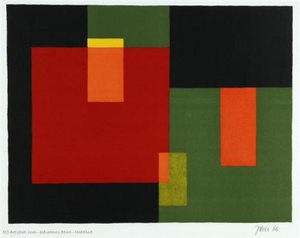
Johannes Itten - A Pioneer of Color and Form
Johannes Itten, born in Suedern Linden, Switzerland on November 11, 1888, was more than just a painter; he was a visionary educator who fundamentally reshaped the landscape of modern art instruction. His journey began not within the hallowed halls of traditional art academies, but as an elementary school teacher—a formative experience that instilled in him a deep understanding of learning processes and the blossoming of creative potential. Itten’s early pedagogical explorations, inspired by Friedrich Fröbel's groundbreaking kindergarten concepts, emphasized intuitive development over rigid instruction, a philosophy he would carry throughout his career. Though briefly attempting formal training at Geneva’s École des Beaux-Arts, he found its methods stifling, returning to Bern where studies with Ernst Schneider proved pivotal. Schneider championed collective critique over individual assessment, nurturing creative impulses rather than suppressing them—a radical approach that became central to Itten's own teaching methodology. Influences from Eugène Gilliard, who explored abstract forms, and Adolf Hölzel, who utilized basic shapes as the foundation for artistic creation, further shaped his evolving aesthetic. He embraced Hölzel’s belief in lines, planes, circles, and spirals as essential starting points for visual exploration, laying the groundwork for his later theoretical work on color and form.The Bauhaus Revolution: The Vorkurs and Color Theory
Itten's arrival at Walter Gropius’ newly founded Bauhaus in Weimar in 1919 marked a turning point not only in his career but also in the history of art education. Appointed as a Master, alongside Lyonel Feininger and Gerhard Marcks, he was tasked with developing a foundational course—the *Vorkurs*, or preliminary course—that would become legendary. This wasn’t merely an introductory class; it was a complete reimagining of how artists were trained. Itten believed in stripping away preconceived notions and encouraging students to explore the fundamental properties of materials, composition, and, most importantly, color. He theorized seven distinct types of color contrast – hue, value, temperature, complements (neutralization), simultaneous contrast, saturation, and extension—and devised a series of exercises designed to unlock an intuitive understanding of these principles. His “color sphere,” encompassing twelve fundamental colors, became a cornerstone of Bauhaus curriculum. Itten insisted that students engage in active experimentation with various mediums – clay, paper mache, wood shavings – fostering tactile awareness and encouraging them to respond directly to the materials themselves. He challenged conventional artistic dogma, advocating for a process-oriented approach that prioritized observation and sensory experience over technical skill alone. The Vorkurs was designed to liberate artists from academic constraints and empower them to discover their own unique creative vision.Influence and Artistic Output
Itten’s theoretical work on color profoundly impacted the development of Op Art, influencing artists like Bridget Riley who sought to create illusions of movement and vibration through precise geometric patterns. His meticulous studies of natural forms—particularly spirals—served as inspiration for countless artworks exploring themes of growth, transformation, and cosmic order. Itten's paintings often featured bold color palettes juxtaposed against stark geometric shapes, reflecting his belief in the interplay between emotion and intellect. Notable works include *The Encounter*, a monumental spiral composition imbued with symbolic meaning rooted in Mazdaznan cosmology—a testament to his spiritual convictions and artistic exploration. He also produced numerous drawings and prints that showcased his mastery of line and form, demonstrating an unwavering commitment to simplifying visual elements while maximizing expressive impact. His oeuvre embodies the Bauhaus ethos of combining craftsmanship with conceptual innovation, cementing his place as one of the most influential figures in 20th-century art.Legacy and Continuing Relevance
Johannes Itten’s pedagogical approach continues to resonate with educators today, advocating for holistic learning experiences that nurture creativity and foster a deep connection between students and their environment. His insistence on intuitive exploration—rather than rote memorization—remains remarkably pertinent in an era increasingly focused on standardized testing and quantifiable outcomes. Beyond his artistic achievements, Itten’s unwavering belief in the transformative power of art serves as an enduring reminder that true beauty lies not merely in aesthetic perfection but also in fostering intellectual curiosity and cultivating a sense of wonder. He died peacefully in Zürich, Switzerland on March 25, 1967, leaving behind a legacy of artistic innovation and pedagogical inspiration—a testament to his profound contribution to the history of modern art and education.Otázky a odpovědi
V jakém historickém období působil/a János Itten?
János Itten působil v období Modernismus. Toto období historicky vymezuje uměleckou činnost tohoto autora.
V jakém městě a z jaké země pochází János Itten?
János Itten se narodil(a) ve městě Süderen Linden v zemi Švýcarsko.
Mohu si prohlédnout díla umělce János Itten podle použité techniky?
Chcete-li najít všechna díla umělce János Itten v určité technice, navštivte jeho stránku Podle techniky.