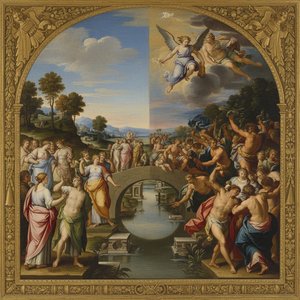
A Quiet Genius of the Baroque: Unveiling Jacopino da Reggio’s Legacy
Jacopino da Reggio remains a figure shrouded in relative obscurity compared to his contemporaries, yet his contribution to Renaissance and Baroque art deserves recognition as a master craftsman and innovator. Born sometime around 1300 – precise dates are elusive, reflecting the challenges of documenting life during that era – he emerged from Parma, Italy, establishing himself as a prolific illuminator and painter primarily active in the Duchy’s ecclesiastical circles. While his output wasn't monumental in scale like Correggio or Titian, Reggio’s meticulous attention to detail and profound understanding of symbolism cemented his place within the artistic landscape of his time.
- Early Influences: Reggio’s formative years coincided with the flourishing Gothic style prevalent across Northern Europe. The soaring arches, stained glass windows, and intricate ornamentation of Parma Cathedral undoubtedly instilled in him a reverence for grandeur and visual complexity. However, unlike many artists of his generation who embraced purely decorative pursuits, Regio possessed an intellectual curiosity that propelled him toward exploring humanist ideals – particularly those championed by Petrarch and Dante – informing his artistic vision.
- The Illuminated Gospels: Reggio’s fame rests largely on his stunning Gospel illuminations commissioned for the Benedictine Monastery of Parma. These manuscripts are considered masterpieces of Gothic illumination, showcasing unparalleled skill in pigment preparation, gilding techniques, and compositional artistry. Each page is a testament to meticulous craftsmanship, featuring vibrant colors derived from mineral pigments—azurite blue, ultramarine – painstakingly applied with delicate brushes.
Technique and Artistic Vision
Reggio’s artistic style distinguishes itself through its masterful use of *chiaroscuro*, a technique pioneered by Leonardo da Vinci that emphasizes dramatic contrasts between light and dark. This approach wasn't merely stylistic; it served to heighten the emotional impact of his depictions, conveying spiritual depth and conveying profound theological concepts. His compositions are carefully balanced, prioritizing clarity and readability alongside aesthetic beauty. Unlike some artists who favored elaborate ornamentation, Reggio opted for restraint, allowing the inherent luminosity of the pigments—particularly gold leaf—to illuminate the sacred narratives he portrayed.
- Notable Works Beyond Gospels: Although his Gospel illuminations dominate scholarly attention, Regio undertook commissions for altarpieces and frescoes in Parma churches. The Crucifixion with St Francis exemplifies his ability to convey emotion through subtle gestures and expressive drapery—a hallmark of the burgeoning Baroque aesthetic. This piece demonstrates a move toward greater realism and psychological nuance compared to earlier Gothic styles.
- Symbolism and Narrative Depth: Regio’s illuminations are laden with symbolic imagery reflecting medieval Christian theology. Recurring motifs such as lilies, doves, and crosses represent purity, peace, and divine grace respectively. Careful consideration of color palettes—often employing rich reds and blues—further enhances the narrative power of each scene.
Legacy and Historical Significance
Jacopino da Reggio’s influence extends beyond his immediate contemporaries. His meticulous technique and profound understanding of symbolism served as a crucial bridge between Gothic art and the emerging Baroque style. Artists like Correggio drew inspiration from Regio's mastery of illusionism, furthering the development of dramatic spatial effects—a cornerstone of Baroque painting. Although overshadowed by more celebrated figures, Reggio’s legacy persists in the enduring beauty and spiritual resonance of his illuminated Gospels – a testament to his artistic genius and unwavering devotion.
Further Exploration
You can delve deeper into Jacopino da Reggio's work through resources like
Antonio da Correggio: Innovation, Illusionism & the Poetics of Grace in Renaissance Painting for a comparative study of artistic styles and influences. Also consider visiting
Biblia Clementis VII Papae to admire one of his most iconic illuminated manuscripts.