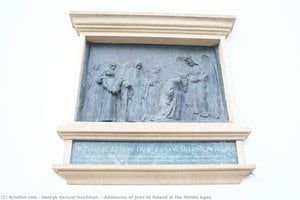
Henryk Hochman (1879 or 1881 – 1942 or 1943)
Henryk Herszel Hochman (born 1879 or 1881 in Lublin – died 1942 or 1943 in Baczków near Bochnia) was a Polish Jewish sculptor from the Academy of Fine Arts in Kraków. He honed his craft under the tutelage of Paweł Rosen in Warsaw, Konstanty Laszczka during his studies at Kraków (1900–1906), and Auguste Rodin in France, absorbing the stylistic principles of the Impressionist master. Hochman’s artistic journey was tragically cut short by the horrors of the Holocaust, leaving behind a legacy marked by both remarkable creativity and profound loss.
Early Life & Artistic Formation
Born in Lublin, Poland, Hochman's formative years were steeped in Jewish cultural traditions and intellectual pursuits. Details about his early life remain somewhat sparse, primarily documented through biographical sketches found in scholarly publications. However, it is known that he demonstrated an exceptional aptitude for artistic endeavors from a young age, gravitating towards sculpture as his chosen medium. His formal education commenced at the Academy of Fine Arts in Kraków, where he studied under Florian Cynk and Konstanty Laszczka, gaining invaluable experience in classical sculpting techniques. This foundational training proved pivotal in shaping his subsequent artistic style—a distinctive blend of realism and expressive gesture.
Influences & Artistic Style
Hochman’s artistic sensibilities were profoundly impacted by Auguste Rodin, whose monumental sculptures served as a significant inspiration. Like Rodin, Hochman embraced the challenge of capturing human emotion through form, prioritizing anatomical accuracy alongside psychological depth. His sculptural portraits are characterized by meticulous detail and subtle nuances of expression—a testament to his dedication to portraying the inner life of his subjects. Furthermore, Hochman skillfully utilized various materials – marble, bronze, terracotta, and majolica – demonstrating versatility and technical mastery. The influence of Rodin’s approach to modeling and casting techniques is palpable in many of Hochman's works, cementing his place within the broader artistic landscape of the early 20th century.
Notable Works & Achievements
Hochman achieved considerable renown for his sculptural contributions to Polish art history. Among his most celebrated creations is “Kol Nidre,” a monumental bas-relief bronze commemorating Jewish tradition and featuring prominently in the former Town Hall of Kazimierz, Kraków. This evocative piece exemplifies Hochman’s ability to convey complex themes through stylized forms—a hallmark of his artistic vision. Beyond “Kol Nidre,” Hochman produced numerous portraits and busts that captured the likenesses of prominent figures from Polish society. His sculptures are housed in museums across Poland and internationally, ensuring their enduring presence within the canon of modern sculpture. The loss of many of his artworks during the Holocaust represents a devastating blow to artistic heritage, underscoring the tragic circumstances surrounding Hochman’s life and career.
The Holocaust & Legacy
Henryk Hochman's artistic pursuits were tragically interrupted by the outbreak of World War II and the subsequent Nazi occupation of Poland. Forced into hiding amidst escalating antisemitic persecution, he endured immense hardship and deprivation—a harrowing experience that profoundly impacted his personal life. Despite facing insurmountable obstacles, Hochman continued to sculpt clandestinely, preserving his creative spirit in defiance of oppressive conditions. Sadly, he perished in Baczków ghetto during the Holocaust, marking the end of a brilliant artistic career. The destruction of countless artworks during this period represents an irreparable loss for Polish culture—a poignant reminder of the human cost of intolerance and barbarism. Nevertheless, Hochman’s surviving sculptures stand as enduring symbols of resilience and artistic integrity—testaments to his unwavering commitment to art amidst unimaginable adversity.