A Master of Maritime Detail: The Enigmatic Heerman Witmont
Heerman Witmont, a name resonating softly within the annals of the Dutch Golden Age, remains an intriguing figure shrouded in relative obscurity despite his remarkable skill. Born around 1605 in Delft, Netherlands, Witmont dedicated his artistic life to capturing the drama and nuance of ships at sea – not with broad brushstrokes and vibrant color, but through a uniquely refined technique he pioneered: “pen paintings.” These were not mere drawings; they were meticulously rendered works on panels prepared with a white oil ground, using pen and gray paint to achieve an effect remarkably akin to grisaille, yet possessing a delicate precision all his own. While biographical details are sparse, we know that Witmont became a member of the Delft Guild of St. Luke in 1644, a testament to his recognized talent within the thriving artistic community of the time. He passed away in Delft around 1684, leaving behind a legacy of captivating maritime scenes that offer a fascinating glimpse into 17th-century naval life and artistry.
The Art of the Pen: A Unique Technique
Witmont’s defining characteristic was his mastery of the “pen painting.” This wasn't simply drawing with ink; it involved an elaborate process. He began with a panel meticulously primed with white oil paint, creating a luminous base for his work. Upon this surface, he employed a pen and varying shades of gray to build up layers of detail, mimicking the effects of light and shadow with astonishing accuracy. The resulting images possess a graphic quality, often resembling intricate engravings or etchings, yet retain a painterly softness due to the underlying oil ground. The thousands of tiny dots used to create tonal values and textures – particularly in rendering water and sails – were his original contribution to marine pen painting. While artists like Hendrick Goltzius had previously experimented with similar techniques, Witmont’s application to seascapes was novel. His work often included black framing lines around the composition, further enhancing the impression of a print, though evidence suggests he did not utilize printing methods himself. The effect is one of remarkable control and precision, capturing the essence of ships battling the elements with an almost photographic realism.
Influences and Artistic Context
Witmont’s artistic development was likely shaped by the vibrant marine painting tradition flourishing in Amsterdam during his formative years. While specific teachers remain unknown, it's reasonable to assume exposure to the works of established masters like Jan Porcellis and Simon de Vlieger influenced his early style. The rise of specialized maritime painters – artists dedicated solely to depicting ships and seascapes – reflected the Netherlands’ burgeoning naval power and its dependence on trade. The work of Willem van de Velde the Elder, who began creating similar marine pen paintings around 1643, represents a significant parallel. In fact, documents from 1653 record Van de Velde offering his expert opinion on Witmont's work, suggesting a level of professional respect and engagement within the artistic community. Furthermore, connections to tapestry workshops like that of Spiering have been noted, indicating Witmont may have designed cartoons for larger-scale textile works. This suggests a versatility beyond purely easel painting.
Themes and Legacy
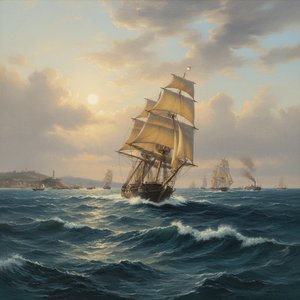
Witmont’s subject matter consistently revolved around ships – merchant vessels, three-masters, *fluytens* (Dutch cargo ships with rounded hulls), and scenes of dramatic weather conditions. He excelled at portraying the power of the sea, capturing the turbulence of waves, the precariousness of navigation, and the sheer scale of maritime endeavors. His paintings often feature low viewpoints and horizons, intensifying the sense of drama and immersing the viewer in the scene. While it’s difficult to definitively determine if his works depict specific historical events or vessels, their meticulous detail suggests a keen observation of naval architecture and seafaring practices. The enduring appeal of Witmont's work lies in its unique aesthetic – a captivating blend of graphic precision and painterly subtlety. Though he remains less celebrated than some of his contemporaries, his pioneering technique and evocative depictions of maritime life continue to fascinate art historians and collectors alike. His paintings offer a valuable window into the Golden Age of Dutch seafaring, rendered with an artistry that is both technically masterful and emotionally resonant.
Rediscovering Witmont
For centuries, Heerman Witmont remained a relatively obscure figure in the pantheon of Dutch Masters. However, recent scholarship has begun to shed light on his life and work, revealing a talented artist whose unique technique deserves greater recognition. Approximately nine artworks are currently attributed to him or considered to be executed after his designs. The meticulous examination of these paintings – particularly through dendrochronological analysis – is helping to refine our understanding of his chronology and artistic development. As more research emerges, it’s likely that Witmont's place within the Dutch Golden Age will continue to grow, solidifying his reputation as a master of maritime detail and an innovator in the art of pen painting. His work serves as a reminder that even within well-documented periods of art history, there remain hidden gems waiting to be rediscovered and appreciated for their singular beauty and artistic merit.