A Life Rooted in Norwegian Soil: The World of Gustav Wentzel
Gustav Wentzel, a name synonymous with the quiet dignity of late 19th and early 20th century Norwegian life, emerged from humble beginnings to become a pivotal figure in his nation’s artistic landscape. Born in Oslo in 1859, Wentzel's early years were marked by financial hardship; his father, initially a craftsman and farm owner, succumbed to bankruptcy, forcing his mother to establish a meat store to sustain the family. This backdrop of everyday struggle would profoundly shape Wentzel’s artistic vision, imbuing his work with an empathetic realism that resonated deeply with his contemporaries. Initially apprenticed as a mason with aspirations toward architecture, it was the allure of drawing that ultimately captured his imagination and set him on the path to becoming one of Norway's most beloved painters. His formal training began at the Norwegian National Academy of Craft and Art Industry in 1875, followed by studies under the esteemed Knud Bergslien, laying a solid foundation for his future artistic explorations.
Parisian Influences and the Embrace of Naturalism
Wentzel’s artistic development was significantly influenced by his travels and studies abroad, particularly in Paris during the 1880s. He first exhibited publicly in 1879, signaling a burgeoning talent eager to find its voice. His time at the Académie Julian and later the Académie Colarossi exposed him to leading artists like Léon Bonnat and Alfred Philippe Roll, whose emphasis on meticulous observation and realistic depiction left an indelible mark on his style. These experiences steered Wentzel toward Naturalism – a movement that championed accurate representation of the world without idealization or romantic embellishment. He absorbed these principles, returning to Norway with a refined technique and a commitment to portraying life as it truly was. The influence of Knud Bergslien, Frits Thaulow, alongside Bonnat and Roll, can be seen in his evolving style, a blend of Norwegian sensibility and European academic training.
Capturing the Essence of Everyday Life
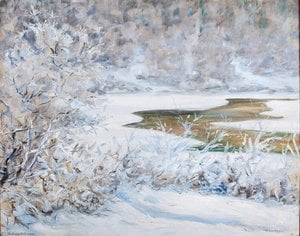
Wentzel’s artistic focus centered on intimate portrayals of interiors, domestic scenes, and rural life within Norway. He possessed an extraordinary ability to capture the quiet moments of ordinary people – farmers at work, families gathered in their homes, craftsmen practicing their trades. His paintings are not grand historical narratives or dramatic allegories; instead, they offer a poignant glimpse into the daily routines and simple joys of Norwegian society. “I fiskernaustet” (In the Boathouse), “Frokost” (Breakfast), “Dans i setesdal” (Dance in Setesdal), and “Winter scene from vågå” are prime examples of his mastery, each canvas radiating a sense of authenticity and intimacy. He excelled at rendering light and atmosphere, creating works that feel both immediate and timeless. His dedication to depicting subjects as they appeared in reality, without artifice, established him as a leading figure within the Naturalist movement in Norway.
A Champion of Norwegian Art: The Autumn Exhibition
Beyond his artistic contributions, Wentzel played a crucial role in shaping the Norwegian art scene itself. He was instrumental in establishing the Autumn Exhibition (Høstutstillingen) in Oslo, an event that became a cornerstone of national artistic expression. This initiative arose from a dispute – the rejection of his painting “Snekkersvennen” by the official selection committee. Rather than accepting this decision passively, Wentzel spearheaded the creation of an alternative exhibition space where Norwegian artists could showcase their work independently. The Autumn Exhibition quickly gained prominence, providing a vital platform for emerging talents and fostering a vibrant artistic community. In 1908, his contributions were formally recognized with the honor of being decorated as a Knight, First Class of the Royal Norwegian Order of St. Olav.
Legacy and Enduring Appeal
Despite facing financial challenges later in life, Wentzel remained dedicated to his craft, continuing to paint and share his knowledge through teaching. His wife, Kitty Wentzel, a writer and journalist, meticulously documented his life in a biography published in 1956 (and re-published in 2009), offering invaluable insights into his artistic journey and personal struggles. Today, his former homes in Lom are partially open to the public, allowing visitors to step back in time and experience the world that inspired his art. Gustav Wentzel’s legacy endures not only through his captivating paintings but also through his unwavering commitment to fostering a thriving artistic community in Norway. He remains a significant figure in Norwegian art history, celebrated for his realistic depictions of everyday life, his dedication to Naturalism, and his pivotal role in establishing the Autumn Exhibition – a testament to his enduring influence on the nation’s cultural landscape.
Redakce WahooArt.com
Kvíz o umění
U každé otázky je pouze jedna správná odpověď.
Otázka 1:
Gustav Wentzel initially pursued a career as what before discovering his passion for art?
Otázka 2:
Which artistic style is Gustav Wentzel most closely associated with?
Otázka 3:
Gustav Wentzel played a key role in establishing what important art event in Oslo?
Otázka 4:
Where did Wentzel study painting with William Bouguereau?
Otázka 5:
Who wrote a biography documenting Gustav Wentzel's life?
Prozkoumejte 25 ikonických děl Gustava Klimta! Objevte příběhy za Zlatou fází, Secesí a slavnými portréty. Luxusní reprodukce obrazů pro váš interiér na WahooArt.com – inspirace a umění pro váš domov.
Prozkoumejte 25 ikonických děl Johna Constabla, mistra anglického krajinářství a romantismu. Obdivujte jeho olejomalby, plátna s venkovskou atmosférou a inspirujte se pro dekoraci interiéru. Reprodukce obrazů nejvyšší kvality na WahooArt.com
Objevte harmonii klasického a moderního umění pro nadčasové interiéry. Inspirace, tipy a kvalitní reprodukce obrazů od WahooArt – přinášíme umění do vašeho domova. Vytvořte luxusní prostor s našimi odbornými radami!