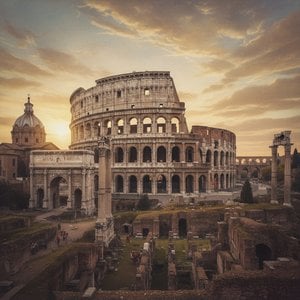
Giovanni Paolo Panini (1691–1765): Master of Roman vedute & architectural fantasies
Giovanni Paolo Pannini, a name synonymous with the grandeur and romantic allure of 18th-century Rome, was more than just a painter; he was a visual architect of memory. Born in Piacenza in 1691, his artistic journey began under the tutelage of Giuseppe Natali and Andrea Galluzzi, but it was his exposure to the theatrical designs of Francesco Galli-Bibiena that truly ignited his imagination. This early immersion in stagecraft would profoundly influence his later work, imbuing it with a sense of dramatic composition and illusionistic space. In 1711, Panini relocated to Rome, a city already steeped in artistic history, where he honed his skills under the guidance of Benedetto Luti, mastering the art of drawing and laying the foundation for his future mastery of perspective.Early Training and Influences: Shaping a Vision
Panini’s formative years were marked by rigorous instruction in disegno—drawing—and quadratura—scenic perspective—techniques that would become central to his artistic style. He studied under Giuseppe Natali, a respected Bolognese painter known for his meticulous realism, and Andrea Galluzzi, who instilled in him an appreciation for classical ideals of beauty and harmony. Crucially, Panini’s encounter with Francesco Galli-Bibiena proved transformative. Galli Bibiena was a celebrated stage designer whose productions employed innovative theatrical devices to create immersive environments—a skill that Panini seamlessly integrated into his paintings. This fascination with theatrical illusion would permeate his oeuvre, resulting in compositions characterized by dramatic lighting and meticulously crafted architectural spaces. The influence of Giovanni Ghisolfi, another Bolognese painter who championed the depiction of ruins as symbols of antiquity, further broadened Panini’s artistic horizons. Similarly, Jan Frans van Bloemen's landscapes provided inspiration for capturing the grandeur of the Italian countryside.From Frescoes to Vedute: The Evolution of an Artistic Style
Panini initially gained recognition as a decorator of palaces—a profession that demanded technical virtuosity and a keen understanding of spatial relationships. His frescoes adorned prestigious residences in Rome, including the Villa Patrizi (1719–1725), Palazzo de Carolis (1720) and Seminario Romano (1721–1722). These commissions allowed him to refine his skills as a quadraturista—a painter specializing in scenic perspective—and establish himself within Rome’s artistic circles. However, it was Panini's embrace of the *veduta*, or view painting, that would ultimately define his legacy. Unlike earlier topographical artists who focused on precise documentation, Panini infused his depictions of Rome with a sense of imaginative reconstruction. He didn’t merely record what he saw; he re-imagined it, blending existing structures with fragments of ancient ruins and fanciful architectural elements. This approach—often referred to as *capriccio*, or fantasy landscape—allowed him to create scenes that were both recognizable and dreamlike, capturing the spirit of Rome’s layered history. His 1719 admission into the Congregazione dei Virtuosi al Pantheon signaled his growing recognition within the Roman art world.The Pantheon and Beyond: Panini's Signature Style
Panini’s most celebrated works exemplify this distinctive style—particularly his depiction of the interior of Saint Peter’s Basilica (c. 1734) and the Pantheon (c. 1754). These paintings are remarkable for their masterful use of perspective, creating an illusion of depth that transports viewers into the heart of Rome's architectural heritage. Panini skillfully employed quadratura techniques—borrowed from theatrical design—to heighten the dramatic effect of his compositions, layering architectural elements and figures to create a sense of grandeur and mystery. He meticulously rendered details with astonishing accuracy, capturing the textures and colors of stone, marble, and pigment alike. Furthermore, Panini’s penchant for incorporating ruins into his landscapes—a practice that foreshadowed the Romantic movement—demonstrated his profound understanding of the relationship between past and present. His *vedute* are not simply representations of places; they are meditations on time, memory, and the enduring beauty of antiquity.Legacy and Influence: Shaping Artistic Discourse
Giovanni Paolo Panini’s influence extended far beyond his own lifetime. He was a respected teacher at both the Accademia di San Luca and the Académie de France in Rome—institutions that fostered artistic innovation and intellectual debate. Among his pupils were Hubert Robert, Jean-Honoré Fragonard and Giovanni Battista Piranesi—artists who would become equally renowned for their depictions of ruins and architectural fantasies. Panini’s meticulous observation and imaginative reconstructions established him as a pioneer of *vedutismo*, influencing generations of painters who sought to capture the essence of urban landscapes with unparalleled realism and artistic flair. His works continue to inspire admiration and scholarly study today, cementing his place as one of Rome's most iconic artists—a testament to his enduring vision and mastery of technique.- Notable Works: Villa Patrizi Frescoes, Palazzo de Carolis Decorations, Seminario Romano Murals
- Key Techniques: Quadratura (Scenic Perspective), Vedutismo (View Painting), Capriccio (Fantasy Landscape)
Otázky a odpovědi
Jak se umění umělce Giovanni Paolo Pannini v čase vyvíjelo?
Kariéra umělce Giovanni Paolo Pannini se na stránce Kronika odvíjí období po období: jako horizontální časová osa děl uspořádaných do kapitol podle tvůrčích etap.
Mohu navštívit virtuální muzeum děl umělce Giovanni Paolo Pannini?
Virtuální prohlídka je možná: stránka 3D muzeum umělce Giovanni Paolo Pannini představuje díla umělce v trojrozměrné galerii.
V jakém městě a z jaké země pochází Giovanni Paolo Pannini?
Giovanni Paolo Pannini se narodil(a) ve městě Piacenza v zemi Itálie.
Jak populární jsou umělecká díla umělce Giovanni Paolo Pannini?
Statistiky o dílech umělce Giovanni Paolo Pannini jsou k dispozici na jeho profilové stránce Statistiky.
Odkud pochází Giovanni Paolo Pannini?
Giovanni Paolo Pannini se narodil(a) v zemi Itálie.
Mohu si prohlédnout díla umělce Giovanni Paolo Pannini podle nálady?
Stránka umělce Pokoj nálad zobrazuje díla Giovanni Paolo Pannini uspořádaná podle jejich atmosféry.
Existuje přehled všech témat, která Giovanni Paolo Pannini maloval/a?
Díla umělce Giovanni Paolo Pannini si můžete prohlédnout podle tématu na stránce Abeceda témat tohoto umělce.
Kde a kdy se narodil/a Giovanni Paolo Pannini?
Giovanni Paolo Pannini se narodil(a) ve městě Piacenza v roce 1691.