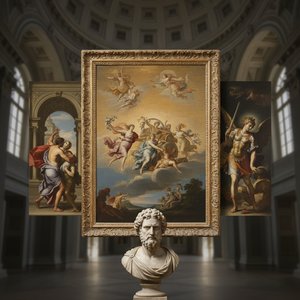
Giovanni Martinelli: A Baroque Master Rediscovered
Giovanni Martinelli, a name largely absent from the annals of art history for over a century, represents a fascinating paradox – a profoundly talented painter whose work deserves far greater recognition than it has received. Born in Veneto, Italy, in 1885 and tragically dying in 1969, Martinelli’s career unfolded primarily within the vibrant artistic landscape of Florence during the Baroque era. For decades, his canvases remained largely unseen, dismissed as unremarkable, yet a closer examination reveals an artist deeply influenced by the giants of his time – Caravaggio, Orazio Gentileschi, Artemisia, Vouet, and Valentin – while forging a distinct and compelling style. His story is one of quiet brilliance overshadowed by circumstance, finally brought to light through dedicated scholarship and a remarkable exhibition in his native city.
Martinelli’s early life remains somewhat shrouded in mystery. He began his artistic training under the tutelage of Jacopo Ligozzi in Florence from 1625 until 1625, a period offering little documented insight into his formative years. However, a significant commission in 1622 – a series of works for the church of San Leonardo in Grosseto commissioned by the Commander of the Order of Malta and late patron of Caravaggio, Fra Francesco dell’Antella – suggests an early level of success and recognition. Following this notable undertaking, there is a considerable gap in his documented activity spanning nearly ten years, leading to speculation that he spent time in Rome, immersing himself in the revolutionary style of Caravaggio and absorbing the caraveggesque movement. This hypothesis is powerfully supported by the stylistic echoes present in his 1632 altarpiece, “The Miracle of the Mule,” currently housed in the church of San Francesco at Pescia, Pistoia – a painting characterized by its masterful naturalism, dramatic use of light, and profound adherence to Caravaggio’s lessons.
A Synthesis of Influences: Style and Technique
Martinelli's artistic development reveals a fascinating synthesis of influences. While undeniably indebted to the Baroque masters who preceded him, he didn’t simply mimic their techniques; instead, he skillfully integrated them into his own unique vision. The impact of Orazio Gentileschi and Artemisia is particularly evident in his allegorical paintings, characterized by their elegant compositions, dynamic figures, and a sophisticated understanding of human emotion. His portraits are distinguished by the remarkable clarity of the faces – rendered with an almost Caravaggesque precision—illuminated by extraordinarily clear, cold color tones. This meticulous attention to detail, combined with a masterful command of light and shadow, creates a sense of immediacy and psychological depth rarely found in his contemporaries.
The artist’s palette was notably restrained, favoring cool, luminous colors that enhanced the dramatic effect of his scenes. He demonstrated a remarkable ability to capture fleeting moments of emotion and action, imbuing his works with a palpable sense of drama and vitality. His allegories, in particular, are notable for their intricate symbolism and their exploration of complex moral and philosophical themes. The influence of Vouet and Valentin is also apparent in the refined elegance and decorative quality of many of his compositions.
Key Works and Notable Commissions
Martinelli’s oeuvre encompasses a diverse range of subjects, including sacred narratives, allegorical scenes, and portraits. Among his most significant works are “The Miracle of the Mule,” a powerful depiction of faith and divine intervention; "The Sacrifice of Noah," showcasing his ability to convey profound religious themes with dramatic intensity; and a series of frescoes for the Certosa del Galluzzo, demonstrating his skill in large-scale mural painting. His commissions included numerous altarpieces, panel paintings, and decorative works for churches and private patrons throughout Tuscany.
His work for the Rospigliosi family’s “Allegories of the Arts” is particularly noteworthy, showcasing his talent for rendering the beauty and grace of female figures – a hallmark of his style. The meticulous detail with which he depicted their hands, lips, and hair speaks to his dedication to realism and his profound understanding of human anatomy.
Legacy and Rediscovery
Despite his undeniable talent and the quality of his work, Giovanni Martinelli remained largely obscure for centuries. His obscurity is a testament to the biases inherent in art historical narratives – often favoring established figures while marginalizing those who didn’t fit pre-defined categories. However, in 2015, a comprehensive monographic volume dedicated solely to his life and work was published, followed by an exhibition at the Uffizi Gallery in Florence—a long overdue acknowledgment of his artistic merit. This rediscovery has sparked renewed interest in Martinelli's paintings, prompting scholars to reassess his place within the broader context of Baroque art. Today, Giovanni Martinelli is finally receiving the recognition he deserves as a significant and original voice within the rich tapestry of Italian painting.