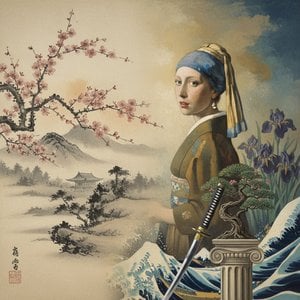
Gikō Tettō (1295 – 1369): A Brushstroke of Zen
Gikō Tettō, also known as Tetto Giko, emerged from the heart of Japan in 1295, born into a lineage steeped in artistic tradition within the coastal town of Hara. His life coincided with a pivotal period of transformation for Japanese art and culture, marked by the burgeoning influence of Zen Buddhism and a renewed interest in Chinese artistic models. Tettō’s journey wasn't merely one of creation; it was a profound exploration of self through brush and ink, deeply intertwined with the tenets of his spiritual practice. He became a student under Daito Kokushi, the second patriarch of the Ōtōkan lineage within the Rinzai school of Zen – a connection that profoundly shaped his artistic vision and approach to painting. This mentorship instilled in him not just technical skill but also an understanding of *mu*, or emptiness, a core concept central to Zen philosophy, which informed his ability to capture the essence of subjects rather than merely their outward appearance.The Echoes of Hsieh Ho: Style and Technique
Tettō’s artistic style is often characterized by its bold execution and vibrant color palette – qualities that immediately draw attention and evoke a sense of immediacy. He was particularly influenced by the Chinese master Hsieh Ho (c. 1021–1076), whose innovative use of color, particularly in depicting landscapes, served as a significant model for Tettō. Hsieh Ho’s approach to capturing atmospheric effects through subtle shifts in hue and tone resonated deeply with Tettō's own desire to convey emotion and spiritual depth within his works. Tettō skillfully employed *sumi* ink – the traditional Japanese black pigment – but he wasn’t constrained by its limitations. He layered it, diluted it, and combined it with mineral pigments to achieve a remarkable range of colors, often utilizing techniques that mimicked the effects of Chinese landscape painting. His compositions frequently featured sweeping vistas and dynamic brushstrokes, reflecting both the natural world and the internal landscapes of Zen meditation. The manila paper he favored – a material imported from the Philippines – provided an ideal surface for his expressive style, allowing the ink to spread and blend in captivating ways.Early Life and Artistic Training
Tettō’s early life was immersed in the traditions of Japanese art. Born into a family with a history of artistic endeavors, he received his initial training in various traditional forms – calligraphy, landscape painting, and perhaps even woodblock printing. However, it was his encounter with Zen Buddhism that truly ignited his creative spirit. The emphasis on meditation, self-discipline, and the pursuit of enlightenment provided a framework for understanding art not merely as an aesthetic exercise but as a path to spiritual realization. This philosophical grounding is evident in the contemplative quality of many of his paintings – they aren’t simply representations of scenes; they are invitations to contemplate the nature of existence. His dedication to mastering the techniques of Hsieh Ho, combined with his own unique interpretation and application, resulted in a distinctive style that quickly gained recognition within Japan.Influence and Legacy: A Lasting Impression
Gikō Tettō’s influence on Japanese art extends far beyond his own lifetime. His bold use of color and expressive brushwork served as an inspiration for subsequent generations of artists, including those who followed in the footsteps of the Ōtōkan school. The techniques he pioneered – particularly his innovative approach to color layering and atmospheric perspective – continue to be studied and emulated today. Furthermore, Tettō’s work helped establish manila paper as a viable medium for painting, contributing to its growing popularity among artists seeking a surface that could accommodate the fluidity of ink washes. His paintings are now held in prestigious collections worldwide, including the private collection of Nimes Museum in France, testament to their enduring artistic merit and historical significance. Tettō’s legacy is not simply one of technical skill; it's a reminder of the profound connection between art, spirituality, and the human experience.Conclusion: A Master of Zen Expression
Gikō Tettō (1295 – 1369) stands as a significant figure in Japanese art history—a master calligrapher and painter who skillfully blended the traditions of his time with the principles of Zen Buddhism. His bold, expressive style, deeply influenced by Hsieh Ho, created works that resonate with both visual beauty and spiritual depth. Through his innovative use of color, dynamic brushwork, and a profound understanding of *mu*, Tettō left an indelible mark on Japanese art, inspiring artists for centuries to come and solidifying his place as a true pioneer of Zen expression.Otázky a odpovědi
Jaké nálady vyjadřují umělecká díla umělce Gikō Tettō?
Díla umělce Gikō Tettō si můžete prohlédnout podle nálady na jeho stránce Galerie nálad, kde jsou umělecká díla uspořádána podle jejich vyvolané nálady.
V jakém městě a z jaké země pochází Gikō Tettō?
Gikō Tettō se narodil(a) ve městě Hara v zemi Japan.
Kde najdu díla umělce Gikō Tettō seskupená podle uměleckých směrů?
Stránka Všechna umělecká hnutí seskupuje díla umělce Gikō Tettō podle jednotlivých uměleckých směrů.