Georgette Agutte: A Fauvist Visionary Silenced by Time
The art world, for all its grand pronouncements and celebrated figures, often overlooks those who dared to forge their own paths—particularly women artists of the late 19th and early 20th centuries. Georgette Agutte (1867-1922) stands as a poignant example of this historical neglect. Born in Calais into an artistic family – her father a painter, her mother a draughtswoman – she inherited not just a lineage of creativity but also a spirit of independence that would define her life and work. Agutte’s story is one of audacious experimentation, a brief but brilliant career cut short by tragedy, and a legacy only recently beginning to be recognized for its unique power.
Her early training at Gustave Moreau's studio in Paris was pivotal. Moreau, a key figure in the Symbolist movement, instilled in Agutte a philosophy of artistic freedom – a rejection of academic constraints and an embrace of subjective experience. This emphasis on inner vision would become a hallmark of her style. She quickly distinguished herself as a non-conformist, becoming the sole woman admitted to the prestigious École nationale supérieure des Beaux-Arts, a testament to her talent and determination. Her circle included luminaries like Matisse and Georges Rouault, suggesting an engagement with the burgeoning avant-garde currents of the time.
The Fauvist Palette: Color as Emotion
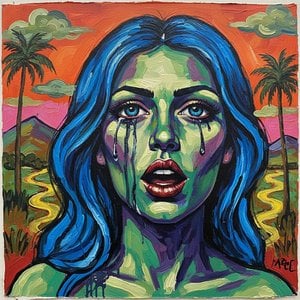
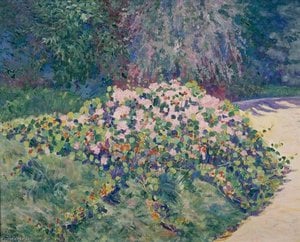
Agutte’s artistic development is inextricably linked to the rise of Fauvism – a movement characterized by its bold, non-naturalistic use of color. While she wasn't formally associated with the group (which primarily coalesced in the early 20th century), her work demonstrates a clear kinship with the Fauvist aesthetic. Her canvases explode with vibrant hues—intense blues, fiery reds, and luminous yellows – applied with thick, impasto strokes that prioritize emotional impact over realistic representation. This is evident in pieces like “Nature morte aux pastèques, vases et tapis” (1912-14), a still life rendered in an almost hallucinatory palette of pinks, greens, and blues, where form seems to dissolve into pure color.
She wasn’t simply applying bright colors; Agutte used them to convey mood and feeling. Her landscapes, such as “Le Château Antique” (1903), are imbued with a sense of dreamlike intensity, the forms rendered in simplified shapes against a swirling backdrop of color. Her portraits, too, moved beyond mere likeness, capturing the essence of her subjects through expressive brushwork and carefully chosen hues. The portrait of Marcel Sembat reading, for example, is not just a depiction of a man; it’s an evocation of intellect and contemplation.
A Life Beyond the Canvas: Sculpture and Decorative Arts
Agutte's artistic pursuits extended beyond painting. She was also a skilled sculptor, creating evocative bronze figures like “Portrait of Jules Guesde” (1925), a tribute to the socialist politician who became her husband. Furthermore, she engaged in the world of decorative arts, designing tapestries and contributing to the Aubusson National School of Decorative Art – a testament to her versatility and commitment to artistic innovation.
Her involvement with Aubusson is particularly noteworthy. She created a mountain landscape woven in 1923, which was exhibited at the Salon des Artistes Décorateurs and later featured prominently at the International Exhibition of Decorative Arts in Paris in 1925. This piece, alongside her fireplace screen adorned with marigolds and Aubusson tapestry, showcased her ability to seamlessly blend artistic vision with craftsmanship.
Tragedy and Legacy: A Forgotten Voice
Agutte’s life was tragically cut short in 1922, following the sudden death of her husband, Marcel Sembat. Overwhelmed by grief, she succumbed to suicide, leaving behind a small but potent body of work. For decades, her art remained largely unknown, overshadowed by the more celebrated figures of the Fauvist movement and other contemporary artists. However, in recent years, there has been a growing recognition of her unique contribution to French painting – a rediscovery fueled by meticulous research and dedicated exhibitions.
The 2003 retrospective at the Musée de Grenoble brought Agutte’s work back into the public eye, revealing the depth and complexity of her artistic vision. A street is now named after her in the 18th arrondissement of Paris, a small but significant gesture acknowledging her place in the city's cultural landscape. Georgette Agutte’s story serves as a powerful reminder that history often forgets those who dare to be different—and that it is our responsibility to ensure their voices are heard and their art appreciated for its enduring beauty and significance.
Otázky a odpovědi
Jak najdu všechna díla umělce Georgette Agutte v určitém médiu?
Stránka Podle techniky seskupuje díla umělce Georgette Agutte podle použité techniky.
Kde mohu najít statistiky o dílech umělce Georgette Agutte?
Statistiky o dílech umělce Georgette Agutte naleznete na jeho profilové stránce Statistiky.
Kde a v jakém roce se narodil/a Georgette Agutte?
Georgette Agutte se narodil(a) v roce 1867 ve městě 4th arrondissement of Paris.