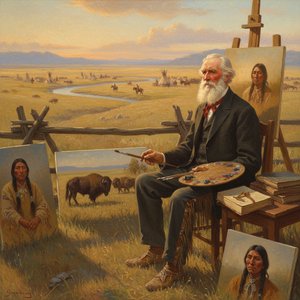
A Life Dedicated to Capturing the Spirit of the Sioux
Frederick P. Weygold, born in 1870 in Saint Charles, Missouri, was more than just a painter; he was a dedicated observer and recorder of a vanishing way of life. His artistic journey began with formal studies at the Pennsylvania Academy of Fine Arts and further refinement through immersion in European art traditions. However, it wasn’t within the established studios of Europe or America that Weygold found his true calling, but rather amongst the Sioux tribes of the American Great Plains. A burgeoning fascination with Native American culture led him to spend considerable time living among various Sioux communities, particularly on the Pine Ridge and Rosebud Reservations in South Dakota beginning in 1909. This wasn’t a detached anthropological study; Weygold actively sought understanding, learning the Lakota language and forging relationships built on respect and genuine curiosity.Ethnographic Artistry: Bridging Science and Sensitivity
Weygold distinguished himself through his unique approach to representing Native American life. He didn't simply paint picturesque scenes for a romanticized audience; he aimed to document, with scientific precision, the customs, rituals, and daily existence of the Sioux people. This commitment led him to collect artifacts for museums – notably the Museum of Ethnology in Hamburg – alongside his paintings and photographs. His photographic work is particularly significant, providing some of the earliest visual evidence of Plains Indian Sign Language, a complex system of communication often overlooked by contemporary observers. He skillfully blended artistic talent with ethnographic rigor, creating works that were both aesthetically compelling and historically valuable. This dedication to accurate representation was unusual for the time, setting him apart from many artists who favored sensationalism or stereotypical depictions.Influences and Artistic Development
While details of Weygold’s early artistic influences remain somewhat scarce, it is clear that his European training provided a solid foundation in realism. However, his style evolved significantly after prolonged exposure to the landscapes and people of the Plains. His paintings often feature muted color palettes reflecting the natural tones of the prairie environment, and a focus on capturing the dignity and resilience of his subjects. He moved away from highly detailed academic styles towards a more impressionistic approach that emphasized atmosphere and emotional resonance. The influence of artists like George Catlin, who also documented Native American life, is apparent in Weygold’s commitment to portraiture and scene-setting, but Weygold's work possesses a greater sense of intimacy and cultural sensitivity.Legacy and Historical Significance
Frederick Weygold’s contributions extend beyond the beauty of his paintings and the accuracy of his documentation. He played a crucial role in preserving a visual record of Sioux culture at a time when it was under immense pressure from assimilation policies and societal prejudice. His collection of artifacts, later donated to the Speed Art Museum in Louisville, Kentucky, forms a cornerstone of their Native American art holdings. Furthermore, Weygold’s ethnographic insights proved invaluable to European scholars and helped shape public understanding of Plains Indian culture. While perhaps not as widely recognized as some of his contemporaries, Weygold's work stands as a testament to the power of art to bridge cultural divides and offer a respectful glimpse into the lives of those often marginalized by history. He died in Louisville in 1941, leaving behind a body of work that continues to inspire and inform our understanding of the American West and its indigenous peoples.Selected Achievements
- Extensive Ethnographic Research: Documented Sioux life through paintings, photography, and artifact collection.
- Preservation of Cultural Heritage: Donated a significant Native American art collection to the Speed Art Museum.
- Early Documentation of Plains Indian Sign Language: Captured crucial visual evidence of this unique communication system.
- Collaboration with Authors: Illustrated books by Charles Eastman and James Willard Schultz, bringing Native American stories to a wider audience.